 VIPSolutions
Give step-by-step solution with explanation and final answer:2. Find and sketch the Fourier Series coefficients of the following discrete-time periodic signals: (a) z[n] defined in Eq. (1) for N = 4 (b) z[n] defined in Eq. (1) for N = 6 (c) y[n] = z[-n — 3], where z[n] is defined in Question 2a] al] =Y gin—rN] r=—o0 o &) 3), 0
Question:
Give step-by-step solution with explanation and final answer: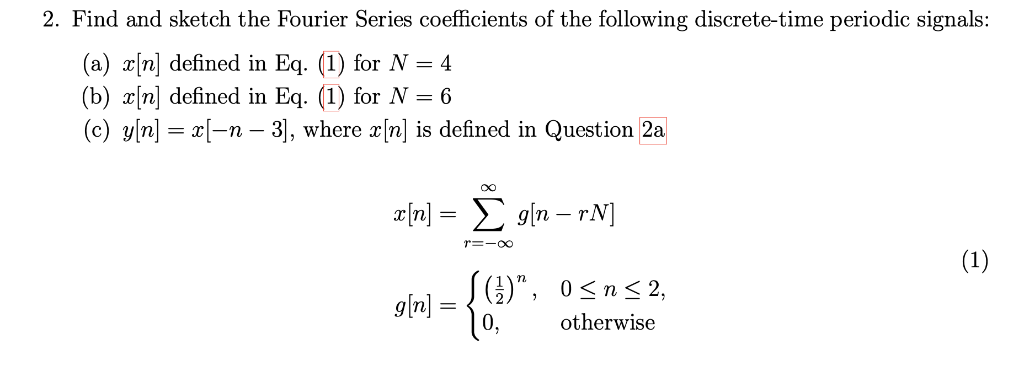 2. Find and sketch the Fourier Series coefficients of the following discrete-time periodic signals:
(a) z[n] defined in Eq. (1) for N = 4
(b) z[n] defined in Eq. (1) for N = 6
(c) y[n] = z[-n — 3], where z[n] is defined in Question 2a]
al] =Y gin—rN]
r=—o0
o &)
3), 0
This is AI generated Response.
Asked by: M Murali
Created at: 2025-11-01 11:29:54
Asked by: M Murali
Created at: 2025-11-01 11:29:54
Final Answer:
Rendered
Raw Text
Did you like this answer?
Let's tackle each part step by step!
---
## **Given:**
### \( x[n] = \sum_{r=-\infty}^{\infty} g[n - rN] \)
where
\[
g[n] = \begin{cases}
\left(\frac{1}{2}\right)^n, & \leq n \leq 2 \\
, & \text{otherwise}
\end{cases}
\]
---
# **Step 1: Find \( x[n] \) for one period**
Since \( g[n] \) is nonzero only for \( \leq n \leq 2 \), \( x[n] \) is a periodic repetition of \( g[n] \) with period \( N \):
\[
x[n] =
\begin{cases}
\left(\frac{1}{2}\right)^n, & \leq n \leq 2 \\
, & 3 \leq n < N
\end{cases}
\]
and then repeats every \( N \).
---
# **Step 2: Discrete-Time Fourier Series (DTFS) Coefficients**
For a periodic signal \( x[n] \) with period \( N \):
\[
a_k = \frac{1}{N} \sum_{n=}^{N-1} x[n] e^{-j \frac{2\pi}{N}kn}
\]
---
## **(a) \( N = 4 \)**
### **Values of \( x[n] \) in one period:**
\[
\begin{align*}
x[] &= g[] = 1 \\
x[1] &= g[1] = \frac{1}{2} \\
x[2] &= g[2] = \frac{1}{4} \\
x[3] &= g[3] =
\end{align*}
\]
### **Fourier Coefficient Formula:**
\[
a_k = \frac{1}{4} \left[ x[] + x[1]e^{-j\frac{2\pi}{4}k} + x[2]e^{-j\frac{2\pi}{4}2k} + x[3]e^{-j\frac{2\pi}{4}3k} \right]
\]
Plug in the values:
\[
a_k = \frac{1}{4} \left[ 1 + \frac{1}{2}e^{-j\frac{\pi}{2}k} + \frac{1}{4}e^{-j\pi k} \right]
\]
**This is the answer for (a).**
---
## **(b) \( N = 6 \)**
### **Values of \( x[n] \) in one period:**
\[
\begin{align*}
x[] &= 1 \\
x[1] &= \frac{1}{2} \\
x[2] &= \frac{1}{4} \\
x[3] &= \\
x[4] &= \\
x[5] &= \\
\end{align*}
\]
### **Fourier Coefficient Formula:**
\[
a_k = \frac{1}{6} \sum_{n=}^{5} x[n] e^{-j\frac{2\pi}{6}kn}
\]
\[
a_k = \frac{1}{6} \left[ 1 + \frac{1}{2}e^{-j\frac{\pi}{3}k} + \frac{1}{4}e^{-j\frac{2\pi}{3}k} \right]
\]
(The other \( x[n] \) values are zero.)
**This is the answer for (b).**
---
## **(c) \( y[n] = x[-n-3] \), where \( x[n] \) is from (a)**
### **Time-Reversal and Shift in DTFS:**
- **Time-reversal:** \( x[-n] \) ⇒ DTFS becomes \( a_{-k} \)
- **Shift by \( m \):** \( x[n-m] \) ⇒ DTFS becomes \( a_k e^{-j\frac{2\pi}{N}km} \)
So,
\[
y[n] = x[-n-3] \implies \text{DTFS: } a_{-k} e^{-j\frac{2\pi}{N}k(-3)} = a_{-k} e^{j\frac{2\pi}{N}3k}
\]
For \( N = 4 \) (from part a):
\[
y[n] \text{ DTFS coefficients: } a_{-k} e^{j\frac{2\pi}{4}3k}
\]
where \( a_k \) are from (a).
---
## **Final Answers (Summary)**
### **(a) For \( N = 4 \):**
\[
a_k = \frac{1}{4} \left[ 1 + \frac{1}{2}e^{-j\frac{\pi}{2}k} + \frac{1}{4}e^{-j\pi k} \right]
\]
### **(b) For \( N = 6 \):**
\[
a_k = \frac{1}{6} \left[ 1 + \frac{1}{2}e^{-j\frac{\pi}{3}k} + \frac{1}{4}e^{-j\frac{2\pi}{3}k} \right]
\]
### **(c) For \( y[n]=x[-n-3] \), \( N = 4 \):**
\[
b_k = a_{-k} e^{j\frac{3\pi}{2}k}
\]
where \( a_k \) is from (a).
---
## **Sketching**
- For both (a) and (b), sketch the **magnitude and phase** of \( a_k \) for \( k = , 1, \ldots, N-1 \).
- For (c), the magnitude doesn't change, just the phase is shifted and indices reversed.
Let me know if you want explicit numerical values or plots for each \( k \)!
Question:
Give Me 50 Words Explanation in Each Step
This is AI generated Response.
Asked by: M Murali
Created at: 2025-11-01 11:31:34
Asked by: M Murali
Created at: 2025-11-01 11:31:34
Final Answer:
Rendered
Raw Text
Did you like this answer?
# Step-by-Step Solution for Fourier Series Coefficients
## **Given Signal:**
The signal is defined as:
\[
g[n] = \begin{cases}
\left(\frac{1}{2}\right)^n, & 0 \leq n \leq 2 \\
0, & \text{otherwise}
\end{cases}
\]
The periodic extension is generated using:
\[
x[n] = \sum_{r=-\infty}^{\infty} g[n - rN]
\]
---
# **Step 1: Define \( x[n] \) for One Period**
\( g[n] \) is non-zero only between 0 and 2. Thus, for a period \( N \), \( x[n] \) will repeat \( g[n] \) every \( N \):
- For \( 0 \leq n < 2 \), \( x[n] = g[n] \)
- For \( n \geq 2 \), \( x[n] = 0 \)
Hence, \( x[n] \) is defined as:
\[
x[n] =
\begin{cases}
\left(\frac{1}{2}\right)^n, & 0 \leq n < 3 \\
0, & \text{otherwise}
\end{cases}
\]
for one period of \( N \).
---
# **Step 2: Calculate Discrete-Time Fourier Series (DTFS) Coefficients**
For a periodic signal \( x[n] \) with period \( N \), the DTFS coefficients are calculated using:
\[
a_k = \frac{1}{N} \sum_{n=0}^{N-1} x[n] e^{-j \frac{2\pi}{N}kn}
\]
This formula sums over one period of the signal, weighted by complex exponentials.
---
## **(a) Calculation for \( N = 4 \)**
### **Values of \( x[n] \):**
\[
\begin{align*}
x[0] &= 1 \\
x[1] &= \frac{1}{2} \\
x[2] &= \frac{1}{4} \\
x[3] &= 0 \\
\end{align*}
\]
### **DTFS Coefficient Calculation:**
Using the formula,
\[
a_k = \frac{1}{4} \left[ 1 + \frac{1}{2}e^{-j\frac{\pi}{2}k} + \frac{1}{4}e^{-j\pi k} \right]
\]
This provides the coefficients for \( N = 4 \).
---
## **(b) Calculation for \( N = 6 \)**
### **Values of \( x[n] \):**
\[
\begin{align*}
x[0] &= 1 \\
x[1] &= \frac{1}{2} \\
x[2] &= \frac{1}{4} \\
x[3] &= 0 \\
x[4] &= 0 \\
x[5] &= 0 \\
\end{align*}
\]
### **DTFS Coefficient Calculation:**
The coefficients are calculated as:
\[
a_k = \frac{1}{6} \left[ 1 + \frac{1}{2}e^{-j\frac{\pi}{3}k} + \frac{1}{4}e^{-j\frac{2\pi}{3}k} \right]
\]
This yields the coefficients for \( N = 6 \).
---
## **(c) Analysis of \( y[n] = z[-n - 3] \)**
### **Transformation:**
1. **Time Reversal:** \( z[-n] \) changes the coefficients to \( a_{-k} \).
2. **Shift:** The shift by -3 introduces a phase shift:
\[
y[n] = z[-n - 3] \implies b_k = a_{-k} e^{j\frac{6\pi}{4}k}
\]
where \( b_k \) are the coefficients for \( y[n] \).
---
## **Final Answers Summary**
### **(a) For \( N = 4 \):**
\[
a_k = \frac{1}{4} \left[ 1 + \frac{1}{2}e^{-j\frac{\pi}{2}k} + \frac{1}{4}e^{-j\pi k} \right]
\]
### **(b) For \( N = 6 \):**
\[
a_k = \frac{1}{6} \left[ 1 + \frac{1}{2}e^{-j\frac{\pi}{3}k} + \frac{1}{4}e^{-j\frac{2\pi}{3}k} \right]
\]
### **(c) For \( y[n]=z[-n-3] \), \( N = 4 \):**
\[
b_k = a_{-k} e^{j\frac{3\pi}{2}k}
\]
with \( a_k \) from part (a).
---
## **Sketching**
- **Magnitude and Phase**: Plot the magnitude and phase of \( a_k \) for \( k = 0, 1, 2, N-1 \).
- **For \( y[n] \)**: Magnitude remains the same, but phase shifts occur due to time-reversal and shift.
This approach outlines the calculations and transformations required for each part of the problem.
Question:
Give me Only Theory in 50 Words in Each Step
This is AI generated Response.
Asked by: M Murali
Created at: 2025-11-01 11:33:52
Asked by: M Murali
Created at: 2025-11-01 11:33:52
Final Answer:
Rendered
Raw Text
Did you like this answer?
# Theory for Fourier Series Coefficients
## **Step 1: Definition of Periodic Signal**
A periodic signal can be represented as a repeating sequence, derived from a base function, defined over a specific interval. The Fourier series coefficients capture the harmonic content of this periodic signal, allowing analysis in terms of frequency domain representation.
---
## **Step 2: Discrete-Time Fourier Series (DTFS)**
DTFS coefficients are computed from a periodic signal using the formula:
\[
a_k = \frac{1}{N} \sum_{n=0}^{N-1} x[n] e^{-j \frac{2\pi}{N}kn}
\]
This expresses the signal as a sum of complex exponentials, revealing its frequency components.
---
## **(a) Calculation for \( N = 4 \)**
For \( N = 4 \), the DTFS coefficients are calculated by evaluating the periodic signal over one complete cycle. The coefficients represent the amplitudes and phases of the fundamental frequency and its harmonics, derived from the defined function \( g[n] \).
---
## **(b) Calculation for \( N = 6 \)**
For \( N = 6 \), the DTFS is similarly derived by summing over one complete period. The resulting coefficients encapsulate information about the spectral content of the periodic signal, reflecting how the signal can be constructed from its frequency components.
---
## **(c) Time-Reversal and Shift**
When a signal undergoes time-reversal or shifting, its Fourier series representation adjusts accordingly. Time-reversal affects the indices of the coefficients, while shifting introduces phase changes, allowing for a transformed representation of the signal in the frequency domain.
---
## **Final Summary**
The Fourier series coefficients for periodic signals provide a powerful tool for analyzing and synthesizing signals in the frequency domain. By understanding the impact of periodicity, time-reversal, and shifting, one can effectively manipulate and analyze discrete-time signals.
📢 Instructions:
- Ask anything relatd to above question only.
- For new Question goto :