 VIPSolutions
Give step-by-step solution with explanation and final answer:Calculate the following convolutions A. p(O® p(t-1) B. op(-0p(n)® pl) C. pH ® pln)
Question:
Give step-by-step solution with explanation and final answer: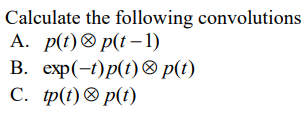 Calculate the following convolutions
A. p(O® p(t-1)
B. op(-0p(n)® pl)
C. pH ® pln)
This is AI generated Response.
Asked by: Aman
Created at: 2025-11-01 00:32:36
Asked by: Aman
Created at: 2025-11-01 00:32:36
Final Answer:
Rendered
Raw Text
Did you like this answer?
Let's solve each convolution step by step.
### **Preliminaries**
Let \( p(t) \) be the **unit step function**:
\[
p(t) =
\begin{cases}
1, & t \geq \\
, & t <
\end{cases}
\]
The **convolution** of \( f(t) \) and \( g(t) \) is defined as:
\[
(f \ast g)(t) = \int_{-\infty}^{\infty} f(\tau)g(t-\tau) d\tau
\]
For causal functions (zero for \( t< \)), this simplifies to:
\[
(f \ast g)(t) = \int_{}^{t} f(\tau)g(t-\tau) d\tau
\]
---
## **A. \( p(t) \ast p(t-1) \)**
### **Step 1: Write the convolution integral**
\[
(p(t) \ast p(t-1))(t) = \int_{}^{t} p(\tau) p(t-\tau-1) d\tau
\]
### **Step 2: Analyzing the functions**
- \( p(\tau) = 1 \) for \( \tau \geq \)
- \( p(t-\tau-1) = 1 \) for \( t-\tau-1 \geq \implies \tau \leq t-1 \)
### **Step 3: Limits of integration**
- Both are 1 only if \( \leq \tau \leq t-1 \)
- But \( \tau \leq t \), so upper limit is \( \min(t, t-1) \)
- For \( t < 1 \), \( t-1 < \), so integration is over an empty interval: result is .
### **Step 4: Evaluate the integral**
For \( t \geq 1 \):
\[
\int_{}^{t-1} 1 \, d\tau = [\tau]_{}^{t-1} = t-1
\]
For \( t < 1 \):
\[
\int_{}^{} 1 \, d\tau =
\]
### **Step 5: Combine**
\[
(p(t) \ast p(t-1))(t) =
\begin{cases}
, & t < 1 \\
t-1, & t \geq 1
\end{cases}
\]
Or,
\[
\boxed{(p(t) \ast p(t-1))(t) = (t-1) p(t-1)}
\]
---
## **B. \( e^{-t} p(t) \ast p(t) \)**
### **Step 1: Write the convolution**
\[
(e^{-t} p(t) \ast p(t))(t) = \int_{}^{t} e^{-\tau} p(\tau) p(t-\tau) d\tau
\]
But both step functions are 1 for \( \leq \tau \leq t \):
\[
= \int_{}^{t} e^{-\tau} d\tau
\]
### **Step 2: Evaluate the integral**
\[
= \left[ -e^{-\tau} \right]_{}^{t} = -(e^{-t} - 1) = 1 - e^{-t}
\]
### **Step 3: Include causality**
\[
\boxed{(e^{-t} p(t) \ast p(t))(t) = (1 - e^{-t}) p(t)}
\]
---
## **C. \( t p(t) \ast p(t) \)**
### **Step 1: Write the convolution**
\[
(t p(t) \ast p(t))(t) = \int_{}^{t} \tau \cdot 1 \, d\tau = \int_{}^{t} \tau \, d\tau
\]
### **Step 2: Evaluate**
\[
= \left[ \frac{1}{2} \tau^2 \right]_{}^{t} = \frac{1}{2} t^2
\]
### **Step 3: Include causality**
\[
\boxed{(t p(t) \ast p(t))(t) = \frac{1}{2} t^2 p(t)}
\]
---
## **Final Answers**
\[
\boxed{
\begin{aligned}
\text{A.}\quad & (p(t) \ast p(t-1))(t) = (t-1) p(t-1) \\
\text{B.}\quad & (e^{-t} p(t) \ast p(t))(t) = (1 - e^{-t}) p(t) \\
\text{C.}\quad & (t p(t) \ast p(t))(t) = \frac{1}{2} t^2 p(t)
\end{aligned}
}
\]
📢 Instructions:
- Ask anything relatd to above question only.
- For new Question goto :