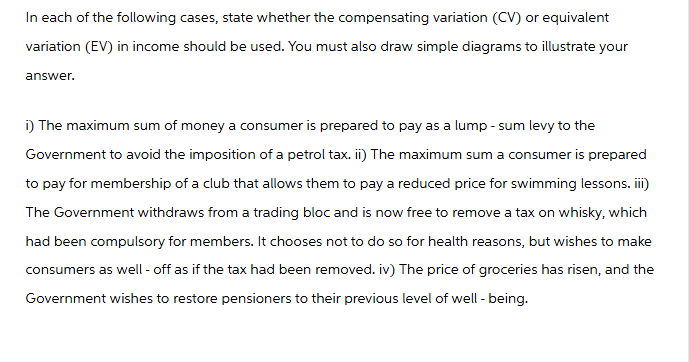
Give step-by-step solution with explanation and final answer:In each of the following cases, state whether the compensating variation (CV) or equivalent
variation (EV) in income should be used. You must also draw simple diagrams to illustrate your
answer.
) The maximum sum of money a consumer is prepared to pay as a lump - sum levy to the
Government to avoid the imposition of a petrol tax. ii) The maximum sum a consumer is prepared
to pay for membership of a club that allows them to pay a reduced price for swimming lessons. ii)
The Government withdraws from a trading bloc and is now free to remove a tax on whisky, which
had been compulsory for members. ft chooses not to do so for health reasons, but wishes to make
consumers as well - off as if the tax had been removed. iv) The price of groceries has risen, and the
Government wishes to restore pensioners to their previous level of well - being.
Question:
Give step-by-step solution with explanation and final answer:In each of the following cases, state whether the compensating variation (CV) or equivalent
variation (EV) in income should be used. You must also draw simple diagrams to illustrate your
answer.
) The maximum sum of money a consumer is prepared to pay as a lump - sum levy to the
Government to avoid the imposition of a petrol tax. ii) The maximum sum a consumer is prepared
to pay for membership of a club that allows them to pay a reduced price for swimming lessons. ii)
The Government withdraws from a trading bloc and is now free to remove a tax on whisky, which
had been compulsory for members. ft chooses not to do so for health reasons, but wishes to make
consumers as well - off as if the tax had been removed. iv) The price of groceries has risen, and the
Government wishes to restore pensioners to their previous level of well - being.
This is AI generated Response.
Asked by: Vikram Kumar
Created at: 2025-10-29 02:10:55
Final Answer:
RenderedRaw Text
Did you like this answer?
Let's address each case step by step, specifying whether **Compensating Variation (CV)** or **Equivalent Variation (EV)** should be used, with explanations and simple illustrative diagrams.
---
## **Key Concepts**
- **Compensating Variation (CV):** The amount of money that must be given to or taken from a consumer *after* a change in prices or policy to restore their *original utility*.
- **Equivalent Variation (EV):** The amount of money that would have to be given or taken from a consumer *before* a change in prices or policy to achieve the same utility change as the policy.
---
## **i) Lump-Sum Levy to Avoid Petrol Tax**
**Situation:** Consumer is asked how much they would pay to avoid a future petrol tax (i.e., to keep the status quo).
**Which to use?**
**Equivalent Variation (EV)**
**Explanation:**
You want to know how much the consumer values *preventing* the tax before it happens. EV measures the maximum amount the consumer is willing to pay to avoid the change.
**Diagram:**
```plaintext
Income
|
U1 ------|-------------------- (Original utility, before tax)
|
|\
| \ (Indifference curves)
| \
U2 ------|---\-------------- (New utility, after tax)
|
+----------------- Price of petrol
EV: Horizontal distance between U1 at old and new petrol prices.
```
---
## **ii) Club Membership for Discounted Swimming Lessons**
**Situation:** Willingness to pay for a club membership that allows lower prices for swimming.
**Which to use?**
**Equivalent Variation (EV)**
**Explanation:**
This is a *potential* gain—how much they are willing to pay to get the new lower price (before it happens). EV measures the value of this prospective benefit.
**Diagram:**
```plaintext
Income
|
U1 ------|-------------------- (Original utility, before membership)
|
|\
| \ (Indifference curves)
| \
U2 ------|---\-------------- (New utility, after membership)
|
+----------------- Price of swimming lessons
EV: Horizontal distance between U1 at old and new prices.
```
---
## **iii) Government Withdraws, Keeps Tax But Wants to Compensate**
**Situation:** Tax remains, but government wants to compensate consumers to make them as well off as if the tax had been removed.
**Which to use?**
**Compensating Variation (CV)**
**Explanation:**
The government wants to know how much money to give so that, after the change (tax remains), the consumer is as well off as if the tax had been removed. CV measures the compensation required to restore *original utility* after the policy.
**Diagram:**
```plaintext
Income
|
U2 ------|----------------- (Higher utility, if tax was removed)
|
|\
| \ (Indifference curves)
| \
U1 ------|---\----------- (Original utility, with tax kept)
|
+--------------- Price of whisky
CV: Vertical distance to raise consumer from U1 to U2 at current prices.
```
---
## **iv) Groceries Prices Rise, Want to Restore Pensioners’ Well-being**
**Situation:** Prices rise; government wants to compensate pensioners to restore their previous utility.
**Which to use?**
**Compensating Variation (CV)**
**Explanation:**
The government is responding to a price increase that has already happened and wants to compensate pensioners so they return to their previous utility level. CV is the correct measure.
**Diagram:**
```plaintext
Income
|
U2 ------|----------------- (Original utility, before price rise)
|
|\
| \ (Indifference curves)
| \
U1 ------|---\----------- (Lower utility, after price rise)
|
+--------------- Price of groceries
CV: Vertical distance to raise consumer from U1 to U2 at new prices.
```
---
# **Summary Table**
| Case | Use CV or EV? | Reason |
|------|--------------|--------|
| i | EV | Willingness to pay to avoid a future loss |
| ii | EV | Willingness to pay to secure a future gain |
| iii | CV | Compensation needed after a loss to restore utility |
| iv | CV | Compensation to restore utility after a price rise |
---
If you need more detailed diagrams (e.g., with indifference curves and budget lines), let me know!
VIPSolutions focuses on clear, step‑by‑step explanations so you can learn quickly. Whether you need an AI‑generated walkthrough or a short hint to get unstuck, each solution is organized for fast reading and easy review later.
Search similar questions, compare approaches, and bookmark the best answers for revision. Our goal is simple: quick, reliable study help that feels natural—not noisy.
 VIPSolutions
 In each of the following cases, state whether the compensating variation (CV) or equivalent
variation (EV) in income should be used. You must also draw simple diagrams to illustrate your
answer.
) The maximum sum of money a consumer is prepared to pay as a lump - sum levy to the
Government to avoid the imposition of a petrol tax. ii) The maximum sum a consumer is prepared
to pay for membership of a club that allows them to pay a reduced price for swimming lessons. ii)
The Government withdraws from a trading bloc and is now free to remove a tax on whisky, which
had been compulsory for members. ft chooses not to do so for health reasons, but wishes to make
consumers as well - off as if the tax had been removed. iv) The price of groceries has risen, and the
Government wishes to restore pensioners to their previous level of well - being.