 VIPSolutions
Give step-by-step solution with explanation and final answer:3. Two players must choose among three alternatives a, ,b, and c. Player 1's preferences are given by a >; b >=, ¢ while player 2s preferences are given by ¢ >, b >5 a. The rules are that player 1 moves first and can veto one of the three alternatives. Then player 2 chooses one of the remaining two alternatives. a. Model this as an extensive form game tree (choose payoffs that represent the prefer- ences). b. How many pure strategies does each player have? c. Find all the pure-strategy Nash equilibria of the game.
Question:
Give step-by-step solution with explanation and final answer: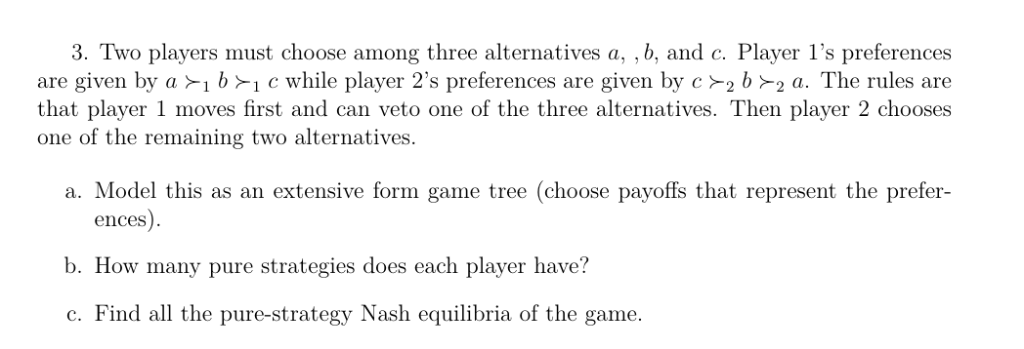 3. Two players must choose among three alternatives a, ,b, and c. Player 1's preferences
are given by a >; b >=, ¢ while player 2s preferences are given by ¢ >, b >5 a. The rules are
that player 1 moves first and can veto one of the three alternatives. Then player 2 chooses
one of the remaining two alternatives.
a. Model this as an extensive form game tree (choose payoffs that represent the prefer-
ences).
b. How many pure strategies does each player have?
c. Find all the pure-strategy Nash equilibria of the game.
This is AI generated Response.
Asked by: Sahab Sharan
Created at: 2025-10-28 08:43:51
Asked by: Sahab Sharan
Created at: 2025-10-28 08:43:51
Final Answer:
Rendered
Raw Text
Did you like this answer?
Let's carefully analyze and solve the problem step-by-step.
---
## Problem Restatement:
- Two players choose among three alternatives \( a, b, c \).
- Player 1's preferences: \( a \succ_1 b \succ_1 c \)
- Player 2's preferences: \( c \succ_2 b \succ_2 a \)
- Move order: Player 1 moves first, then Player 2.
- Player 1 can veto one alternative.
- Player 2, after observing Player 1's veto, chooses one of the remaining two alternatives.
---
## Part a: Model as an extensive form game tree
### Step 1: Player 1 chooses an alternative to veto:
- Player 1 chooses to veto either \( a \), \( b \), or \( c \).
- After this veto, the remaining two alternatives are available to Player 2.
### Step 2: Player 2 chooses an alternative:
- Player 2 observes Player 1’s veto and chooses from the remaining two alternatives.
### Game Tree Structure:
1. Player 1's move: veto \( a \), \( b \), or \( c \).
2. Player 2's move: choose one of the remaining two alternatives.
---
## Part b: Number of pure strategies for each player
### Player 1:
- Player 1's strategy is to specify a veto choice.
- **Strategies for Player 1**: Veto \( a \), or veto \( b \), or veto \( c \).
- **Total strategies for Player 1**: **3**.
### Player 2:
- Player 2 observes Player 1's veto and then chooses from the remaining 2 alternatives.
- For each possible veto by Player 1, Player 2 has 2 choices.
- **Strategies for Player 2**: For each of Player 1's 3 vetoes, pick one of the remaining 2 options.
- Total strategies for Player 2: \( 2 \times 3 = 6 \).
---
## Part c: Find all pure-strategy Nash equilibria
### Step 1: List Player 1's possible veto strategies:
- \( V_a \): Veto \( a \)
- \( V_b \): Veto \( b \)
- \( V_c \): Veto \( c \)
### Step 2: List Player 2's possible responses after each veto:
| Player 1's veto | Remaining options for Player 2 | Player 2's choices | Player 2's choice | Player 2's payoff (Player 2 prefers \( c \succ b \succ a \)) |
|-----------------|----------------------------------|----------------------|---------------------|--------------------------------------------------------------|
| veto \( a \) | \( b, c \) | choose \( b \) or \( c \) | \( b \) or \( c \) | payoff based on preferences: \( c \succ_2 b \succ_2 a \) |
| veto \( b \) | \( a, c \) | choose \( a \) or \( c \) |
| veto \( c \) | \( a, b \) | choose \( a \) or \( b \) |
### Step 3: Determine Player 2's best response (highest payoff) in each case:
- After veto \( a \): remaining \( b, c \).
Player 2 prefers \( c \) over \( b \), so best response: **choose \( c \)**.
- After veto \( b \): remaining \( a, c \).
Player 2 prefers \( c \) over \( a \), so best response: **choose \( c \)**.
- After veto \( c \): remaining \( a, b \).
Player 2 prefers \( b \) over \( a \), so best response: **choose \( b \)**.
### Step 4: Player 1's decision:
- Player 1 anticipates Player 2's responses and chooses the veto that maximizes Player 1's payoff.
Recall Player 1's preferences:
\[
a \succ_1 b \succ_1 c
\]
- **Veto \( a \)**:
- Remaining: \( b, c \)
- Player 2's best response: \( c \)
- Player 1's payoff: \( c \) (least preferred, since \( a \succ_1 b \succ_1 c \))
- **Veto \( b \)**:
- Remaining: \( a, c \)
- Player 2's best response: \( c \)
- Player 1's payoff: \( a \) (most preferred among remaining options)
- **Veto \( c \)**:
- Remaining: \( a, b \)
- Player 2's best response: \( b \)
- Player 1's payoff: \( a \) (most preferred among remaining options)
### Step 5: Final outcome:
- Player 1 prefers to veto \( c \) to leave \( a, b \).
- Player 2 then chooses \( b \) (their best response), resulting in the outcome \( b \).
**Conclusion:**
Player 1's **best veto** is \( c \), leading to the outcome \( b \), which gives Player 1 a payoff of \( b \) (second most preferred).
Player 2's best response after veto \( c \) is \( b \).
---
## **Final Answer:**
### Extensive form game tree:
- Player 1 chooses to veto \( a \), \( b \), or \( c \).
- Player 2, observing the veto, chooses from remaining options, with the best responses as above.
### Number of strategies:
- Player 1: **3**.
- Player 2: **6**.
### Nash equilibria:
- The **unique pure-strategy Nash equilibrium** is:
\[
\boxed{
\text{Player 1 vetoes } c, \quad \text{Player 2 chooses } b
}
\]
Outcome: **\( b \)** (Player 2's choice after Player 1 vetoes \( c \)).
📢 Instructions:
- Ask anything relatd to above question only.
- For new Question goto :