Give step-by-step solution with explanation and final answer:
Economics:In the fiscal year
2
0
2
3
–
2
4
,
a leading apparel manufacturing brand in a Middle Eastern country reviewed the effect of a small price increase on the sale of its most popular shirt collection. The marketing division reported that when the price
(
P
)
of a premium cotton shirt was raised from $
5
0
to $
5
5
,
the quantity demanded
(
Q
)
decreased from
1
2
0
,
0
0
0
units to
1
0
8
,
0
0
0
units. The management wanted to determine the extent to which consumers were sensitive to this price change in a highly competitive fashion market. Using the elasticity relationship E
_
d
=
(
Δ
Q
/
Δ
P
)
×
(
P
/
Q
)
,
the finance department decided to calculate the degree of elasticity to inform future price
-
setting strategies. Based on the data provided, substitute the respective values for price and quantity into the formula and compute the Price Elasticity of Demand
(
E
_
d
)
for the apparel company during the year
2
0
2
3
–
2
4
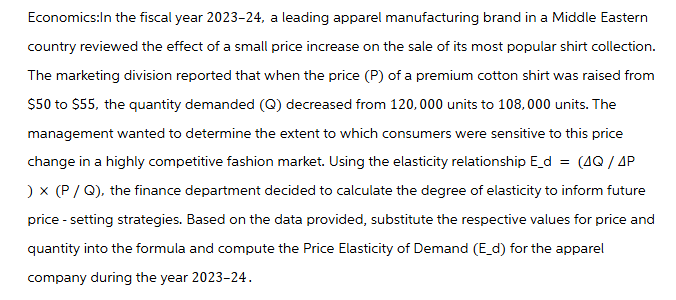
.Economicsin the fiscal year 2023-24, a leading apparel manufacturing brand in a Middle Eastern
country reviewed the effect of a small price increase on the sale of its most popular shirt collection.
The marketing division reported that when the price (P) of a premium cotton shirt was raised from
$50 to $55, the quantity demanded (Q) decreased from 120,000 units to 108,000 units. The
management wanted to determine the extent to which consumers were sensitive to this price
change in a highly competitive fashion market. Using the elasticity relationship E.d = (4Q / 4P
) X (P/Q). the finance department decided to calculate the degree of elasticity to inform future
price - setting strategies. Based on the data provided, substitute the respective values for price and
quantity into the formula and compute the Price Elasticity of Demand (E_d) for the apparel
company during the year 2023-24.
Question:
Give step-by-step solution with explanation and final answer:
Economics:In the fiscal year
2
0
2
3
–
2
4
,
a leading apparel manufacturing brand in a Middle Eastern country reviewed the effect of a small price increase on the sale of its most popular shirt collection. The marketing division reported that when the price
(
P
)
of a premium cotton shirt was raised from $
5
0
to $
5
5
,
the quantity demanded
(
Q
)
decreased from
1
2
0
,
0
0
0
units to
1
0
8
,
0
0
0
units. The management wanted to determine the extent to which consumers were sensitive to this price change in a highly competitive fashion market. Using the elasticity relationship E
_
d
=
(
Δ
Q
/
Δ
P
)
×
(
P
/
Q
)
,
the finance department decided to calculate the degree of elasticity to inform future price
-
setting strategies. Based on the data provided, substitute the respective values for price and quantity into the formula and compute the Price Elasticity of Demand
(
E
_
d
)
for the apparel company during the year
2
0
2
3
–
2
4
.Economicsin the fiscal year 2023-24, a leading apparel manufacturing brand in a Middle Eastern
country reviewed the effect of a small price increase on the sale of its most popular shirt collection.
The marketing division reported that when the price (P) of a premium cotton shirt was raised from
$50 to $55, the quantity demanded (Q) decreased from 120,000 units to 108,000 units. The
management wanted to determine the extent to which consumers were sensitive to this price
change in a highly competitive fashion market. Using the elasticity relationship E.d = (4Q / 4P
) X (P/Q). the finance department decided to calculate the degree of elasticity to inform future
price - setting strategies. Based on the data provided, substitute the respective values for price and
quantity into the formula and compute the Price Elasticity of Demand (E_d) for the apparel
company during the year 2023-24.
This is AI generated Response.
Asked by: Vikram Kumar
Created at: 2025-10-28 04:57:27
Final Answer:
RenderedRaw Text
Did you like this answer?
Let's walk through the step-by-step solution to compute the Price Elasticity Demand (\(E_d)).
---
Step 1 Understand the given data
Variable | Value|------------|---------|
| Initial (\(P1\)) | \$50 |
| New Price (\(P_2\)) | \$ |
| Initial Quantity Demanded (\(Q_1\)) | 120,000 units |
| New Quantity Demanded (\(Q_2\)) | 108,000 units |
---
## Step 2: Calculate the change in price (\(\Delta P\))
\[
\Delta P = P_2 - P_1 = 55 - 50 = \$5
\]
## Step 3: Calculate the change in quantity demanded (\(\Delta Q\))
\[
\Delta Q = Q_2 - Q_1 = 108,000 - 120,000 = -12,000 \text{ units}
\]
(Note: The negative sign indicates a decrease in quantity demanded.)
---
## Step 4: Calculate the average price (\(\frac{P_1 + P_2}{2}\)) and average quantity (\(\frac{Q_1 + Q_2}{2}\))
\[
\text{Average Price} = \frac{50 + 55}{2} = \frac{105}{2} = \$52.50
\]
\[
\text{Average Quantity} = \frac{120,000 + 108,000}{2} = \frac{228,000}{2} = 114,000 \text{ units}
\]
---
## Step 5: Calculate the elasticity \(E_d\)
The elasticity formula is:
\[
E_d = \left( \frac{\Delta Q}{\Delta P} \right) \times \left( \frac{P_{avg}}{Q_{avg}} \right)
\]
Substituting the values:
\[
E_d = \left( \frac{-12,000}{5} \right) \times \left( \frac{52.50}{114,000} \right)
\]
Calculate each part:
\[
\frac{-12,000}{5} = -2,400
\]
\[
\frac{52.50}{114,000} \approx .0004605
\]
Now multiply:
\[
E_d = -2,400 \times .0004605 \approx -1.105
\]
---
## **Final Answer:**
\[
\boxed{
E_d \approx -1.105
}
\]
### Interpretation:
- The absolute value of the price elasticity of demand is approximately **1.105**.
- Since \( |E_d| > 1 \), demand is **elastic**; consumers are relatively sensitive to price changes. A 1% increase in price results in approximately a 1.105% decrease in quantity demanded.
---
## Summary:
- **Price Elasticity of Demand** during 2023-24 = **approximately 1.105 (elastic demand)**.
Question:
Calculating Price Elasticity of Demand
This is AI generated Response.
Asked by: Vikram Kumar
Created at: 2025-10-28 05:43:03
Final Answer:
RenderedRaw Text
Did you like this answer?
# Step-by-Step Calculation of Price Elasticity of Demand
We will calculate the Price Elasticity of Demand (\(E_d\)) for a premium cotton shirt based on the provided data.
## Step 1: Understand the Given Data
| Variable | Value |
|--------------------------------|----------------|
| Initial Price (\(P_1\)) | \$50 |
| New Price (\(P_2\)) | \$55 |
| Initial Quantity Demanded (\(Q_1\)) | 120,000 units |
| New Quantity Demanded (\(Q_2\)) | 108,000 units |
## Step 2: Calculate the Change in Price (\(\Delta P\))
\[
\Delta P = P_2 - P_1 = 55 - 50 = \$5
\]
## Step 3: Calculate the Change in Quantity Demanded (\(\Delta Q\))
\[
\Delta Q = Q_2 - Q_1 = 108,000 - 120,000 = -12,000 \text{ units}
\]
(Note: The negative sign indicates a decrease in quantity demanded.)
## Step 4: Calculate the Average Price and Average Quantity
### Average Price
\[
P_{avg} = \frac{P_1 + P_2}{2} = \frac{50 + 55}{2} = \$52.50
\]
### Average Quantity
\[
Q_{avg} = \frac{Q_1 + Q_2}{2} = \frac{120,000 + 108,000}{2} = 114,000 \text{ units}
\]
## Step 5: Calculate the Elasticity \(E_d\)
The formula for elasticity is:
\[
E_d = \left( \frac{\Delta Q}{\Delta P} \right) \times \left( \frac{P_{avg}}{Q_{avg}} \right)
\]
### Substitute the Values
\[
E_d = \left( \frac{-12,000}{5} \right) \times \left( \frac{52.50}{114,000} \right)
\]
### Calculate Each Part
1. **Change in Quantity per Change in Price:**
\[
\frac{-12,000}{5} = -2,400
\]
2. **Price to Quantity Ratio:**
\[
\frac{52.50}{114,000} \approx 0.0004605
\]
### Combine to Find \(E_d\)
\[
E_d = -2,400 \times 0.0004605 \approx -1.105
\]
## Final Answer
\[
\boxed{E_d \approx -1.105}
\]
### Interpretation
- The absolute value of the price elasticity of demand is approximately **1.105**.
- Since \( |E_d| > 1 \), demand is **elastic**; consumers are sensitive to price changes. A 1% increase in price results in approximately a 1.105% decrease in quantity demanded.
## Summary
- **Price Elasticity of Demand** during 2023-24 = **approximately 1.105 (elastic demand)**.
Question:
Calculating Price Elasticity of Demand defination
This is AI generated Response.
Asked by: Vikram Kumar
Created at: 2025-10-28 05:43:56
Final Answer:
RenderedRaw Text
Did you like this answer?
# Price Elasticity of Demand (Definition)
## Definition
Price Elasticity of Demand (\(E_d\)) measures how the quantity demanded of a good responds to a change in its price. It is calculated as the percentage change in quantity demanded divided by the percentage change in price.
## Formula
The formula for calculating \(E_d\) is:
\[
E_d = \left( \frac{\Delta Q}{\Delta P} \right) \times \left( \frac{P_{avg}}{Q_{avg}} \right)
\]
Where:
- \(\Delta Q\) = Change in quantity demanded
- \(\Delta P\) = Change in price
- \(P_{avg}\) = Average price
- \(Q_{avg}\) = Average quantity demanded
## Interpretation
- **Elastic Demand**: \( |E_d| > 1 \) (Consumers are sensitive to price changes)
- **Inelastic Demand**: \( |E_d| < 1 \) (Consumers are less sensitive to price changes)
- **Unitary Elastic Demand**: \( |E_d| = 1 \) (Percentage change in quantity demanded equals percentage change in price)
### Importance
Understanding price elasticity helps businesses and policymakers make informed decisions regarding pricing strategies, product availability, and revenue predictions.
Question:
the Average Price and Average Quantity
Average Price defination
This is AI generated Response.
Asked by: Vikram Kumar
Created at: 2025-10-28 05:53:54
Final Answer:
RenderedRaw Text
Did you like this answer?
# Average Price and Average Quantity
## Definitions
### Average Price
The **Average Price** is the midpoint between the initial price and the new price of a product. It provides a representative price level that can be used for calculations related to elasticity and demand.
#### Formula
The formula for calculating the Average Price (\(P_{avg}\)) is:
\[
P_{avg} = \frac{P_1 + P_2}{2}
\]
Where:
- \(P_1\) = Initial Price
- \(P_2\) = New Price
### Average Quantity
The **Average Quantity** is the midpoint between the initial quantity demanded and the new quantity demanded. This value is useful in elasticity calculations to reflect changes in demand over a range of prices.
#### Formula
The formula for calculating the Average Quantity (\(Q_{avg}\)) is:
\[
Q_{avg} = \frac{Q_1 + Q_2}{2}
\]
Where:
- \(Q_1\) = Initial Quantity Demanded
- \(Q_2\) = New Quantity Demanded
## Importance
Both Average Price and Average Quantity are critical for calculating the Price Elasticity of Demand (\(E_d\)), which helps businesses understand consumer sensitivity to price changes. This understanding aids in effective pricing strategies and revenue management decisions.
VIPSolutions focuses on clear, step‑by‑step explanations so you can learn quickly. Whether you need an AI‑generated walkthrough or a short hint to get unstuck, each solution is organized for fast reading and easy review later.
Search similar questions, compare approaches, and bookmark the best answers for revision. Our goal is simple: quick, reliable study help that feels natural—not noisy.
 VIPSolutions
 Economicsin the fiscal year 2023-24, a leading apparel manufacturing brand in a Middle Eastern
country reviewed the effect of a small price increase on the sale of its most popular shirt collection.
The marketing division reported that when the price (P) of a premium cotton shirt was raised from
$50 to $55, the quantity demanded (Q) decreased from 120,000 units to 108,000 units. The
management wanted to determine the extent to which consumers were sensitive to this price
change in a highly competitive fashion market. Using the elasticity relationship E.d = (4Q / 4P
) X (P/Q). the finance department decided to calculate the degree of elasticity to inform future
price - setting strategies. Based on the data provided, substitute the respective values for price and
quantity into the formula and compute the Price Elasticity of Demand (E_d) for the apparel
company during the year 2023-24.