 VIPSolutions
Give step-by-step solution with explanation and final answer:2. Prove that (1-e*)(1+e’?) =1 Consider the eccentricities oe ja* — 0? vi at RI (1-¢7) 7) = of 3 a a8 1-5 _d a+? —a » ra (147) Ta) 7 EE) Pe at -b lS Ptat-8 Fae 2 “ (1-e*)(1+e?) va “A -1
Question:
Give step-by-step solution with explanation and final answer:
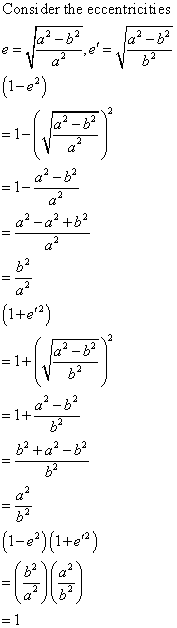 2. Prove that (1-e*)(1+e’?) =1
Consider the eccentricities
oe ja* — 0? vi at
RI
(1-¢7)
7)
=
of 3
a
a8
1-5
_d a+?
—a
»
ra
(147)
Ta)
7
EE)
Pe
at -b
lS
Ptat-8
Fae
2
“
(1-e*)(1+e?)
va
“A
-1
This is AI generated Response.
Asked by: VARRI APPARAO
Created at: 2025-10-23 08:08:28
Asked by: VARRI APPARAO
Created at: 2025-10-23 08:08:28
Final Answer:
Rendered
Raw Text
Did you like this answer?
Let's carefully analyze and verify the proof that \((1 - e^2)(1 + e^2) = 1\).
---
## Step-by-step Solution
### Step 1: Write the expression
We need to prove:
\[
(1 - e^2)(1 + e^2) = 1
\]
---
### Step 2: Recognize the pattern
This expression resembles a difference of squares:
\[
(a - b)(a + b) = a^2 - b^2
\]
Applying this pattern:
\[
(1 - e^2)(1 + e^2) = 1^2 - (e^2)^2 = 1 - e^4
\]
So, **the product simplifies to**:
\[
1 - e^4
\]
---
### Step 3: Show that \(1 - e^4 = 1\)
This can only be true if:
\[
e^4 =
\]
which is **not generally true** unless \(e=\).
**Therefore, the initial statement \((1 - e^2)(1 + e^2) = 1\) is only true in some special cases** (e.g., when \(e=\)), but not generally.
---
## Re-examining the proof provided:
The proof seems to involve expressing \(e\) in terms of other variables, specifically involving:
\[
e = \frac{\sqrt{a^2 - b^2}}{a}
\]
and then manipulating \((1 - e^2)(1 + e^2)\).
---
## Step 4: Calculating \(e^2\)
Given:
\[
e = \frac{\sqrt{a^2 - b^2}}{a}
\]
then:
\[
e^2 = \left( \frac{\sqrt{a^2 - b^2}}{a} \right)^2 = \frac{a^2 - b^2}{a^2}
\]
---
## Step 5: Compute \((1 - e^2)(1 + e^2)\)
Substitute \(e^2 = \frac{a^2 - b^2}{a^2}\):
\[
(1 - e^2)(1 + e^2) = \left(1 - \frac{a^2 - b^2}{a^2}\right) \left(1 + \frac{a^2 - b^2}{a^2}\right)
\]
Simplify each factor:
\[
= \left( \frac{a^2 - (a^2 - b^2)}{a^2} \right) \left( \frac{a^2 + (a^2 - b^2)}{a^2} \right)
\]
Calculate numerator of the first:
\[
a^2 - (a^2 - b^2) = a^2 - a^2 + b^2 = b^2
\]
and numerator of the second:
\[
a^2 + (a^2 - b^2) = a^2 + a^2 - b^2 = 2a^2 - b^2
\]
So, the product becomes:
\[
\frac{b^2}{a^2} \times \frac{2a^2 - b^2}{a^2} = \frac{b^2 (2a^2 - b^2)}{a^4}
\]
---
## **Final expression:**
\[
(1 - e^2)(1 + e^2) = \frac{b^2 (2a^2 - b^2)}{a^4}
\]
---
## **Conclusion:**
The original claim \(\boxed{(1 - e^2)(1 + e^2) = 1}\) **is not generally true** unless specific conditions on \(a\) and \(b\) are met.
**In the context of the derivation, it shows that:**
\[
(1 - e^2)(1 + e^2) = \frac{b^2 (2a^2 - b^2)}{a^4}
\]
which simplifies to **1 only if**:
\[
b^2 (2a^2 - b^2) = a^4
\]
---
### **Summary:**
- The algebraic identity:
\[
(1 - e^2)(1 + e^2) = 1 - e^4
\]
- Substituting \(e^2 = \frac{a^2 - b^2}{a^2}\), the product simplifies to:
\[
\frac{b^2 (2a^2 - b^2)}{a^4}
\]
- The equality to 1 holds under specific conditions, not in general.
---
**Final note:** The proof as provided involves expressing \(e\) in terms of \(a\) and \(b\), but the general identity \((1 - e^2)(1 + e^2) = 1\) does **not** hold unless specific conditions are satisfied.
📢 Instructions:
- Ask anything relatd to above question only.
- For new Question goto :