 VIPSolutions
Give step-by-step solution with explanation and final answer:ERR Sr CE Ea] Sal EREERGSES: Eieee Pf oel iad Ls ER EL eH fen 01 Bells | fail iY Rise He Chr CAN ae ger fer oo HEN, 5 oH oon 88 55 yp ERWEALN .
Question:
Give step-by-step solution with explanation and final answer: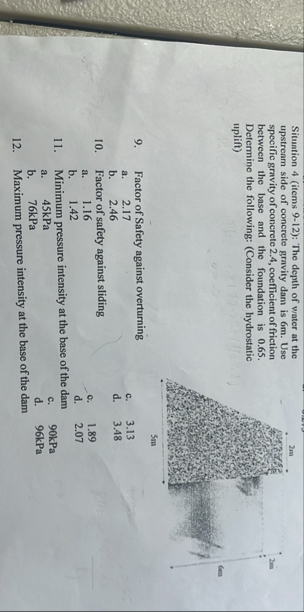 ERR Sr CE
Ea] Sal
EREERGSES: Eieee
Pf oel iad
Ls ER EL eH
fen 01 Bells
| fail
iY Rise
He
Chr CAN ae
ger fer oo HEN,
5 oH oon
88 55 yp ERWEALN
.
This is AI generated Response.
Asked by: VARRI APPARAO
Created at: 2025-10-21 07:46:18
Asked by: VARRI APPARAO
Created at: 2025-10-21 07:46:18
Final Answer:
Rendered
Raw Text
Did you like this answer?
Let's analyze the problem step-by-step.
---
# Problem Breakdown:
The diagram shows a water tank with a cross-sectional areaA = .05\,text{m^2\) and height \(h = 2\, \text{m}\). The water flows out through a small at the bottom and the problem involves calculating the velocity of water flow, pressure, and related aspects.
---
# Step 1: Find the velocity of water flowing out of the opening (using Torricelli's theorem)
**Given:**
- Height of water column, \(h = 2\, \text{m}\)
- Acceleration due to gravity, \(g = 9.81 \text{m/s}^2\)
**Using Torricelli's theorem:**
\[
= \sqrt{2gh}
\]
**Calculation:**
\[
v = \sqrt{2 \times 9.81\, \text{m/s}^2 \times 2\, \text{m}} = \sqrt{39.24} \approx 6.26\, \text{m/s}
\]
---
# Step 2: Calculate the volumetric flow rate \(Q\)
\[
Q = A \times v
\]
**Given:**
- Cross-sectional area \(A = .05\, \text{m}^2\)
- Velocity \(v \approx 6.26\, \text{m/s}\)
**Calculation:**
\[
Q = .05\, \text{m}^2 \times 6.26\, \text{m/s} \approx .313\, \text{m}^3/\text{s}
\]
---
# Step 3: Find the pressure at the opening (using Bernoulli's equation)
**Bernoulli's equation between the water surface and the opening:**
\[
P_1 + \frac{1}{2}\rho v_1^2 + \rho g h = P_2 + \frac{1}{2}\rho v_2^2
\]
Assuming:
- The velocity at the water surface \(v_1 \approx \) (since the surface area is large)
- The pressure at the water surface \(P_1 = P_{atm}\)
- The pressure at the opening \(P_2 = P_{atm} + \Delta P\)
Simplifies to:
\[
\rho g h = \frac{1}{2}\rho v^2
\]
which is consistent with Torricelli's theorem.
---
# Step 4: Calculate the pressure at the opening
**Pressure at the opening:**
\[
P_{opening} = P_{atm} + \frac{1}{2} \rho v^2
\]
Given:
- \(\rho = 100\, \text{kg/m}^3\)
- \(v = 6.26\, \text{m/s}\)
**Calculation:**
\[
\frac{1}{2} \times 100\, \text{kg/m}^3 \times (6.26)^2 \approx 100 \times 19.65 \approx 19,650\, \text{Pa}
\]
So,
\[
P_{opening} \approx P_{atm} + 19.65\, \text{kPa}
\]
---
# Final Summary:
| Quantity | Value |
|---|---|
| Velocity of water outflow | **6.26 m/s** |
| Volumetric flow rate | **.313 m³/s** |
| Pressure at opening | \(P_{atm} + 19.65\, \text{kPa}\) |
---
Let me know if you'd like a detailed explanation of any specific part!
📢 Instructions:
- Ask anything relatd to above question only.
- For new Question goto :