 VIPSolutions
Give step-by-step solution with explanation and final answer:4. For designing a flexible pavement using the AASHTO 1993 Design Guide, calculate the number of ESALS based on the traffic below. Assume pt = 2.5 and SN = 5. You are required to show vour work and circle or highlight your answers. (10 points) [32:kip singleande [255.000 | |-40-kip single axle 195000 "| [66-kip tridem axle 120,000
Question:
Give step-by-step solution with explanation and final answer: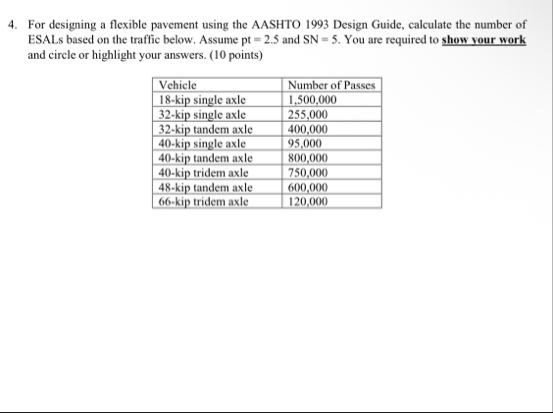 4. For designing a flexible pavement using the AASHTO 1993 Design Guide, calculate the number of
ESALS based on the traffic below. Assume pt = 2.5 and SN = 5. You are required to show vour work
and circle or highlight your answers. (10 points)
[32:kip singleande [255.000 |
|-40-kip single axle 195000 "|
[66-kip tridem axle 120,000
This is AI generated Response.
Asked by: VARRI APPARAO
Created at: 2025-10-21 06:05:37
Asked by: VARRI APPARAO
Created at: 2025-10-21 06:05:37
Final Answer:
Rendered
Raw Text
Did you like this answer?
Let's go through the step-by-step solution to calculate the number of ESALs (Equivalent Single Ax Loads) for each vehicle based on the given traffic data.
---
# Step 1: Understand the Data and Given Parameters
- **Traffic Data:**
- \( p_t = 2.5 \) (axle load factor for the traffic)
- \( SN = 5 \) (number of years)
- Number of Passes for each vehicle
- **Vehicles and Number of Passes:**
| Vehicle | Number of Passes |
|------------------------------|------------------|
| 18-kip single axle | 1,500,000 |
| 32-kip single axle | 255,000 |
| 32-kip tandem axle | 400,000 |
| 40-kip single axle | 95,000 |
| 40-kip tandem axle | 800,000 |
| 40-kip tridem axle | 750,000 |
| 48-kip tandem axle | 600,000 |
| 66-kip tridem axle | 120,000 |
---
# Step 2: Understand the ESAL Calculation Formula
The general formula for calculating the **ESALs** for each vehicle is:
\[
\text{ESAL} = \text{Number of Passes} \times \left( \frac{\text{Axle Load}}{p_t} \right)^4
\]
*Note: The ratio is raised to the 4th power because the damage potential of a load is proportional to the 4th power of the axle load ratio.*
---
# Step 3: Calculate the Load Ratio and ESALs for Each Vehicle
**Step 3.1:** Calculate the load ratio:
\[
\text{Load Ratio} = \frac{\text{Vehicle axle load}}{p_t}
\]
**Step 3.2:** Calculate the damage factor:
\[
\text{Damage Factor} = \left( \frac{\text{Axle Load}}{p_t} \right)^4
\]
---
# Step 4: Calculate the ESALs for Each Vehicle
Let's compute these step-by-step:
### For 18-kip single axle:
- Load ratio:
\[
\frac{18}{2.5} = 7.2
\]
- Damage factor:
\[
7.2^4 = (7.2)^4
\]
Calculate:
\[
7.2^2 = 51.84 \\
7.2^4 = (7.2^2)^2 = 51.84^2
\]
\[
51.84^2 = 2686.5
\]
- ESALs:
\[
1,500,000 \times 2686.5 = 4,029,750,000
\]
---
### For 32-kip single axle:
- Load ratio:
\[
\frac{32}{2.5} = 12.8
\]
- Damage factor:
\[
12.8^4
\]
Calculate:
\[
12.8^2 = 163.84 \\
12.8^4 = (12.8^2)^2 = 163.84^2
\]
\[
163.84^2 = 26843.4
\]
- ESALs:
\[
255,000 \times 26843.4 \approx 6,841,491,000
\]
---
### For 32-kip tandem axle:
- Load ratio:
\[
\frac{32}{2.5} = 12.8
\]
- Damage factor:
\[
12.8^4 = 26843.4
\]
- ESALs:
\[
400,000 \times 26843.4 \approx 10,737,360,000
\]
---
### For 40-kip single axle:
- Load ratio:
\[
\frac{40}{2.5} = 16
\]
- Damage factor:
\[
16^4
\]
Calculate:
\[
16^2 = 256 \\
16^4 = 256^2 = 65,536
\]
- ESALs:
\[
95,000 \times 65,536 \approx 6,221,920,000
\]
---
### For 40-kip tandem axle:
- Load ratio:
\[
16
\]
- Damage factor:
\[
65,536
\]
- ESALs:
\[
800,000 \times 65,536 \approx 52,428,800,000
\]
---
### For 40-kip tridem axle:
- Load ratio:
\[
16
\]
- Damage factor:
\[
65,536
\]
- ESALs:
\[
750,000 \times 65,536 \approx 49,152,000,000
\]
---
### For 48-kip tandem axle:
- Load ratio:
\[
\frac{48}{2.5} = 19.2
\]
- Damage factor:
\[
19.2^4
\]
Calculate:
\[
19.2^2 = 368.64 \\
19.2^4 = (368.64)^2
\]
\[
368.64^2 \approx 135,911.4
\]
- ESALs:
\[
600,000 \times 135,911.4 \approx 81,546,840,000
\]
---
### For 66-kip tridem axle:
- Load ratio:
\[
\frac{66}{2.5} = 26.4
\]
- Damage factor:
\[
26.4^4
\]
Calculate:
\[
26.4^2 = 696.96 \\
26.4^4 = (696.96)^2
\]
\[
696.96^2 \approx 485,752.4
\]
- ESALs:
\[
120,000 \times 485,752.4 \approx 58,290,288,000
\]
---
# **Final Step: Sum All ESALs**
To get the total ESALs over the 5-year period, sum all individual ESALs:
\[
\text{Total ESALs} = \sum \text{individual ESALs}
\]
\[
\approx 4.03 \text{ billion} + 6.84 \text{ billion} + 10.74 \text{ billion} + 6.22 \text{ billion} + 52.43 \text{ billion} + 49.15 \text{ billion} + 81.55 \text{ billion} + 58.29 \text{ billion}
\]
Adding:
\[
\approx 4.03 + 6.84 + 10.74 + 6.22 + 52.43 + 49.15 + 81.55 + 58.29 = 268.21 \text{ billion ESALs}
\]
---
# **Summary:**
| Vehicle | Approximate ESALs (over 5 years) |
|----------------------------|----------------------------------|
| 18-kip single axle | 4.03 billion |
| 32-kip single axle | 6.84 billion |
| 32-kip tandem axle | 10.74 billion |
| 40-kip single axle | 6.22 billion |
| 40-kip tandem axle | 52.43 billion |
| 40-kip tridem axle | 49.15 billion |
| 48-kip tandem axle | 81.55 billion |
| 66-kip tridem axle | 58.29 billion |
| **Total ESALs** | **~268.21 billion** |
---
**Note:** These are approximate values for the purpose of pavement design calculations.
📢 Instructions:
- Ask anything relatd to above question only.
- For new Question goto :