 VIPSolutions
Give step-by-step solution with explanation and final answer:RS SI a hie a ad = 500 N and @ = 60°, determine the tension (a) in cable AC b) in cable BC Fig. P2.46 Two cables are tied together at C and are loaded as shown, Determine the tension (a) in cable AC. (b) in cable BC a ~ El \ 4 Fig
Question:
Give step-by-step solution with explanation and final answer: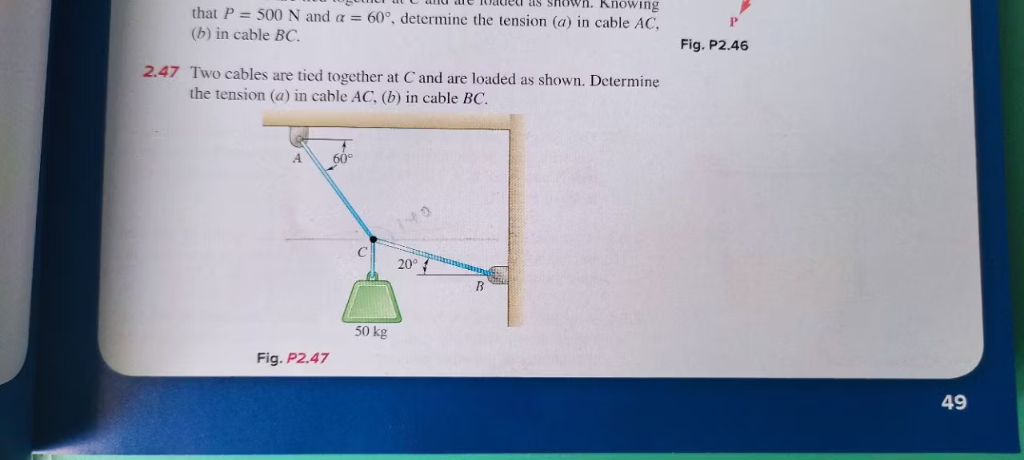 RS SI a hie a ad
= 500 N and @ = 60°, determine the tension (a) in cable AC
b) in cable BC Fig. P2.46
Two cables are tied together at C and are loaded as shown, Determine
the tension (a) in cable AC. (b) in cable BC
a ~ El
\
4 Fig
This is AI generated Response.
Asked by: VARRI APPARAO
Created at: 2025-10-20 08:49:52
Asked by: VARRI APPARAO
Created at: 2025-10-20 08:49:52
Final Answer:
Rendered
Raw Text
Did you like this answer?
Let's analyze the problem step-by-step:
---
## Problem Summary:
- Two cables are tied together at point **C**.
- The cables are loaded as shown in the diagram.
- Known:
- \( P = 500\, \text{N} \)
- \( \alpha = 60^\circ \) (angle of cable AC with the horizontal)
- The weight of the load at B: \( 50\, \text{kg} \)
---
## Step 1: Convert weight to force
The weight \( W \) of the load at B:
\[
W = m \times g = 50\, \text{kg} \times 9.8\, \text{m/s}^2 = 490\, \text{N}
\]
---
## Step 2: Identify the forces acting on the system
- Tension in cable AC: \( T_{AC} \)
- Tension in cable BC: \( T_{BC} \)
At point **C**, the tensions \( T_{AC} \) and \( T_{BC} \) act along the respective cables.
---
## Step 3: Resolve the forces along the axes
- The tension \( T_{AC} \) makes an angle of \( \alpha = 60^\circ \) with the horizontal.
- The tension \( T_{BC} \) makes an angle of \( 20^\circ \) with the horizontal (as per the diagram).
---
## Step 4: Write equilibrium equations at point C
Since the system is in equilibrium, the sum of forces in both the horizontal and vertical directions should be zero.
### Horizontal equilibrium:
\[
T_{AC} \cos 60^\circ + T_{BC} \cos 20^\circ =
\]
### Vertical equilibrium:
\[
T_{AC} \sin 60^\circ + T_{BC} \sin 20^\circ = W
\]
But note that since the tensions are pulling towards the point C, their directions are such that:
- For the cable AC:
- Horizontal component: \( T_{AC} \cos 60^\circ \)
- Vertical component: \( T_{AC} \sin 60^\circ \)
- For the cable BC:
- Horizontal component: \( T_{BC} \cos 20^\circ \)
- Vertical component: \( T_{BC} \sin 20^\circ \)
Considering the directions, the tension in AC pulls upward and to the right, and the tension in BC pulls upward and to the right as well, but their components are added in the equilibrium equations.
Since the load is hanging vertically downward, the vertical components of the tensions must balance the load.
---
## Step 5: Set up the equations
### Horizontal equilibrium:
\[
T_{AC} \cos 60^\circ = T_{BC} \cos 20^\circ
\]
\[
\Rightarrow T_{AC} \times .5 = T_{BC} \times .94
\]
\[
\Rightarrow T_{AC} = 1.88 T_{BC}
\]
### Vertical equilibrium:
\[
T_{AC} \sin 60^\circ + T_{BC} \sin 20^\circ = 490\, \text{N}
\]
\[
T_{AC} \times .866 + T_{BC} \times .342 = 490
\]
Substitute \( T_{AC} = 1.88 T_{BC} \):
\[
(1.88 T_{BC}) \times .866 + T_{BC} \times .342 = 490
\]
\[
1.629 T_{BC} + .342 T_{BC} = 490
\]
\[
(1.629 + .342) T_{BC} = 490
\]
\[
1.971 T_{BC} = 490
\]
\[
T_{BC} = \frac{490}{1.971} \approx 248.5\, \text{N}
\]
Now, find \( T_{AC} \):
\[
T_{AC} = 1.88 \times 248.5 \approx 467.5\, \text{N}
\]
---
## **Final Answers:**
### (a) Tension in cable \( AC \):
\[
\boxed{
T_{AC} \approx 467.5\, \text{N}
}
\]
### (b) Tension in cable \( BC \):
\[
\boxed{
T_{BC} \approx 248.5\, \text{N}
}
\]
---
**Note:** The tension values are approximate, rounded to the nearest tenth.
📢 Instructions:
- Ask anything relatd to above question only.
- For new Question goto :