 VIPSolutions
Give step-by-step solution with explanation and final answer:4-82. The three bars are made of A-36 steel and form a pin- A connected truss. If the truss is constructed when 7; = 50°F, determine the vertical displacement of joint A when T, = 150°F. Each bar has a cross-sectional area of 2 in’. 5 v an X Br")as = (OF) an = (5r)ap + (3r)an m However, 8, = 8/43 cos 6; B D) C op = ABS f—3 ft —f—30—| Ban = cosg = 40am Substitute into Eq. (1) = i Sons Sou di 2 F608 = 3Gr)an = Gran + Gr)aw =} /, & 5 -6 fated p \ [6.60010 — 509 _ Fas®)12) fo (107)(150° = S0°)(5)(12) = 56505 » Fap#)(12) - 6 (150° — 50° Fwo®a2) S0(107)(150° = 50412) + ZEOE 239.25 ~ 625F up = 153.12 + 4 F ap 4 Fp + 625F 45 = 86.13 @ SIF =0 Hac-a=0 Fim Fu : 4 +1EF, =0; Fap— (45am) =0; Fap = 16Fn [&) Solving Eqs. (2) and (3) yields: Fag = 68086 kip: Fap = 10.8939 kip ®a), = (Gr)an + Gr)an ~ 10.8939(4)(12) -6i 6150° — 50° 108939(4)(12) 660(10°)(150° — 50°))(12) + == = 0.0407 in. 1 Ans. Vi : 7 : ie hd a Re Fac «4-81. The three bars are made of A-36 steel and form A a pin-connected truss. If the truss is constructed when /R\ Ty = 50°F, determine the force in each bar when VAN T, = 10°F. Each bar has a cross-sectional area of 2 in’. 4 A y 4&5 \ Bf D, cp —3 ft ——30—] (61) as = (86) an = (3r)ap + (8) an mm However, 8,15 = 8x cos 6; , _ bas _5 Ban = Cosg = 4048 Substitute into Eq. (1) 5 5 3 @ran —5 Grlan = Godan + Gran 5 Let 216.60(107)(110° — 50°)(5)(12) — —2E= 3 (107%)( )(5)(12) 20910) Fap(#)(12) = 6.60(1079)(110° — 50°)(4)(12) + —22=2 (107°)( )(@)(12) 20910) 620.136 = 75F 45 + 48F 4p @ I" 3 3 SF=0 SFac—3Fam=0 Fac=Fan 4 +1SF =0; Fap— (2a) =0 [&) Solving Eqs. (2) and (3) yields : Fap = 654kip Ans. Fae = Fp = 409kip Ans. bagor ' A Se aed, dol | A6e AN Yo ‘ k) \ I ORNS p 8 \s \ Fie hy ae
Question:
Give step-by-step solution with explanation and final answer: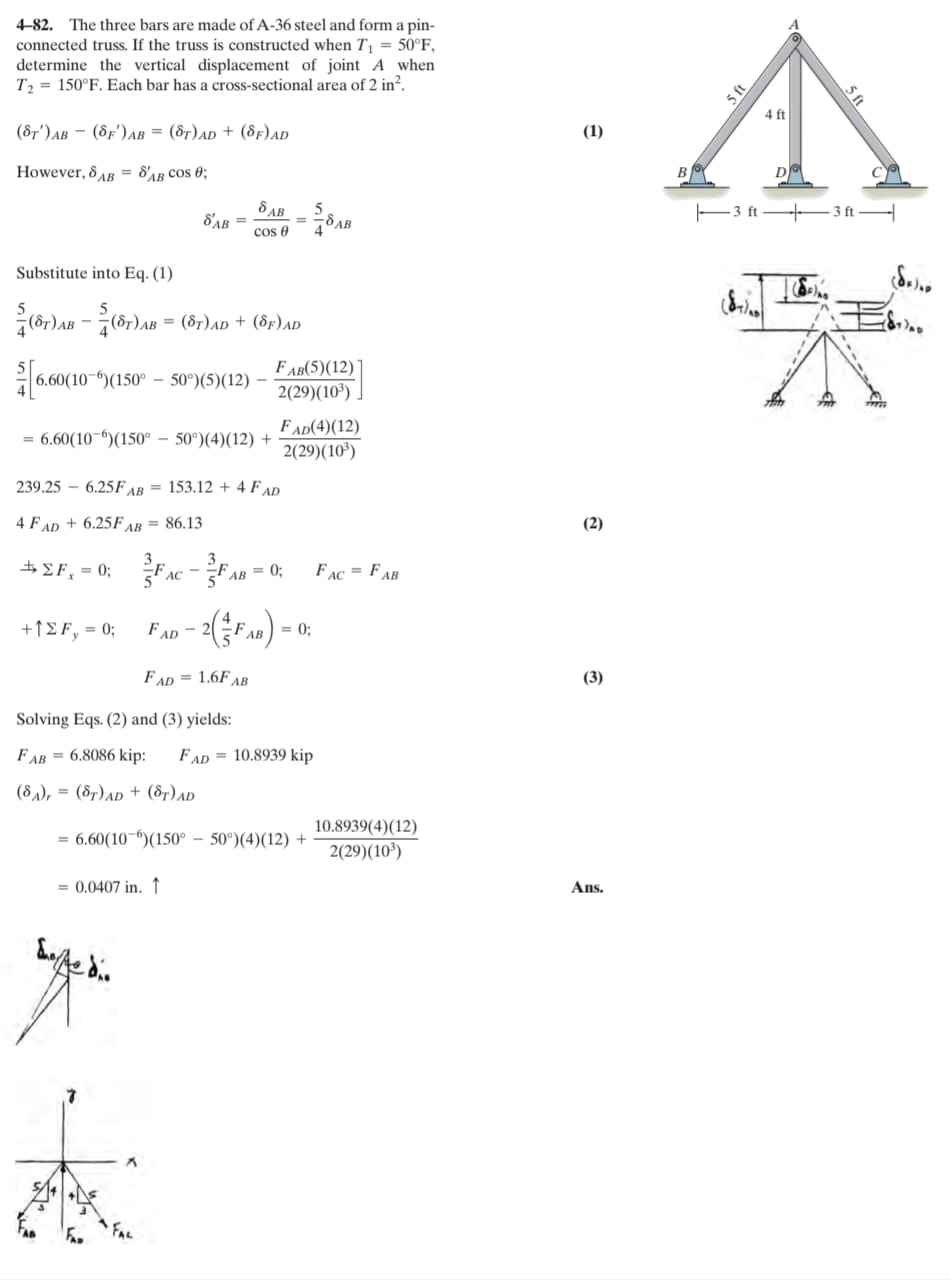
 4-82. The three bars are made of A-36 steel and form a pin- A
connected truss. If the truss is constructed when 7; = 50°F,
determine the vertical displacement of joint A when
T, = 150°F. Each bar has a cross-sectional area of 2 in’. 5 v
an X
Br")as = (OF) an = (5r)ap + (3r)an m
However, 8, = 8/43 cos 6; B D) C
op = ABS f—3 ft —f—30—|
Ban = cosg = 40am
Substitute into Eq. (1) = i Sons
Sou di 2
F608 = 3Gr)an = Gran + Gr)aw =}
/, &
5 -6 fated p \
[6.60010 — 509 _ Fas®)12)
fo (107)(150° = S0°)(5)(12) = 56505
» Fap#)(12)
- 6 (150° — 50° Fwo®a2)
S0(107)(150° = 50412) + ZEOE
239.25 ~ 625F up = 153.12 + 4 F ap
4 Fp + 625F 45 = 86.13 @
SIF =0 Hac-a=0 Fim Fu
: 4
+1EF, =0; Fap— (45am) =0;
Fap = 16Fn [&)
Solving Eqs. (2) and (3) yields:
Fag = 68086 kip: Fap = 10.8939 kip
®a), = (Gr)an + Gr)an
~ 10.8939(4)(12)
-6i 6150° — 50° 108939(4)(12)
660(10°)(150° — 50°))(12) + ==
= 0.0407 in. 1 Ans.
Vi :
7
:
ie
hd a
Re Fac
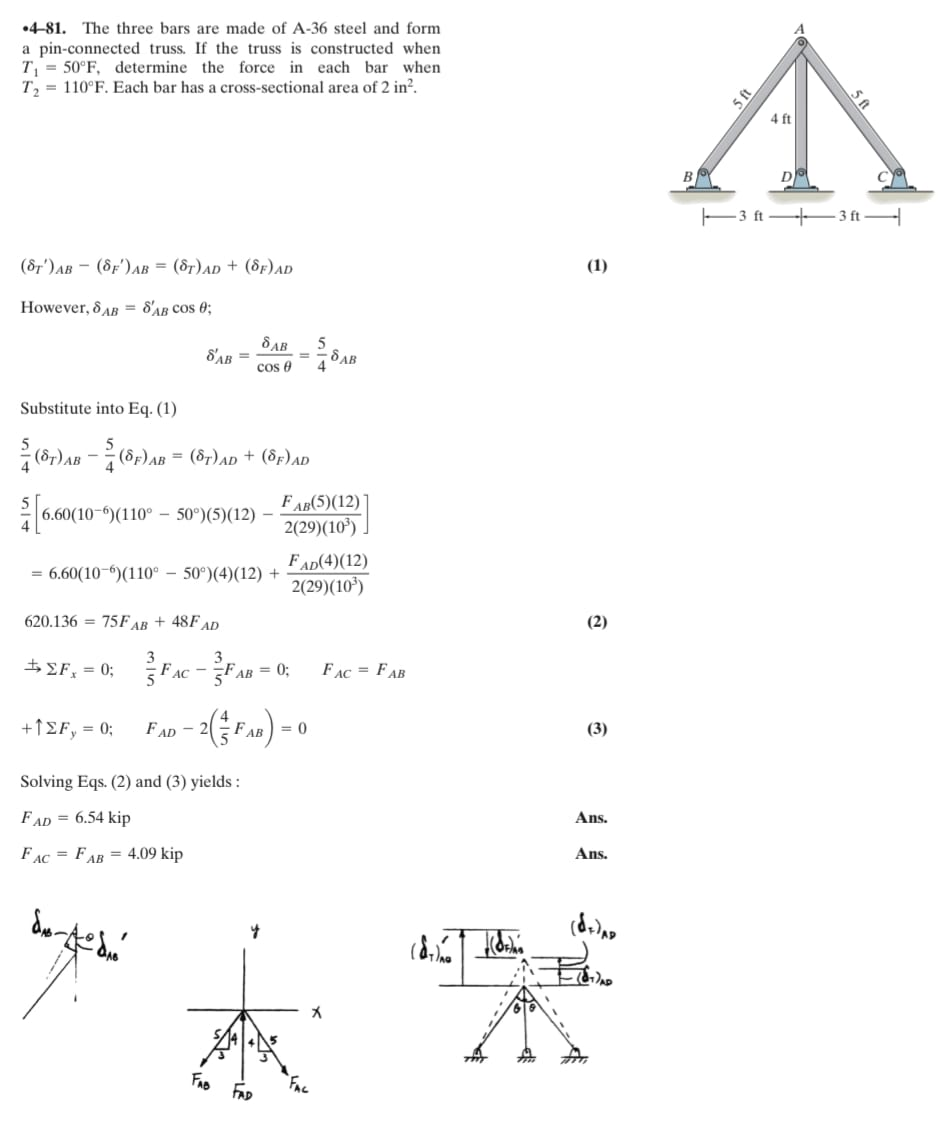
«4-81. The three bars are made of A-36 steel and form A
a pin-connected truss. If the truss is constructed when /R\
Ty = 50°F, determine the force in each bar when VAN
T, = 10°F. Each bar has a cross-sectional area of 2 in’. 4 A
y 4&5 \
Bf D, cp
—3 ft ——30—]
(61) as = (86) an = (3r)ap + (8) an mm
However, 8,15 = 8x cos 6;
, _ bas _5
Ban = Cosg = 4048
Substitute into Eq. (1)
5 5
3 @ran —5 Grlan = Godan + Gran
5 Let
216.60(107)(110° — 50°)(5)(12) — —2E=
3 (107%)( )(5)(12) 20910)
Fap(#)(12)
= 6.60(1079)(110° — 50°)(4)(12) + —22=2
(107°)( )(@)(12) 20910)
620.136 = 75F 45 + 48F 4p @
I" 3 3
SF=0 SFac—3Fam=0 Fac=Fan
4
+1SF =0; Fap— (2a) =0 [&)
Solving Eqs. (2) and (3) yields :
Fap = 654kip Ans.
Fae = Fp = 409kip Ans.
bagor ' A Se
aed, dol | A6e
AN Yo
‘ k) \
I ORNS
p 8
\s \
Fie hy ae
Asked by: Md Israrul Haque
Created at: 2025-10-19 20:34:43
Final Answer:
📢 Instructions:
- Ask anything relatd to above question only.
- For new Question goto :