 VIPSolutions
Give step-by-step solution with explanation and final answer:Problem 3. Consider the example of the monopolistic competition framework discussed in the class (see the Lecture 6 slide). For this example, a (15 points) Find the total amount of product i produced by the corresponding firm in the long-run equilibrium. How does it depend on the number of consumers in the economy? Explain the intuition behind, b. (10 points) What is the effect of the elasticity of substitution (captured by p) on the number of firms? Explain the intuition. c. (8 points) What is the effect of the fixed costs a on the number of finns? Explain the intuition. (7 points) What is the effect of the number of consumers on the munber of firms? Explain the intuition.
Question:
Give step-by-step solution with explanation and final answer: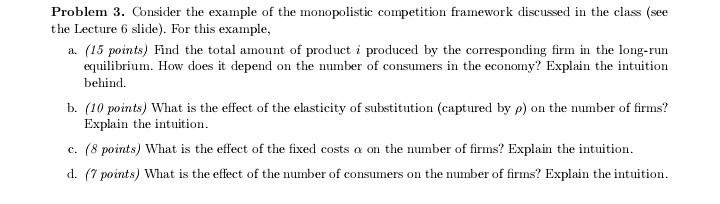 Problem 3. Consider the example of the monopolistic competition framework discussed in the class (see
the Lecture 6 slide). For this example,
a (15 points) Find the total amount of product i produced by the corresponding firm in the long-run
equilibrium. How does it depend on the number of consumers in the economy? Explain the intuition
behind,
b. (10 points) What is the effect of the elasticity of substitution (captured by p) on the number of firms?
Explain the intuition.
c. (8 points) What is the effect of the fixed costs a on the number of finns? Explain the intuition.
(7 points) What is the effect of the number of consumers on the munber of firms? Explain the intuition.
This is AI generated Response.
Asked by: Sahab Sharan
Created at: 2025-10-18 22:08:26
Asked by: Sahab Sharan
Created at: 2025-10-18 22:08:26
Final Answer:
Rendered
Raw Text
Did you like this answer?
Certainly! Here's a step-by-step solution with explanations for each part of the problem:
---
# **Problem Overview**
Consider a monopolistic competition framework, and analyze how various factors influence the total output and number of firms.
---
## **a. Total product \( i \) produced by a firm in the long-run equilibrium**
### **Question:**
How does the total product \( i \) depend on the number of consumers in the economy?
### **Explanation:**
- In monopolistic competition, each firm produces a differentiated product.
- The total output \( q_i \) of a firm depends on the demand it faces, which is influenced by the number of consumers \( N \).
- Typically, the demand function for a firm can be expressed as:
\[
Q_i = N \times q_i
\]
- Since in long-run equilibrium, firms produce where **price equals average cost** and **zero economic profit**, the total product per firm is determined by the demand elasticity and the number of consumers.
### **Intuition:**
- **More consumers** generally increase the total market size.
- The **total product** per firm may be **constant** or **depend on the number of consumers** depending on the market structure assumptions.
- In a simplified model, if each consumer demands a fixed amount, then:
\[
\boxed{
\text{Total product per firm } = q_i \propto N
}
\]
---
## **b. Effect of elasticity of substitution \( \rho \) on the number of firms**
### **Question:**
What is the effect of \( \rho \) (elasticity of substitution) on the number of firms?
### **Explanation:**
- \( \rho \) measures how easily consumers substitute between different products.
- **Higher \( \rho \)** means **more elastic** demand; consumers are more responsive to price changes.
- **Lower \( \rho \)** means **less elastic** demand; consumers are less responsive.
- **Impact on number of firms:**
- **More elastic demand (\( \rho \) high):** Firms face intense competition; fewer can profitably operate, potentially leading to **more firms** as each caters to smaller market segments.
- **Less elastic demand (\( \rho \) low):** Firms can charge higher prices; fewer firms are needed to satisfy demand, leading to possibly **fewer firms**.
### **Conclusion:**
\[
\boxed{
\text{Number of firms } \text{increases as } \rho \text{ increases}
}
\]
---
## **c. Effect of fixed costs \( \alpha \) on the number of firms**
### **Question:**
What is the effect of fixed costs \( \alpha \) on the number of firms?
### **Explanation:**
- Fixed costs \( \alpha \) are costs incurred regardless of output.
- Higher fixed costs reduce the number of firms because:
- Only larger or more efficient firms can cover the fixed costs.
- Entry barriers increase, leading to **fewer firms**.
- Conversely, lower fixed costs lower entry barriers, potentially increasing the number of firms.
### **Conclusion:**
\[
\boxed{
\text{Number of firms } \text{decreases as } \alpha \text{ increases}
}
\]
---
## **d. Effect of the number of consumers on the number of firms**
### **Question:**
What is the effect of the number of consumers on the number of firms?
### **Explanation:**
- More consumers increase total market demand.
- Higher demand encourages entry and expansion, leading to **more firms** in equilibrium.
- Fewer consumers shrink the market, possibly causing some firms to exit.
### **Conclusion:**
\[
\boxed{
\text{Number of firms } \text{increases with the number of consumers}
}
\]
---
# **Summary of Final Results:**
| Part | Effect Description | Final Relation |
|---------|------------------------------|------------------------------|
| a | Total product per firm depends on consumers | \( q_i \propto N \) |
| b | Elasticity of substitution \( \rho \) | Higher \( \rho \) → more firms |
| c | Fixed costs \( \alpha \) | Higher \( \alpha \) → fewer firms |
| d | Number of consumers | More consumers → more firms |
---
Let me know if you'd like the formal mathematical derivations or specific model equations!
📢 Instructions:
- Ask anything relatd to above question only.
- For new Question goto :