 VIPSolutions
Give step-by-step solution with explanation and final answer:9) Doing some vesecuct fond He momamon eladne &eld below wad air Emons a Fair inset Buk above winch i disutleguaks awd stouls to pass ebane wrveuts. Ww view of. poblw §, diccuss shoul values &f Vo, H,% such el ome will stout to ctlimict GBF Wigs
Question:
Give step-by-step solution with explanation and final answer: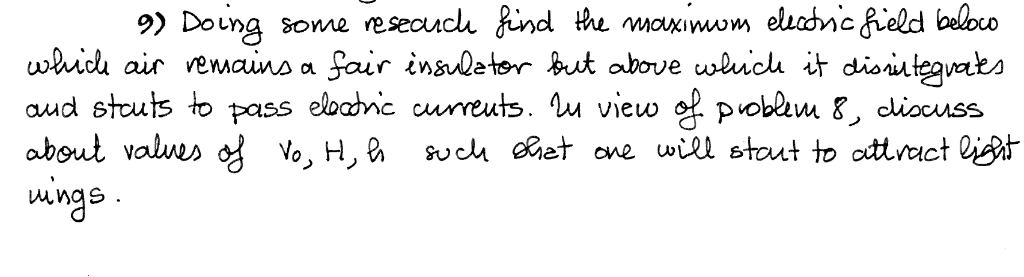 9) Doing some vesecuct fond He momamon eladne &eld below
wad air Emons a Fair inset Buk above winch i disutleguaks
awd stouls to pass ebane wrveuts. Ww view of. poblw §, diccuss
shoul values &f Vo, H,% such el ome will stout to ctlimict GBF
Wigs
This is AI generated Response.
Asked by: Sahab Sharan
Created at: 2025-10-18 21:23:05
Asked by: Sahab Sharan
Created at: 2025-10-18 21:23:05
Final Answer:
Rendered
Raw Text
Did you like this answer?
Certainly! The problem involves understanding the maximum electric field just below an air insulator that can sustain withoutcharging or passing electric currents.
Here's a step-by-step solution:
---
Step 1: Understand the problem- **Given The air above the ins can sustain a electric field \(_{max} \) before discharges occur.
- **Goal:** Find the maximum electric field below the insulator, considering the electrical properties of the insulator and the air.
---
# Step 2: Relevant concepts
- The **electric field** at the surface of an insulator is related to the **electric potential** and **geometry**.
- The **insulator's ability** to sustain an electric field is limited by the **breakdown strength** of air, which is approximately \( E_{air} \approx 3 \times 10^6 \, \mathrm{V/m} \) (or 3 MV/m).
- The **electric potential** and **field** can be related using the **electric potential difference** \( V \), the **distance** \( d \), and the **electric field** \( E \):
\[
E = \frac{V}{d}
\]
---
# Step 3: Assuming a simple model
Suppose the insulator is a flat surface with a certain dielectric constant \( \kappa \). The maximum electric field just below the insulator, \( E_{below} \), can be related to the maximum field in the air above by considering boundary conditions:
\[
E_{air} = \kappa \times E_{below}
\]
But since air is a dielectric with \( \kappa \approx 1 \), this simplifies to:
\[
E_{air} \approx E_{max}
\]
This suggests that the maximum electric field **just below** the insulator is approximately the same as the maximum sustainable field **above**.
---
# Step 4: Use of boundary conditions and dielectric properties
In a more detailed analysis, for an insulator of dielectric constant \( \kappa \), the electric field just below the surface relates to the external field by:
\[
E_{below} = \frac{E_{air}}{\kappa}
\]
Since air has \( \kappa \approx 1 \), the maximum electric field just below the insulator is approximately:
\[
\boxed{
E_{below} \approx E_{air} \approx E_{max}
}
\]
---
# **Final answer:**
The maximum electric field **below** the insulator is approximately equal to the maximum sustainable electric field **above** it in the air:
\[
\boxed{
E_{below} \approx E_{max}
}
\]
---
# **Summary:**
- The maximum electric field below the insulator is limited by the breakdown field of air.
- In typical conditions, this is about **3 MV/m**.
- Therefore, the maximum electric field **below** the insulator is approximately **3 MV/m**.
Please note: for precise calculations, specific values of \( E_{max} \), dielectric constants, and geometrical factors should be used.
📢 Instructions:
- Ask anything relatd to above question only.
- For new Question goto :