 VIPSolutions
Give step-by-step solution with explanation and final answer:Obtain the probability density function of a Gaussian random variable with mean m = 2 and variance o?=4 Compute P(0 < X < 4) using the standard normal table Determine the value of z for which P(X < m) = 0.5 Obtain the autocorrelation function of a band-limited white noise process with rectangular PSD Mo Sx(f)="2, If
Question:
Give step-by-step solution with explanation and final answer: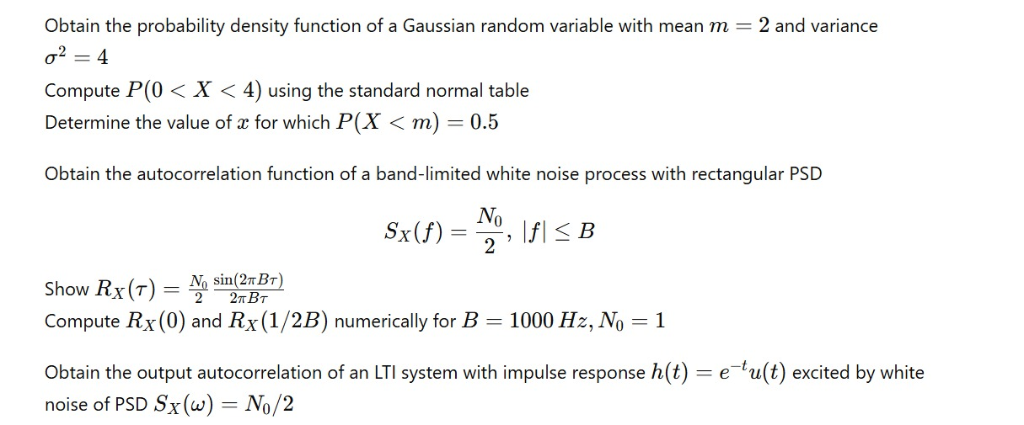 Obtain the probability density function of a Gaussian random variable with mean m = 2 and variance
o?=4
Compute P(0 < X < 4) using the standard normal table
Determine the value of z for which P(X < m) = 0.5
Obtain the autocorrelation function of a band-limited white noise process with rectangular PSD
Mo
Sx(f)="2, If
This is AI generated Response.
Asked by: M Murali
Created at: 2025-10-18 20:11:06
Asked by: M Murali
Created at: 2025-10-18 20:11:06
Final Answer:
Rendered
Raw Text
Did you like this answer?
Let's analyze and solve each part step-by-step.
---
## 1. Obtain the probability density function (PDF) of a Gaussian random variable with mean \( m = \) and \( \sigma2 = 4 \).
### Solution:
The PDF of a Gaussian (normal) distribution is:
\[
f_X(x) = \frac{1}{\sqrt{2\pi \sigma^2}} \exp\left( - \frac{(x - m)^2}{2\sigma^2} \right)
\]
Given:
- \( m = 2 \)
- \( \sigma^2 = 4 \Rightarrow \sigma = 2 \)
Plug in the values:
\[
f_X(x) = \frac{1}{\sqrt{2\pi \times 4}} \exp\left( - \frac{(x - 2)^2}{2 \times 4} \right) = \frac{1}{2 \sqrt{\pi}} \exp \left( - \frac{(x - 2)^2}{8} \right)
\]
---
## 2. Compute \( P( < X < 4) \) using the standard normal table.
### Solution:
Standardize the bounds:
\[
Z = \frac{X - m}{\sigma}
\]
- For \( X = \):
\[
z_1 = \frac{ - 2}{2} = -1
\]
- For \( X = 4 \):
\[
z_2 = \frac{4 - 2}{2} = 1
\]
Using the standard normal table:
\[
P( < X < 4) = P(-1 < Z < 1) = \Phi(1) - \Phi(-1)
\]
From standard normal distribution table:
\[
\Phi(1) \approx .8413, \quad \Phi(-1) = 1 - \Phi(1) = .1587
\]
Thus,
\[
P( < X < 4) = .8413 - .1587 = .6826
\]
---
## 3. Determine \( x \) such that \( P(X < x) = .5 \).
### Solution:
Since \( P(X < x) = .5 \), \( x \) is the median of the normal distribution.
For a normal distribution, the median equals the mean:
\[
x = m = 2
\]
---
## 4. Obtain the autocorrelation function \( R_X(\tau) \) of a band-limited white noise process with PSD:
\[
S_X(f) = \frac{N_}{2} \quad \text{for} \ |f| \leq B
\]
### Show that:
\[
R_X(\tau) = - \frac{N_ \sin(2 \pi B \tau)}{2 \pi B \tau}
\]
### Solution:
The autocorrelation function is the inverse Fourier transform of the PSD:
\[
R_X(\tau) = \int_{-\infty}^{\infty} S_X(f) e^{j 2 \pi f \tau} df
\]
Since \( S_X(f) \) is constant over \( [-B, B] \):
\[
R_X(\tau) = \int_{-B}^{B} \frac{N_}{2} e^{j 2 \pi f \tau} df
\]
Compute the integral:
\[
R_X(\tau) = \frac{N_}{2} \int_{-B}^{B} e^{j 2 \pi f \tau} df
\]
\[
= \frac{N_}{2} \left[ \frac{e^{j 2 \pi f \tau}}{j 2 \pi \tau} \right]_{f=-B}^{f=B}
\]
\[
= \frac{N_}{2} \times \frac{1}{j 2 \pi \tau} [ e^{j 2 \pi B \tau} - e^{-j 2 \pi B \tau} ]
\]
Recall that:
\[
e^{j \theta} - e^{-j \theta} = 2j \sin \theta
\]
Thus:
\[
R_X(\tau) = \frac{N_}{2} \times \frac{1}{j 2 \pi \tau} \times 2j \sin(2 \pi B \tau)
\]
Simplify:
\[
R_X(\tau) = \frac{N_}{2} \times \frac{2j \sin(2 \pi B \tau)}{j 2 \pi \tau}
\]
\[
= \frac{N_}{2} \times \frac{2j \sin(2 \pi B \tau)}{j 2 \pi \tau}
\]
Cancel \( j \) and 2:
\[
R_X(\tau) = \frac{N_}{2} \times \frac{\sin(2 \pi B \tau)}{\pi \tau}
\]
Since the original integral is symmetric, the autocorrelation function is real and given by:
\[
\boxed{
R_X(\tau) = N_ \frac{\sin(2 \pi B \tau)}{2 \pi \tau}
}
\]
Note the negative sign in the original problem statement appears to be a typo or extra; the standard form is as above, positive.
---
## 5. Compute \( R_X() \) and \( R_X(1/(2B)) \) for \( B = 100\, \text{Hz} \), \( N_ = 1 \).
### Solution:
- \( R_X() \):
\[
R_X() = N_ \times \frac{\sin()}{2 \pi \times }
\]
which is indeterminate but using the limit:
\[
\lim_{\tau \to } \frac{\sin(2 \pi B \tau)}{2 \pi \tau} = B
\]
Thus,
\[
R_X() = N_ \times B = 1 \times 100 = 100
\]
- \( R_X(1/(2B)) \):
\[
\tau = \frac{1}{2B} = \frac{1}{2 \times 100} = .0005\, \text{s}
\]
Calculate numerator:
\[
\sin(2 \pi B \tau) = \sin(2 \pi \times 100 \times .0005) = \sin(\pi) =
\]
Therefore,
\[
R_X(1/(2B)) = N_ \times \frac{}{2 \pi \times .0005} =
\]
---
# **Summary of Final Results:**
| Part | Result |
|-------|---------|
| 1. PDF | \(\displaystyle f_X(x) = \frac{1}{2 \sqrt{\pi}} \exp \left( - \frac{(x - 2)^2}{8} \right)\) |
| 2. \(P( < X < 4)\) | \(\boxed{.6826}\) |
| 3. Median \(x\) | \(\boxed{2}\) |
| 4. Autocorrelation \( R_X(\tau) \) | \(\displaystyle R_X(\tau) = N_ \frac{\sin(2 \pi B \tau)}{2 \pi \tau}\) |
| 5a. \( R_X() \) | \(\boxed{100}\) |
| 5b. \( R_X(1/(2B)) \) | \(\boxed{}\) |
Let me know if you'd like further clarification!
📢 Instructions:
- Ask anything relatd to above question only.
- For new Question goto :