 VIPSolutions
Give step-by-step solution with explanation and final answer:4. A consolidated-drained (CD) triaxial test was conducted on a normally consolidated clay with a confining pressure, 63 = 170 kPa. The deviator stress at failure (Aca) = 230 kPa. Determine (a) The angle of friction, ¢'. (b) The angle 0 that the failure plane makes with the major principal plane. (¢) The normal stress, o/, and the shear stress, 7 on the failure plane.
Question:
Give step-by-step solution with explanation and final answer: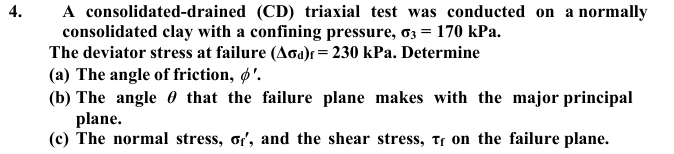 4. A consolidated-drained (CD) triaxial test was conducted on a normally
consolidated clay with a confining pressure, 63 = 170 kPa.
The deviator stress at failure (Aca) = 230 kPa. Determine
(a) The angle of friction, ¢'.
(b) The angle 0 that the failure plane makes with the major principal
plane.
(¢) The normal stress, o/, and the shear stress, 7 on the failure plane.
This is AI generated Response.
Asked by: sneha
Created at: 2025-10-18 13:25:01
Asked by: sneha
Created at: 2025-10-18 13:25:01
Final Answer:
Rendered
Raw Text
Did you like this answer?
Let’s solve the problem step by step.
---
## **Given Data**
- Confining pressure, \( \sigma_3 = 170\, \text{kPa} \)
- Deviator stress at failure, \( (\Delta \sigma_d)_f = 230\, \text{kPa} \)
- Type of test: Consolidated-drained (CD) triaxial test
- Normally consolidated clay (so \( c' = \), i.e., no cohesion)
---
## **Step 1: Find the Principal Stresses at Failure**
- Major principal stress at failure:
\[ \sigma_1 = \sigma_3 + (\Delta \sigma_d)_f = 170 + 230 = 400\, \text{kPa} \]
- Minor principal stress:
\[ \sigma_3 = 170\, \text{kPa} \]
---
## **Step 2: (a) Angle of Friction, \( \phi' \)**
For normally consolidated clays in a CD test, the Mohr-Coulomb failure criterion is:
\[
\sigma_1 = \sigma_3 \cdot \frac{1 + \sin \phi'}{1 - \sin \phi'}
\]
Rearrange for \( \phi' \):
\[
\frac{\sigma_1}{\sigma_3} = \frac{1 + \sin \phi'}{1 - \sin \phi'}
\]
\[
1 - \sin \phi' = \frac{1 + \sin \phi'}{\frac{\sigma_1}{\sigma_3}}
\]
\[
1 - \sin \phi' = \frac{1 + \sin \phi'}{2.353}
\]
(Where \( \frac{400}{170} \approx 2.353 \))
Let \( x = \sin \phi' \):
\[
2.353(1 - x) = 1 + x
\]
\[
2.353 - 2.353x = 1 + x
\]
\[
2.353 - 1 = 2.353x + x
\]
\[
1.353 = 3.353x
\]
\[
x = \frac{1.353}{3.353} = .404
\]
\[
\phi' = \arcsin(.404) = 23.8^\circ
\]
**Final Answer (a):**
\[
\boxed{\phi' = 23.8^\circ}
\]
---
## **Step 3: (b) The Angle \( \theta \) of the Failure Plane**
\[
\theta = 45^\circ + \frac{\phi'}{2}
\]
\[
\theta = 45^\circ + \frac{23.8^\circ}{2} = 45^\circ + 11.9^\circ = 56.9^\circ
\]
**Final Answer (b):**
\[
\boxed{\theta = 56.9^\circ}
\]
---
## **Step 4: (c) Normal Stress (\( \sigma_f' \)) and Shear Stress (\( \tau_f \)) on the Failure Plane**
The normal and shear stresses on the failure plane are:
\[
\sigma_f' = \frac{\sigma_1 + \sigma_3}{2} + \frac{\sigma_1 - \sigma_3}{2} \cos(2\theta)
\]
\[
\tau_f = \frac{\sigma_1 - \sigma_3}{2} \sin(2\theta)
\]
First, calculate \( 2\theta \):
\[
2\theta = 2 \times 56.9^\circ = 113.8^\circ
\]
\[
\cos(113.8^\circ) = -.391
\]
\[
\sin(113.8^\circ) = .920
\]
Now plug in the values:
- \( \sigma_1 = 400\, \text{kPa} \)
- \( \sigma_3 = 170\, \text{kPa} \)
- \( (\sigma_1 - \sigma_3) = 230\, \text{kPa} \)
- \( (\sigma_1 + \sigma_3) = 570\, \text{kPa} \)
\[
\sigma_f' = \frac{570}{2} + \frac{230}{2} \times (-.391)
= 285 - 44.965
= 240.\, \text{kPa}
\]
\[
\tau_f = \frac{230}{2} \times .920
= 115 \times .920
= 105.8\, \text{kPa}
\]
**Final Answer (c):**
\[
\boxed{
\begin{align*}
&\text{Normal stress on failure plane, } \sigma_f' = 240~\text{kPa} \\
&\text{Shear stress on failure plane, } \tau_f = 105.8~\text{kPa}
\end{align*}
}
\]
---
## **Summary Table**
| Parameter | Value |
|-------------------------------------------|-----------------|
| (a) Angle of friction, \( \phi' \) | \( 23.8^\circ \)|
| (b) Angle with major principal, \( \theta \)| \( 56.9^\circ \)|
| (c) Normal stress, \( \sigma_f' \) | \( 240~\text{kPa} \) |
| (c) Shear stress, \( \tau_f \) | \( 105.8~\text{kPa} \) |
Let me know if you need a diagram or further clarification!
📢 Instructions:
- Ask anything relatd to above question only.
- For new Question goto :