 VIPSolutions
Give step-by-step solution with explanation and final answer:A floor system consists of ten 30” long reinforced concrete beams and a continuous 5” deck slab, as shown. For each beam in the floor system, the ACI-specified effective top flange width is most nearly: (A) 36 in. I ory SG J RE NT Se re = 110 (8)50in. C) 60in. 15in (Geom 4 4 (D)90in. . © B— 10in 50in
Question:
Give step-by-step solution with explanation and final answer: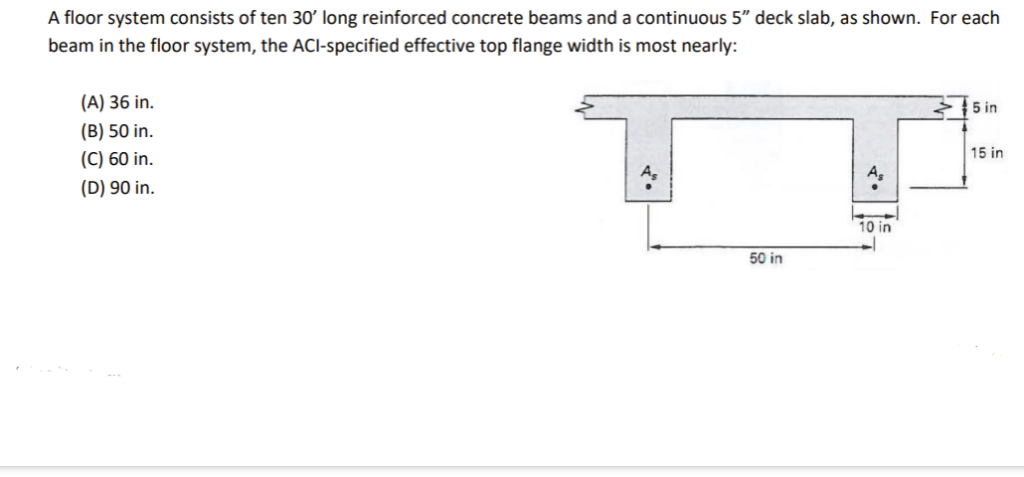 A floor system consists of ten 30” long reinforced concrete beams and a continuous 5” deck slab, as shown. For each
beam in the floor system, the ACI-specified effective top flange width is most nearly:
(A) 36 in. I ory SG J RE NT Se re = 110
(8)50in.
C) 60in. 15in
(Geom 4 4
(D)90in. . ©
B—
10in
50in
This is AI generated Response.
Asked by: sneha
Created at: 2025-10-18 06:36:19
Asked by: sneha
Created at: 2025-10-18 06:36:19
Final Answer:
Rendered
Raw Text
Did you like this answer?
Let's go through the steps as per **ACI 318** code for determining the **effective flange width** (\(b_f\)) for a T-beam.
---
## **Step 1: List Given Data**
- **Beam web width (b_w):** 10 in.
- **Slab thickness (h_f):** 5 in.
- **Beam span (L):** 30 ft = 360 in.
- **Distance to next beam (center-to-center):** 50 in.
---
## **Step 2: ACI 318 Effective Flange Width Criteria**
According to **ACI 318-14 (Section 6.3.2.1)**, for T-beams, the effective flange width \(b_f\) **on each side of the web** shall not exceed:
1. **One-fourth the span length of the beam:**
\( \frac{L}{4} = \frac{360}{4} = 90 \) in
2. **The web width plus 16 times the slab thickness:**
\( b_w + 16h_f = 10 + 16 \times 5 = 10 + 80 = 90 \) in
3. **The center-to-center distance between beams:**
\( 50 \) in
---
## **Step 3: Compute the Minimum**
The **effective flange width** is the **smallest** of the above three values:
- \( \frac{L}{4} = 90 \) in
- \( b_w + 16h_f = 90 \) in
- Center-to-center spacing = 50 in
**The smallest is 50 in.**
---
## **Step 4: Final Answer**
**The ACI-specified effective top flange width is:**
\[
\boxed{50\ \text{in.}}
\]
**Answer:**
**(B) 50 in.**
---
### **Summary Table**
| Criteria | Value |
|--------------------------------------------|-----------|
| \( \frac{L}{4} \) | 90 in |
| \( b_w + 16h_f \) | 90 in |
| Center-to-center distance between beams | 50 in |
| **Effective Flange Width (\(b_f\))** | **50 in** |
📢 Instructions:
- Ask anything relatd to above question only.
- For new Question goto :