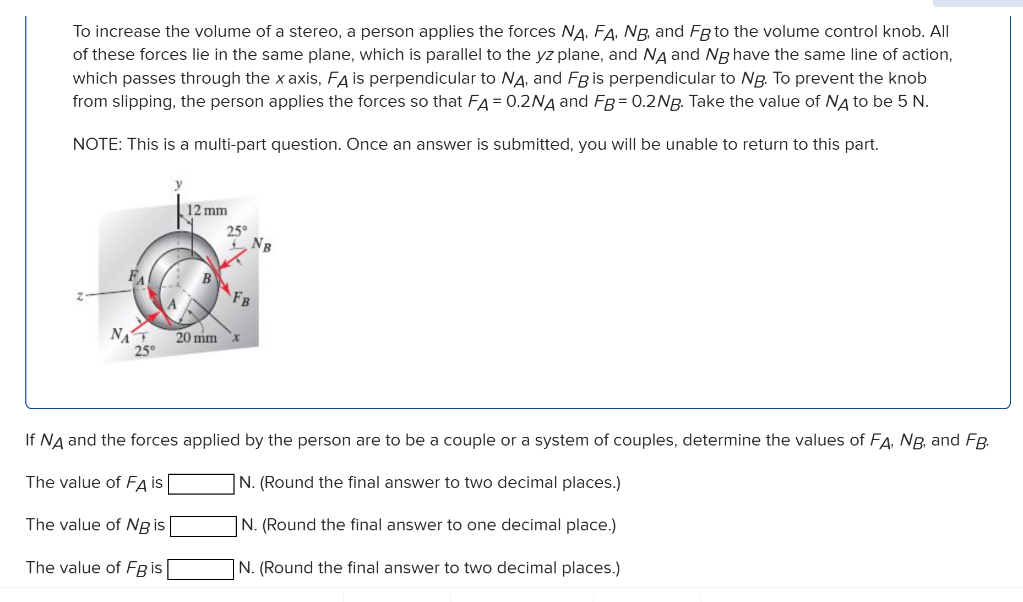
Give step-by-step solution with explanation and final answer:To increase the volume of a stereo, a person applies the forces Na, £4, Ng, and Fgto the volume control knob. All
of these forces lie in the same plane, which is parallel to the yz plane, and N4 and Ng have the same line of action,
which passes through the x axis, £4 is perpendicular to N, and Fgis perpendicular to Ng. To prevent the knob
from slipping, the person applies the forces so that £4 = 0.2N4 and Fg= 0.2Ng. Take the value of Nato be 5 N.
NOTE: This is a multi-part question. Once an answer is submitted, you will be unable to return to this part.
5
12mm
25°
“il
Ax
AVE
Na%r 20, x
pA
If Na and the forces applied by the person are to be a couple or a system of couples, determine the values of £4, Ng, and Fg.
The value of F4is[___]N. (Round the final answer to two decimal places.)
The value of Ngis[____|N. (Round the final answer to one decimal place.)
The value of Fgis[ |. (Round the final answer to two decimal places.)
Question:
Give step-by-step solution with explanation and final answer:To increase the volume of a stereo, a person applies the forces Na, £4, Ng, and Fgto the volume control knob. All
of these forces lie in the same plane, which is parallel to the yz plane, and N4 and Ng have the same line of action,
which passes through the x axis, £4 is perpendicular to N, and Fgis perpendicular to Ng. To prevent the knob
from slipping, the person applies the forces so that £4 = 0.2N4 and Fg= 0.2Ng. Take the value of Nato be 5 N.
NOTE: This is a multi-part question. Once an answer is submitted, you will be unable to return to this part.
5
12mm
25°
“il
Ax
AVE
Na%r 20, x
pA
If Na and the forces applied by the person are to be a couple or a system of couples, determine the values of £4, Ng, and Fg.
The value of F4is[___]N. (Round the final answer to two decimal places.)
The value of Ngis[____|N. (Round the final answer to one decimal place.)
The value of Fgis[ |. (Round the final answer to two decimal places.)
This is AI generated Response.
Asked by: sneha
Created at: 2025-10-16 14:06:55
Thought Process:
RenderedRaw Text
**Interpreting force calculations**
I need to interpret a problem involving forces applied to a volume control knob. We've got forces NA and FA at point A, and NB and FB at point B. They lie in the same plane parallel to the yz plane, which passes through the x-axis. According to the text, NA and NB share a line of action through the x-axis, while FA is perpendicular to NA, and FB is perpendicular to NB. To prevent slipping, the user applies FA = 0.2 NA and FB = 0.2 NB, with NA set at 5 N. Now, I need to calculate FA, NB, and FB based on these relationships.**Understanding net forces and angles**
I’m digging into a problem regarding forces applied to a volume control knob, focusing on whether they form a couple or a system of couples. For this, the net force needs to be zero. It's mentioned that the lines of action must be equal and opposite. I'm considering two locations, A at an inner radius of 20 mm and B at 12 mm. The angles relative to the x-axis are important, with NA and NB both possibly at a symmetrical 25 degrees relative to that axis. The forces lie in the yz plane, making the x-axis perpendicular to it.**Analyzing forces and actions**
I’m examining how the normal forces NA and NB work in relation to the x-axis. It feels a bit confusing because, at first glance, it seems they should be directed along the x-axis. However, I realize that the normal forces actually act radially inwards from the knob's center, along the yz plane, meaning they intersect the x-axis at the center. The tangential forces FA and FB are perpendicular to these normals and are both equal to 0.2 N. I need to adjust the magnitudes, possibly making NB unknown, to ensure the resultant force is zero, indicating a system of couples.**Determining angles and forces**
When analyzing a couple, the net force must be zero while maintaining a non-zero moment vector. The goal is to find NB so that the sum of forces equals zero, given NA as 5 N. FA and FB will be 0.2 times these forces. I also need to consider their orientation angles, which are 25° relative to the y-axis. It’s clear that the angles are measured from the vertical in the yz-plane coordinates. Points A and B are at 20 mm and 12 mm from the center, respectively, with FA and NA positioned below the negative z-axis.**Understanding forces and couples**
I’m trying to analyze how forces NA and NB work at diametrically opposite points on the knob. If both push toward the center, they act in opposite directions, which means if their magnitudes aren't equal, there will be a resultant force. To create a couple, we need to sum all four vectors to zero. FA and FB, being tangential, might also oppose each other depending on their orientation. The key is that tangents at opposite points are parallel but should be oriented in opposite directions. This means that FA and FB will also act in opposing directions to maintain equilibrium. To form a pure couple, I need to ensure that the net force is zero. NA is given as 5 N, providing a basis for determining NB. However, geometry may indicate that NB differs from 5 N due to angular considerations. It seems like NA and NB should equal for a true couple, but their specific arrangement might affect the final calculations.**Establishing couples and forces**
To create a couple, the forces must have equal magnitudes and act in opposite directions along parallel lines. Here, FA and FB must be equal and opposite, as do NA and NB. The person applies forces such that FA = 0.2 NA and FB = 0.2 NB, with NA given as 5 N. This implies NB also equals 5 N, yielding FA and FB as 1 N each.
However, the problem suggests checking NB to one decimal place. The geometry of points A and B—20 mm and 12 mm—might influence overall moments. It seems this is a two-part question, where first we calculate each force, then possibly address moments later. I'll present the calculations clearly and follow through step-by-step!**Calculating forces for balance**
I see that NA and NB share the same line of action and must have equal magn, hence NA = NB. Since NA is given as 5 N, that means NB = 5 N too. The frictional forces depend on the normals, so I calculate FA as 0.2 times NA, which is 1.00 N, and FB as 0.2 times NB, also 1.00 N.
Even though the 25° angles don’t affect the magnitudes in this context, ensuring that the overall forces balance to zero is important as NA + NB and FA + FB sum to zero when considering their directions. Finally, I’ll make sure to round my answers: FA = 1.00 N, NB = 5.0 N, and FB = 1.00 N.
Final Answer:
RenderedRaw Text
Did you like this answer?
Step 1: Interpret the conditions
- All forces are in one plane parallel to the yz-plane.
- NA and NB act along the same line of action (through the knob axis) but at opposite sides of the knob, so they are opposite in direction.
- FA ⟂ NA and FB ⟂ NB. Thus FA and FB are tangential forces at the two opposite points.
- To avoid slip: FA = 0.2 NA and FB = 0.2 NB.
- For the forces “to be a couple or a system of couples,” the net force must be zero; therefore the forces must occur in equal-and-opposite pairs along parallel lines.
Step 2: Enforce zero resultant force
- Since NA and NB are colinear and opposite, zero resultant requires |NA| = |NB|.
- Given NA = 5 N ⇒ NB = 5 N.
Step 3: Use the no-slip relations for the tangential forces
- FA = 0.2 NA = 0.2(5) = 1.00 N.
- FB = 0.2 NB = 0.2(5) = 1.00 N.
Check: NA and NB cancel as a pair, and FA and FB cancel as a pair (equal magnitudes on parallel, opposite lines), hence only couples (moments) remain.
Final answers
- FA = 1.00 N
- NB = 5.0 N
- FB = 1.00 N
VIPSolutions focuses on clear, step‑by‑step explanations so you can learn quickly. Whether you need an AI‑generated walkthrough or a short hint to get unstuck, each solution is organized for fast reading and easy review later.
Search similar questions, compare approaches, and bookmark the best answers for revision. Our goal is simple: quick, reliable study help that feels natural—not noisy.
 VIPSolutions
 To increase the volume of a stereo, a person applies the forces Na, £4, Ng, and Fgto the volume control knob. All
of these forces lie in the same plane, which is parallel to the yz plane, and N4 and Ng have the same line of action,
which passes through the x axis, £4 is perpendicular to N, and Fgis perpendicular to Ng. To prevent the knob
from slipping, the person applies the forces so that £4 = 0.2N4 and Fg= 0.2Ng. Take the value of Nato be 5 N.
NOTE: This is a multi-part question. Once an answer is submitted, you will be unable to return to this part.
5
12mm
25°
“il
Ax
AVE
Na%r 20, x
pA
If Na and the forces applied by the person are to be a couple or a system of couples, determine the values of £4, Ng, and Fg.
The value of F4is[___]N. (Round the final answer to two decimal places.)
The value of Ngis[____|N. (Round the final answer to one decimal place.)
The value of Fgis[ |. (Round the final answer to two decimal places.)