 VIPSolutions
Give step-by-step solution with explanation and final answer:2. Application of Bernoulli's Equation A pitot tube i frequently used to measure the discharge from a fire hydrant. Find the discharge from the fire hydrant show below if the 2 5” nozzle is flowing and the pressure gauge reading is 50 psi. / 50Psi Figure 2
Question:
Give step-by-step solution with explanation and final answer: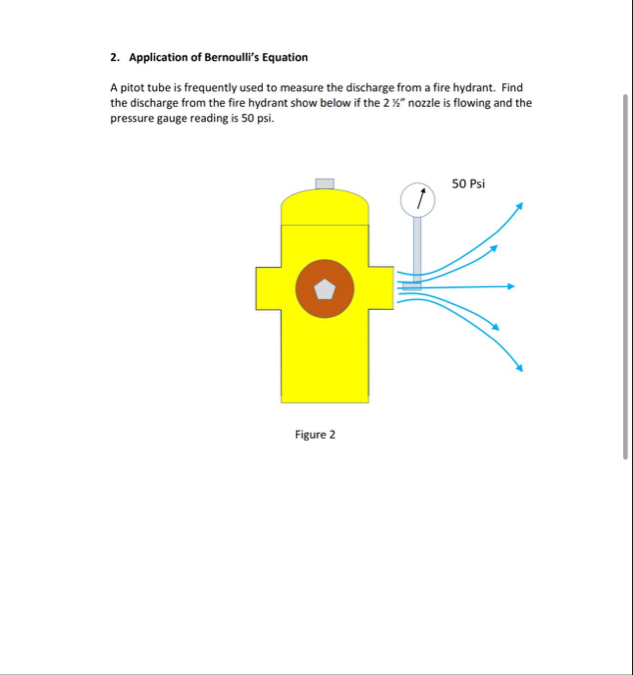 2. Application of Bernoulli's Equation
A pitot tube i frequently used to measure the discharge from a fire hydrant. Find
the discharge from the fire hydrant show below if the 2 5” nozzle is flowing and the
pressure gauge reading is 50 psi.
/ 50Psi
Figure 2
This is AI generated Response.
Asked by: sanni
Created at: 2025-10-15 07:56:47
Asked by: sanni
Created at: 2025-10-15 07:56:47
Final Answer:
Rendered
Raw Text
Did you like this answer?
# Step-by-Step Solution: Fire Hydrant Discharge Using Bernoulli's Equation
## **Given Data**
- **Nozzle diameter (\( D \))**: 2½ inches = 2.5 inches = .2083 ft
- **Pressure at nozzle (\( P \))**: 50 psi
- **Atmospheric pressure at exit**: gauge (open to atmosphere)
- **Assume**: The nozzle is horizontal and the velocity inside the hydrant is negligible compared to the nozzle exit.
---
## **Step 1: Convert Units**
- **Pressure:**
\( 1 \text{ psi} = 144 \text{ lb/ft}^2 \)
\( 50 \text{ psi} = 50 \times 144 = 720 \text{ lb/ft}^2 \)
- **Diameter to Area:**
\( D = 2.5 \text{ in} = \frac{2.5}{12} = .2083 \text{ ft} \)
\( A = \frac{\pi}{4} D^2 = \frac{\pi}{4} (.2083)^2 = .0341 \text{ ft}^2 \)
---
## **Step 2: Bernoulli’s Equation Application**
Apply Bernoulli’s Equation between the inside of the hydrant (point 1) and the nozzle exit (point 2):
\[
\frac{P_1}{\gamma} + \frac{V_1^2}{2g} = \frac{P_2}{\gamma} + \frac{V_2^2}{2g}
\]
Where:
- \( P_1 = 50 \) psi gauge \( = 720 \text{ lb/ft}^2 \)
- \( P_2 \) (atmospheric, gauge) \( = \)
- \( V_1 \) (velocity in hydrant) \( \approx \)
- \( \gamma \) (unit weight of water) \( = 62.4 \text{ lb/ft}^3 \)
- \( g = 32.2 \text{ ft/s}^2 \)
\[
\frac{720}{62.4} = \frac{V_2^2}{2 \times 32.2}
\]
\[
115.38 = \frac{V_2^2}{64.4}
\]
\[
V_2^2 = 115.38 \times 64.4 = 7431
\]
\[
V_2 = \sqrt{7431} = 86.2 \text{ ft/s}
\]
---
## **Step 3: Calculate Discharge \( Q \)**
\[
Q = A \times V_2
\]
\[
Q = .0341 \text{ ft}^2 \times 86.2 \text{ ft/s}
\]
\[
Q = 2.94 \text{ ft}^3/\text{s}
\]
---
## **Step 4: Final Answer**
### **Discharge from the fire hydrant:**
\[
\boxed{2.94\ \text{ft}^3/\text{s}}
\]
---
### **Summary Table**
| Quantity | Value |
|--------------------|-----------------------|
| Nozzle Diameter | 2.5 in (.2083 ft) |
| Pressure | 50 psi (720 lb/ft²) |
| Area (\(A\)) | .0341 ft² |
| Exit Velocity (\(V_2\)) | 86.2 ft/s |
| Discharge (\(Q\)) | 2.94 ft³/s |
---
**Assumptions:**
- Neglect velocity inside hydrant.
- Neglect elevation change.
- Water temperature gives \(\gamma = 62.4 \text{ lb/ft}^3\).
📢 Instructions:
- Ask anything relatd to above question only.
- For new Question goto :