 VIPSolutions
Give step-by-step solution with explanation and final answer:, inemployment rate among kers dropped from 16 percent on 192, to 9 percent on September 1, of construction workers was on September 1, 1996, than 92, wg was the approximate number of unemployed er this. period?
Question:
Give step-by-step solution with explanation and final answer: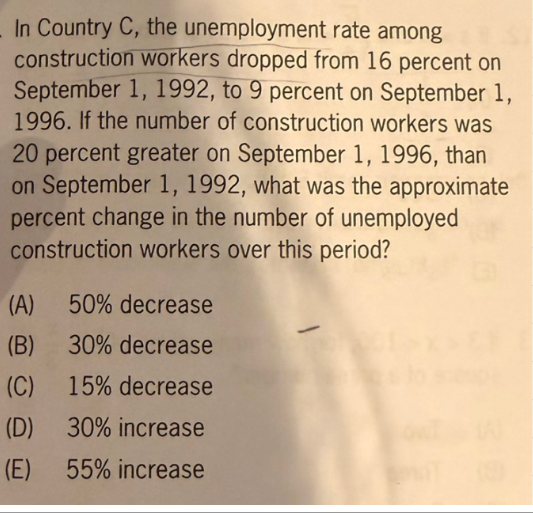 , inemployment rate among
kers dropped from 16 percent on
192, to 9 percent on September 1,
of construction workers was
on September 1, 1996, than
92, wg was the approximate
number of unemployed
er this. period?
This is AI generated Response.
Asked by: Vikram Kumar
Created at: 2025-10-14 00:55:08
Asked by: Vikram Kumar
Created at: 2025-10-14 00:55:08
Final Answer:
Rendered
Raw Text
Did you like this answer?
Let's solve the problem step-by-step:
### **Step 1: Assign Variables**
Let the number of construction workers on September 1, 1992, be \( x \).
### **Step 2: Calculate the Number of Workers in 1996**
On September 1, 1996, the number of construction workers is 20% greater than in 1992:
\[
\text{Number of workers in 1996} = x + .2x = 1.2x
\]
### **Step 3: Calculate the Number of Unemployed Workers in Each Year**
#### **1992:**
Unemployment rate = 16%
\[
\text{Unemployed in 1992} = .16x
\]
#### **1996:**
Unemployment rate = 9%
\[
\text{Unemployed in 1996} = .09 \times 1.2x = .108x
\]
### **Step 4: Calculate the Percent Change in the Number of Unemployed Workers**
\[
\text{Percent change} = \frac{\text{Final} - \text{Initial}}{\text{Initial}} \times 100\%
\]
\[
= \frac{.108x - .16x}{.16x} \times 100\%
\]
\[
= \frac{-.052x}{.16x} \times 100\%
\]
\[
= \frac{-.052}{.16} \times 100\%
\]
\[
= -32.5\%
\]
### **Step 5: Final Answer**
The closest answer is **(B) 30% decrease**.
---
## **Final Answer**
### **(B) 30% decrease**
Question:
every step thory explantion
This is AI generated Response.
Asked by: Vikram Kumar
Created at: 2025-10-14 01:00:01
Asked by: Vikram Kumar
Created at: 2025-10-14 01:00:01
Final Answer:
Rendered
Raw Text
Did you like this answer?
# Step-by-Step Solution with Explanations
Let's break down the problem concerning the unemployment rate among construction workers over the specified time period.
## **Step 1: Assign Variables**
Let \( x \) be the total number of construction workers on September 1, 1992.
## **Step 2: Calculate the Number of Workers in 1996**
From the problem, we know that the number of construction workers increased by 20% from 1992 to 1996. Therefore, we can express the number of workers in 1996 as:
\[
\text{Number of workers in 1996} = x + 0.2x = 1.2x
\]
## **Step 3: Calculate the Number of Unemployed Workers in Each Year**
### **Unemployed Workers in 1992**
Given that the unemployment rate in 1992 was 16%, the number of unemployed construction workers can be calculated as:
\[
\text{Unemployed in 1992} = 0.16x
\]
### **Unemployed Workers in 1996**
With an unemployment rate of 9% in 1996, we calculate the number of unemployed workers as follows:
\[
\text{Unemployed in 1996} = 0.09 \times 1.2x = 0.108x
\]
## **Step 4: Calculate the Percent Change in the Number of Unemployed Workers**
To find the percentage change in the number of unemployed workers from 1992 to 1996, we use the formula:
\[
\text{Percent change} = \frac{\text{Final} - \text{Initial}}{\text{Initial}} \times 100\%
\]
Substituting the values:
\[
\text{Percent change} = \frac{0.108x - 0.16x}{0.16x} \times 100\%
\]
This simplifies to:
\[
= \frac{-0.052x}{0.16x} \times 100\% = \frac{-0.052}{0.16} \times 100\%
\]
Calculating this gives:
\[
= -32.5\%
\]
## **Step 5: Interpretation of Results**
The negative sign indicates a decrease in the number of unemployed workers.
## **Final Answer**
The closest option to the calculated decrease of 32.5% is:
### **(B) 30% decrease**
📢 Instructions:
- Ask anything relatd to above question only.
- For new Question goto :