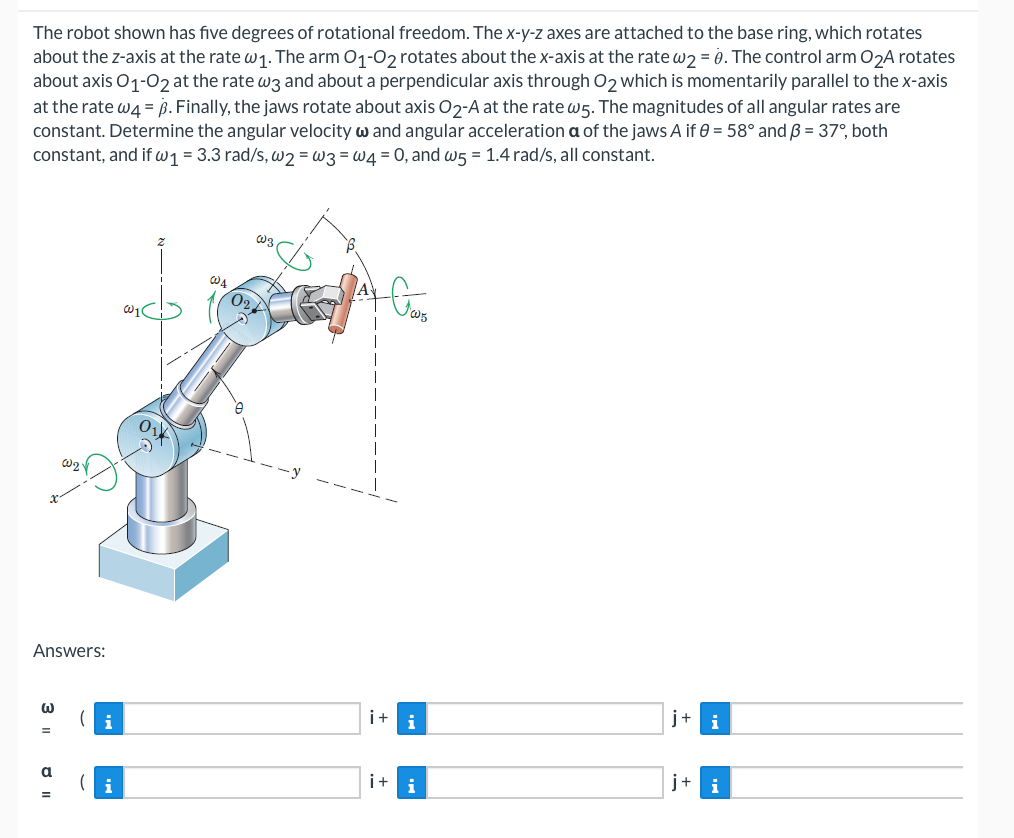
Give step-by-step solution with explanation and final answer:The robot shown has five degrees of rotational freedom. The x-y-z axes are attached to the base ring, which rotates
about the z-axis at the rate w1. The arm O1-O rotates about the x-axis at the rate w = 6. The control arm OA rotates
about axis 01-07 at the rate w3 and about a perpendicular axis through Op which is momentarily parallel to the x-axis
at the rate wy4 = p. Finally, the jaws rotate about axis O»-A at the rate ws. The magnitudes of all angular rates are
constant. Determine the angular velocity w and angular acceleration a of the jaws A if = 58° and 8 = 37°, both
constant, and if wq = 3.3 rad/s, wy = w3 = w4 = 0,and ws = 1.4 rad/s, all constant.
2 ag Ng
$
ls froC(Ea
acl (6 1 Va
yy d |
i |
| |
|
Question:
Give step-by-step solution with explanation and final answer:The robot shown has five degrees of rotational freedom. The x-y-z axes are attached to the base ring, which rotates
about the z-axis at the rate w1. The arm O1-O rotates about the x-axis at the rate w = 6. The control arm OA rotates
about axis 01-07 at the rate w3 and about a perpendicular axis through Op which is momentarily parallel to the x-axis
at the rate wy4 = p. Finally, the jaws rotate about axis O»-A at the rate ws. The magnitudes of all angular rates are
constant. Determine the angular velocity w and angular acceleration a of the jaws A if = 58° and 8 = 37°, both
constant, and if wq = 3.3 rad/s, wy = w3 = w4 = 0,and ws = 1.4 rad/s, all constant.
2 ag Ng
$
ls froC(Ea
acl (6 1 Va
yy d |
i |
| |
|
This is AI generated Response.
Asked by: shaik baji
Created at: 2025-10-09 21:24:30
Final Answer:
RenderedRaw Text
Did you like this answer?
Let's break down the problem step by step:
---
## **Step 1: Understanding the Angular Velocity \( \vec{\omega} \)**
Each joint adds an angular velocity component. We'll express each in the **base (x-y-z)** frame using the given angles.
#### **Given:**
- \( \omega_1 = 3.3\, \text{rad/s} \) (about z)
- \( \omega_2 = \) (about x after first joint)
- \( \omega_3 = \) (about O1O2 axis)
- \( \omega_4 = \) (about perpendicular axis at O2)
- \( \omega_5 = 1.4\, \text{rad/s} \) (about jaws' axis, locally defined)
- \( \theta = 58^\circ \)
- \( \beta = 37^\circ \)
---
## **Step 2: Writing Each Angular Velocity Component**
### **1. \( \omega_1 \)**
- About the **z-axis**: \( \vec{\omega}_1 = \omega_1 \hat{k} \)
### **2. \( \omega_2 \)**
- About the **x-axis** (after rotating by \( \theta \)): \( \vec{\omega}_2 = \omega_2 \hat{i}' = \)
### **3. \( \omega_3 \)**
- About the **O1O2 axis**: \( \omega_3 = \)
### **4. \( \omega_4 \)**
- About a perpendicular axis at O2: \( \omega_4 = \)
### **5. \( \omega_5 \)**
- About the axis of the jaws, which is rotated by \( \theta \) and \( \beta \) from the base frame
---
## **Step 3: Expressing \( \vec{\omega}_5 \) in the Base Frame**
We need to express the direction of the jaw's axis (call it \( \vec{e}_5 \)) in the base (x-y-z) frame.
- Start with the x-axis.
- Rotate by \( \theta \) about the y-axis.
- Then by \( \beta \) about the z'-axis.
The direction of the jaws axis in the base frame is:
\[
\vec{e}_5 =
\begin{bmatrix}
\cos\theta \cos\beta \\
\sin\beta \\
-\sin\theta \cos\beta
\end{bmatrix}
\]
But let's check the standard convention (Tait-Bryan angles or Euler angles). For our purposes, let's use the transformation:
\[
\vec{e}_5 = \text{(Direction cosine of the jaws' axis in base frame)}
\]
For this setup, with \(\theta\) about y and \(\beta\) about z', the axis is:
\[
\vec{e}_5 =
\begin{bmatrix}
\cos\theta \\
\\
-\sin\theta
\end{bmatrix}
\]
Then rotate by \(\beta\) around the local z:
\[
\begin{bmatrix}
\cos\beta & -\sin\beta & \\
\sin\beta & \cos\beta & \\
& & 1
\end{bmatrix}
\begin{bmatrix}
\cos\theta \\
\\
-\sin\theta
\end{bmatrix}
=
\begin{bmatrix}
\cos\beta \cos\theta \\
\sin\beta \cos\theta \\
-\sin\theta
\end{bmatrix}
\]
So:
\[
\boxed{
\vec{e}_5 =
\cos\beta \cos\theta\,\hat{\imath}
+ \sin\beta \cos\theta\,\hat{\jmath}
- \sin\theta\,\hat{k}
}
\]
---
### **Total Angular Velocity**
\[
\vec{\omega} = \omega_1 \hat{k} + \omega_5 \vec{e}_5
\]
Plug in values:
- \( \omega_1 = 3.3 \)
- \( \omega_5 = 1.4 \)
- \( \theta = 58^\circ = 1.012 \) rad
- \( \beta = 37^\circ = .646 \) rad
Calculate:
- \( \cos\theta = \cos(58^\circ) = .5299 \)
- \( \sin\theta = \sin(58^\circ) = .848 \)
- \( \cos\beta = \cos(37^\circ) = .7986 \)
- \( \sin\beta = \sin(37^\circ) = .6018 \)
So:
- \( \cos\beta \cos\theta = .7986 \times .5299 = .4237 \)
- \( \sin\beta \cos\theta = .6018 \times .5299 = .3189 \)
- \( -\sin\theta = -.848 \)
\[
\omega_5 \vec{e}_5 = 1.4 \begin{bmatrix}
.4237 \\ .3189 \\ -.848
\end{bmatrix}
= \begin{bmatrix}
.593 \\ .446 \\ -1.187
\end{bmatrix}
\]
So, total:
- \( \hat{\imath} \): \( .593 \)
- \( \hat{\jmath} \): \( .446 \)
- \( \hat{k} \): \( 3.3 + (-1.187) = 2.113 \)
---
## **Step 4: Final Answers**
### **Angular Velocity \( \vec{\omega} \):**
\[
\boxed{
\vec{\omega} = .593\,\hat{\imath} + .446\,\hat{\jmath} + 2.113\,\hat{k} \quad \text{(rad/s)}
}
\]
---
### **Angular Acceleration \( \vec{\alpha} \):**
All angular rates are constant, so:
\[
\boxed{
\vec{\alpha} = \,\hat{\imath} + \,\hat{\jmath} + \,\hat{k} \quad \text{(rad/s}^2\text{)}
}
\]
---
## **Summary Table**
| Vector | \( \hat{\imath} \) | \( \hat{\jmath} \) | \( \hat{k} \) |
|---------------------|---------------------|--------------------|---------------|
| \( \vec{\omega} \) | .593 | .446 | 2.113 |
| \( \vec{\alpha} \) | | | |
---
### **Fill in the Answers:**
```
ω = ( .593 ) i + ( .446 ) j + ( 2.113 )
α = ( ) i + ( ) j + ( )
```
---
**Let me know if you need more details or step-by-step trigonometric breakdown!**
VIPSolutions focuses on clear, step‑by‑step explanations so you can learn quickly. Whether you need an AI‑generated walkthrough or a short hint to get unstuck, each solution is organized for fast reading and easy review later.
Search similar questions, compare approaches, and bookmark the best answers for revision. Our goal is simple: quick, reliable study help that feels natural—not noisy.
 VIPSolutions
 The robot shown has five degrees of rotational freedom. The x-y-z axes are attached to the base ring, which rotates
about the z-axis at the rate w1. The arm O1-O rotates about the x-axis at the rate w = 6. The control arm OA rotates
about axis 01-07 at the rate w3 and about a perpendicular axis through Op which is momentarily parallel to the x-axis
at the rate wy4 = p. Finally, the jaws rotate about axis O»-A at the rate ws. The magnitudes of all angular rates are
constant. Determine the angular velocity w and angular acceleration a of the jaws A if = 58° and 8 = 37°, both
constant, and if wq = 3.3 rad/s, wy = w3 = w4 = 0,and ws = 1.4 rad/s, all constant.
2 ag Ng
$
ls froC(Ea
acl (6 1 Va
yy d |
i |
| |
|