 VIPSolutions
Give step-by-step solution with explanation and final answer:Problem 2. (Mask 25 Pe Copp ma pl, kf fr mm RS Tyan on 1 prove = — ger
Question:
Give step-by-step solution with explanation and final answer: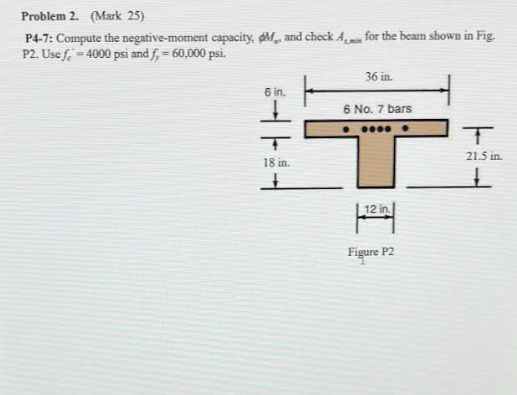 Problem 2. (Mask 25
Pe Copp ma pl, kf fr mm
RS Tyan
on
1
prove
= —
ger
This is AI generated Response.
Asked by: naveen
Created at: 2025-10-09 06:17:41
Asked by: naveen
Created at: 2025-10-09 06:17:41
Final Answer:
Rendered
Raw Text
Did you like this answer?
Let's solve the problem step by step:
---
## **Given Data**
- **Beam Section**: T-beam (see figure)
- **Concrete Strength, \( f'_c \) = 400 psi**
- **Steel Yield Strength, \( f_y \) = 60,000 psi**
- **Top Flange Width, \( b_f \) = 36 in**
- **Flange Thickness, \( t_f \) = 6 in**
- **Web Width, \( b_w \) = 12 in**
- **Overall Depth, \( h \) = 21.5 in**
- **Distance to centroid of steel, \( d \) = 21.5 in**
- **Number and Size of Bars**: 6 No. 7 bars (No. 7 bar area \( = .6 \) in² per bar)
- **Total Area of Steel, \( A_s \) = \( 6 \times .6 = 3.6 \) in²**
---
## **Step 1: Calculate the Effective Depth (\( d \))**
The centroid of the tension reinforcement is at 21.5 in from the top.
---
## **Step 2: Check If Compression Block is in Flange or Web**
\[ a = \frac{A_s f_y}{.85 f'_c b} \]
But first, assume the neutral axis is in the flange. The maximum depth of compression block that can fit in the flange is:
\[ a_{flange} = t_f = 6 \text{ in} \]
Calculate \( a \):
\[
a = \frac{A_s f_y}{.85 f'_c b_f}
\]
\[
a = \frac{3.6 \times 60,000}{.85 \times 4,000 \times 36}
\]
\[
a = \frac{216,000}{122,400}
\]
\[
a = 1.77 \text{ in} < 6 \text{ in}
\]
So the compression block is **entirely in the flange**.
---
## **Step 3: Calculate \( \phi M_n \) (Negative Moment Capacity)**
- \( \beta_1 \) for \( f'_c = 400 \) psi: \( \beta_1 = .85 \) (ACI Table)
### **a. Calculate \( c \) (neutral axis depth):**
\[
a = \beta_1 c \implies c = \frac{a}{\beta_1} = \frac{1.77}{.85} = 2.08 \text{ in}
\]
### **b. Calculate Nominal Moment Strength \( M_n \):**
\[
M_n = A_s f_y \left[d - a/2\right]
\]
\[
M_n = 3.6 \times 60,000 \left[21.5 - \frac{1.77}{2}\right]
\]
\[
= 216,000 \left[21.5 - .885\right]
\]
\[
= 216,000 \times 20.615
\]
\[
= 4,456,840 \text{ in-lb}
\]
Convert to ft-lb (divide by 12):
\[
M_n = \frac{4,456,840}{12} = 371,403 \text{ ft-lb}
\]
Or to ft-kip (divide by 12,000):
\[
M_n = \frac{4,456,840}{12,000} = 371.4 \text{ ft-kip}
\]
### **c. Apply Strength Reduction Factor (\( \phi \)):**
For flexure, \( \phi = .9 \):
\[
\phi M_n = .9 \times 371.4 = 334.3 \text{ ft-kip}
\]
---
## **Step 4: Check \( A_{s, min} \) (Minimum Steel Area)**
\[
A_{s, min} = \text{max} \left[ 3 \sqrt{f'_c} b_w d / f_y, \; 200 b_w d / f_y \right]
\]
- \( b_w = 12 \) in
- \( d = 21.5 \) in
- \( f'_c = 400 \) psi
- \( f_y = 60,000 \) psi
Calculate both:
### **a.**
\[
3 \sqrt{400} \times 12 \times 21.5 / 60,000
\]
\[
= 3 \times 63.25 \times 12 \times 21.5 / 60,000
\]
\[
= 189.75 \times 12 \times 21.5 / 60,000
\]
\[
= 2,277 \times 21.5 / 60,000
\]
\[
= 48,955.5 / 60,000 = .816 \text{ in}^2
\]
### **b.**
\[
200 \times 12 \times 21.5 / 60,000
\]
\[
= 2,400 \times 21.5 / 60,000
\]
\[
= 51,600 / 60,000 = .86 \text{ in}^2
\]
So, use the maximum:
\[
A_{s, min} = .86 \text{ in}^2
\]
Available \( A_s = 3.6 \) in² \( > .86 \) in² → **OK**
---
## **Summary of Answers**
### **1. Negative-Moment Capacity**
\[
\boxed{\phi M_n = 334.3 \text{ ft-kip}}
\]
### **2. Minimum Steel Area Required**
\[
\boxed{A_{s, min} = .86 \text{ in}^2}
\]
### **3. Provided Steel Area**
\[
A_s = 3.6 \text{ in}^2 \text{ (OK, greater than } A_{s, min})
\]
---
### **Explanation**
- The compression block is fully within the flange (since \( a < t_f \)).
- The negative moment capacity is computed using the flexural strength formula for singly-reinforced sections.
- Minimum steel area is checked using ACI requirements, and the section is adequately reinforced.
---
**If you need a detailed sketch or have further sub-questions, let me know!**
📢 Instructions:
- Ask anything relatd to above question only.
- For new Question goto :