 VIPSolutions
Give step-by-step solution with explanation and final answer:Q1)A conical body is made to rotate at a constant speed of ®=42 rad/sec. A film of oil having a viscosity of p=0.1 (Pa.s) seperates the cone from the container. The film thickness is t=0.025 cm. What torque is required to maintain this motion? The cone radius at the base, R=10 cm and cone has a length of h=30 cm. o 7 7 ny \% h oil tI rR
Question:
Give step-by-step solution with explanation and final answer: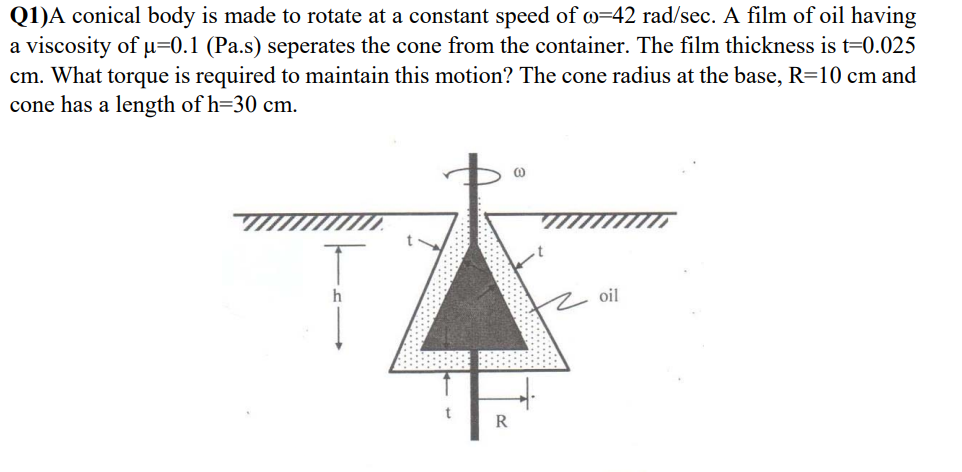 Q1)A conical body is made to rotate at a constant speed of ®=42 rad/sec. A film of oil having
a viscosity of p=0.1 (Pa.s) seperates the cone from the container. The film thickness is t=0.025
cm. What torque is required to maintain this motion? The cone radius at the base, R=10 cm and
cone has a length of h=30 cm.
o
7 7
ny \%
h oil
tI rR
This is AI generated Response.
Asked by: Veera manikanta
Created at: 2025-10-09 02:15:15
Asked by: Veera manikanta
Created at: 2025-10-09 02:15:15
Final Answer:
Rendered
Raw Text
Did you like this answer?
Let's solve the problem step by step.
---
## **Given Data**
- **Angular speed,** \( \omega = 42 \) rad/s
- **Viscosity,** \( \mu = .1 \) Pa·s
- **Film thickness,** \( t = .025 \) cm = \( .00025 \) m
- **Base radius of cone,** \( R = 10 \) cm = \( .1 \) m
- **Length of cone,** \( h = 30 \) cm = \( .3 \) m
---
## **Step 1: Velocity Gradient and Shear Stress**
The oil film thickness \( t \) is very small. Assuming the cone rotates and the oil film causes viscous drag:
**Velocity at distance \( r \) from the axis:**
\[
v = \omega r
\]
**Velocity gradient:**
\[
\frac{dv}{dy} \approx \frac{\omega r}{t}
\]
**Shear stress:**
\[
\tau = \mu \frac{dv}{dy} = \mu \frac{\omega r}{t}
\]
---
## **Step 2: Area Element**
Take a thin ring at distance \( r \) from the axis, width \( dr \):
- **Slant height:** \( h \)
- **Corresponding arc length for a full revolution:** \( 2\pi r \)
**Area of ring on slant surface:**
\[
dA = 2\pi r \cdot dl
\]
where \( dl \) is the width along the slant.
**From the cone geometry:**
\[
\frac{r}{R} = \frac{l}{h} \implies dl = \frac{h}{R} dr
\]
So:
\[
dA = 2\pi r \left(\frac{h}{R}\right) dr
\]
---
## **Step 3: Differential Force and Torque**
**Differential force:**
\[
dF = \tau \cdot dA = \mu \frac{\omega r}{t} \cdot 2\pi r \frac{h}{R} dr
= 2\pi \mu \frac{\omega h}{t R} r^2 dr
\]
**Differential torque:**
\[
dT = dF \cdot r = 2\pi \mu \frac{\omega h}{t R} r^3 dr
\]
---
## **Step 4: Total Torque**
Integrate from \( r = \) to \( r = R \):
\[
T = \int_^R 2\pi \mu \frac{\omega h}{t R} r^3 dr
\]
\[
T = 2\pi \mu \frac{\omega h}{t R} \int_^R r^3 dr
\]
\[
\int_^R r^3 dr = \frac{R^4}{4}
\]
So,
\[
T = 2\pi \mu \frac{\omega h}{t R} \cdot \frac{R^4}{4}
= \frac{\pi}{2} \frac{\mu \omega h R^3}{t}
\]
---
## **Step 5: Plug in the Values**
- \( \mu = .1 \) Pa·s
- \( \omega = 42 \) rad/s
- \( h = .3 \) m
- \( R = .1 \) m
- \( t = .00025 \) m
\[
T = \frac{\pi}{2} \cdot \frac{.1 \cdot 42 \cdot .3 \cdot (.1)^3}{.00025}
\]
First, calculate \( (.1)^3 = .001 \).
\[
T = \frac{\pi}{2} \cdot \frac{.1 \cdot 42 \cdot .3 \cdot .001}{.00025}
\]
\[
= \frac{\pi}{2} \cdot \frac{.00126}{.00025}
\]
\[
= \frac{\pi}{2} \cdot 5.04
\]
\[
= 1.57 \cdot 5.04 \approx 7.92 \text{ Nm}
\]
---
## **Final Answer**
\[
\boxed{T \approx 7.92 \ \text{Nm}}
\]
**This is the torque required to maintain the motion.**
📢 Instructions:
- Ask anything relatd to above question only.
- For new Question goto :