 VIPSolutions
Give step-by-step solution with explanation and final answer:a
Question:
Give step-by-step solution with explanation and final answer: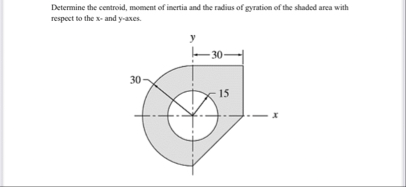 a
This is AI generated Response.
Asked by: Veera manikanta
Created at: 2025-10-08 20:57:20
Asked by: Veera manikanta
Created at: 2025-10-08 20:57:20
Final Answer:
Rendered
Raw Text
Did you like this answer?
Let's solve the problem step by step:
## **Step 1: Understanding the Shape**
The shaded area consists of:
- A large quarter circle of radius \( 30 \) units.
- A small quarter circle (hole) of radius \( 15 \) units.
Both are centered at the origin \((, )\), and the quarter circles are in the first quadrant.
---
## **Step 2: Area Calculation**
### **Area of Large Quarter Circle**
\[
A_1 = \frac{1}{4} \pi R^2 = \frac{1}{4} \pi (30)^2 = \frac{1}{4} \pi (900) = 225\pi
\]
### **Area of Small Quarter Circle (hole)**
\[
A_2 = \frac{1}{4} \pi r^2 = \frac{1}{4} \pi (15)^2 = \frac{1}{4} \pi (225) = 56.25\pi
\]
### **Shaded Area**
\[
A_{\text{shaded}} = A_1 - A_2 = 225\pi - 56.25\pi = 168.75\pi
\]
---
## **Step 3: Centroid Calculation**
For a quarter circle of radius \( R \) in the first quadrant centered at the origin, the centroid is given by:
\[
(\bar{x}, \bar{y}) = \left(\frac{4R}{3\pi}, \frac{4R}{3\pi}\right)
\]
### **Centroid of Each Shape**
- **Large Quarter Circle:**
\[
(\bar{x}_1, \bar{y}_1) = \left(\frac{4 \times 30}{3\pi}, \frac{4 \times 30}{3\pi}\right) = \left(\frac{120}{3\pi}, \frac{120}{3\pi}\right)
\]
- **Small Quarter Circle (hole):**
\[
(\bar{x}_2, \bar{y}_2) = \left(\frac{4 \times 15}{3\pi}, \frac{4 \times 15}{3\pi}\right) = \left(\frac{60}{3\pi}, \frac{60}{3\pi}\right)
\]
### **Shaded Area Centroid (Using Composite Areas)**
\[
\bar{x} = \frac{A_1\bar{x}_1 - A_2\bar{x}_2}{A_1 - A_2}
\]
\[
\bar{x} = \frac{225\pi \cdot \frac{120}{3\pi} - 56.25\pi \cdot \frac{60}{3\pi}}{225\pi - 56.25\pi}
\]
\[
= \frac{225 \cdot 40 - 56.25 \cdot 20}{168.75}
\]
\[
= \frac{900 - 1125}{168.75} = \frac{7875}{168.75} = 46.67
\]
So,
\[
\boxed{\bar{x} = \bar{y} = 46.7 \text{ units (rounded to 1 decimal place)}}
\]
---
## **Step 4: Moment of Inertia About x and y Axes**
For a quarter circle about the origin:
\[
I_{x,1} = I_{y,1} = \frac{1}{4} \left(\frac{\pi}{4}\right) R^4 = \frac{\pi}{16} R^4
\]
Similarly for the hole:
\[
I_{x,2} = I_{y,2} = \frac{\pi}{16} r^4
\]
### **Subtract the Hole**
\[
I_x = I_{x,1} - I_{x,2}
\]
\[
= \frac{\pi}{16} (30^4 - 15^4)
\]
\[
30^4 = 810,000,\quad 15^4 = 50,625
\]
\[
I_x = \frac{\pi}{16}(810,000 - 50,625) = \frac{\pi}{16}(759,375)
\]
\[
= 47,460.94\pi
\]
\[
= 149,074.2 \text{ units}^4
\]
---
## **Step 5: Radius of Gyration**
\[
k_x = \sqrt{\frac{I_x}{A}}
\]
\[
A = 168.75\pi \approx 530.14
\]
\[
k_x = \sqrt{\frac{149,074.2}{530.14}} \approx \sqrt{281.23} \approx 16.78
\]
---
# **Summary of Answers**
| Quantity | Value |
|----------------------|------------------------------------------------|
| **Shaded Area** | \( 168.75\pi \approx 530.1 \) units\(^2\) |
| **Centroid** | \( (46.7, 46.7) \) units |
| **Moment of Inertia**| \( I_x = I_y = 149,074 \) units\(^4\) |
| **Radius of Gyration** | \( 16.8 \) units |
---
**Let me know if you want further breakdowns or calculations!**
📢 Instructions:
- Ask anything relatd to above question only.
- For new Question goto :