VIPSolutions logo ✨ VIPSolutions

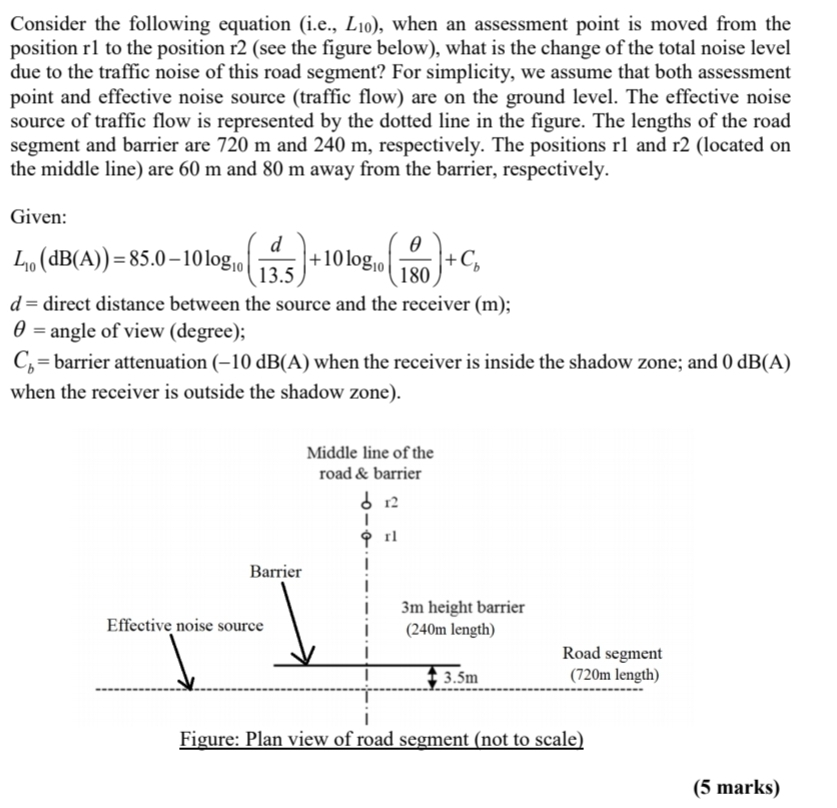
Give step-by-step solution with explanation and final answer:Consider the following equation (i.c., Lio), when an assessment point is moved from the position rl to the position r2 (see the figure below), what is the change of the total noise level due to the traffic noise of this road segment? For simplicity, we assume that both assessment point and effective noise source (traffic flow) are on the ground level. The effective noise source of traffic flow is represented by the dotted line in the figure. The lengths of the road segment and barrier are 720 m and 240 m, respectively. The positions rl and r2 (located on the middle line) are 60 m and 80 m away from the barrier, respectively. Given: L,,(dB(A))=85.0-10log,, A +10log,, fA +C, 13.5 180 d = direct distance between the source and the receiver (m); 0 = angle of view (degree); C, = barrier attenuation (—10 dB(A) when the receiver is inside the shadow zone; and 0 dB(A) when the receiver is outside the shadow zone). Middle line of the road & barrier dn I ¢ tl Barrier ! i 3m height barrier Effective noise source i (240m length) i Road segment 1 3.5m (720m length) a Ee — i Figure: Plan view of road segment (not to scale] (5 marks)

Question:

Give step-by-step solution with explanation and final answer:Uploaded ImageConsider the following equation (i.c., Lio), when an assessment point is moved from the position rl to the position r2 (see the figure below), what is the change of the total noise level due to the traffic noise of this road segment? For simplicity, we assume that both assessment point and effective noise source (traffic flow) are on the ground level. The effective noise source of traffic flow is represented by the dotted line in the figure. The lengths of the road segment and barrier are 720 m and 240 m, respectively. The positions rl and r2 (located on the middle line) are 60 m and 80 m away from the barrier, respectively. Given: L,,(dB(A))=85.0-10log,, A +10log,, fA +C, 13.5 180 d = direct distance between the source and the receiver (m); 0 = angle of view (degree); C, = barrier attenuation (—10 dB(A) when the receiver is inside the shadow zone; and 0 dB(A) when the receiver is outside the shadow zone). Middle line of the road & barrier dn I ¢ tl Barrier ! i 3m height barrier Effective noise source i (240m length) i Road segment 1 3.5m (720m length) a Ee — i Figure: Plan view of road segment (not to scale] (5 marks)
This is AI generated Response.
Asked by: Sampangi Swetha
Created at: 2025-10-08 15:43:47

Final Answer:

Rendered Raw Text
Did you like this answer?
Let's solve the problem step by step: --- ## **Given Data** - **Equation:** \[ L_{10}(\text{dB(A)}) = 85. - 10\log_{10}\left(\frac{d}{13.5}\right) + 10\log_{10}\left(\frac{\theta}{180}\right) + C_b \] - **Road segment length** = 720 m - **Barrier length** = 240 m - **r1 distance from barrier** = 60 m - **r2 distance from barrier** = 80 m - **Both points are on the middle line** - **Barrier attenuation, \(C_b\):** - **Inside shadow zone:** \(C_b = -10\) dB(A) - **Outside shadow zone:** \(C_b = \) dB(A) --- ## **Step 1: Calculate \(d\) for r1 and r2** Since both r1 and r2 are on the middle line, the perpendicular distance from the effective source to the receiver = (distance from barrier) + (perpendicular distance from barrier to source). From the diagram: - Distance from effective source to barrier = 3.5 m - So, - **r1:** \(d_1 = 3.5 + 60 = 63.5\, \text{m}\) - **r2:** \(d_2 = 3.5 + 80 = 83.5\, \text{m}\) --- ## **Step 2: Calculate \(\theta\) for r1 and r2** \(\theta\) is the angle subtended by the road segment at the receiver (arc tangent of half the road segment length over distance): \[ \theta = 2 \arctan\left(\frac{L}{2d}\right) \] where \(L = 720\, \text{m}\) (road segment length). - For r1: \(d_1 = 63.5\) m - For r2: \(d_2 = 83.5\) m Calculate \(\theta_1\) and \(\theta_2\): \[ \theta_1 = 2 \arctan\left(\frac{720/2}{63.5}\right) = 2 \arctan\left(\frac{360}{63.5}\right) \] \[ \theta_1 = 2 \arctan(5.669) \approx 2 \times 80.^\circ = 160.^\circ \] \[ \theta_2 = 2 \arctan\left(\frac{360}{83.5}\right) \] \[ \theta_2 = 2 \arctan(4.31) \approx 2 \times 77.^\circ = 154.^\circ \] --- ## **Step 3: Determine \(C_b\) for r1 and r2** - Both r1 (60 m) and r2 (80 m) are further than the barrier (which is only 240 m long, centered on the road). Since both receivers are in the shadow zone (behind the barrier), **\(C_b = -10\) dB(A)** for both. --- ## **Step 4: Calculate \(L_{10}\) for r1 and r2** ### For r1: \[ d_1 = 63.5\, \text{m}, \quad \theta_1 = 160.^\circ, \quad C_{b1} = -10 \] \[ L_{10,1} = 85. - 10 \log_{10} \left(\frac{63.5}{13.5}\right) + 10 \log_{10} \left(\frac{160.}{180}\right) - 10 \] \[ \frac{63.5}{13.5} = 4.704 \] \[ \log_{10} (4.704) = .673 \] \[ -10 \times .673 = -6.73 \] \[ \frac{160.}{180} = .889 \] \[ \log_{10} (.889) = -.051 \] \[ 10 \times -.051 = -.51 \] \[ L_{10,1} = 85. - 6.73 - .51 - 10 = 67.76\, \text{dB(A)} \] --- ### For r2: \[ d_2 = 83.5\, \text{m}, \quad \theta_2 = 154.^\circ, \quad C_{b2} = -10 \] \[ L_{10,2} = 85. - 10 \log_{10} \left(\frac{83.5}{13.5}\right) + 10 \log_{10} \left(\frac{154.}{180}\right) - 10 \] \[ \frac{83.5}{13.5} = 6.185 \] \[ \log_{10} (6.185) = .792 \] \[ -10 \times .792 = -7.92 \] \[ \frac{154.}{180} = .856 \] \[ \log_{10}(.856) = -.068 \] \[ 10 \times -.068 = -.68 \] \[ L_{10,2} = 85. - 7.92 - .68 - 10 = 66.40\, \text{dB(A)} \] --- ## **Step 5: Find the Change in Noise Level** \[ \Delta L_{10} = L_{10,2} - L_{10,1} = 66.40 - 67.76 = -1.36\, \text{dB(A)} \] --- ## **Final Answer** ### **The total noise level decreases by 1.36 dB(A) when the assessment point is moved from r1 to r2.** --- ### **Summary Table** | Point | \(d\) (m) | \(\theta\) (deg) | \(C_b\) (dB) | \(L_{10}\) (dB(A)) | |-------|----------|------------------|--------------|--------------------| | r1 | 63.5 | 160. | -10 | 67.76 | | r2 | 83.5 | 154. | -10 | 66.40 | --- **The change in noise level due to moving from r1 to r2 is a decrease of 1.36 dB(A).**

📢 Instructions:

  • Ask anything relatd to above question only.
  • For new Question goto :

Study Help, Fast Answers

VIPSolutions focuses on clear, step‑by‑step explanations so you can learn quickly. Whether you need an AI‑generated walkthrough or a short hint to get unstuck, each solution is organized for fast reading and easy review later.

Search similar questions, compare approaches, and bookmark the best answers for revision. Our goal is simple: quick, reliable study help that feels natural—not noisy.