 VIPSolutions
Give step-by-step solution with explanation and final answer:14. Basing their decisions on pessimism as in Example 2, where should (a) Ms. Cooper of Exercise 12 make her reservation; (b) the truck driver of Exercise 13 go first? EXAMPLE | A manufacturer of leather goods must decide whether to expand his plant capacity now or wait at least another year. His advisors tell him that if he expands now and economic conditions remain good, there will be a profit of $164,000 during the next fiscal year; if he expands now and there is a recession, there will be a loss of $40,000; if he waits at least another year and economic conditions remain good, there will be a profit of $80,000; and if he waits at least another year and there is a recession, there will be a small profit of $8,000. What should the manufacturer decide to do if he wants to minimize the expected loss during the next fiscal year and he feels that the odds are 2 to 1 that there will be a recession? EXAMPLE 2 With reference to Example 1, suppose that the manufacturer has no idea about the odds that there will be a recession. What should he decide to do if he is a con- firmed pessimist? Solution Being the kind of person who always expects the worst to happen, he might argue that if he expands his plant capacity now he could lose $40,000, if he delays expan- sion there would be a profit of at least $8,000 and, hence, that he will minimize the maximum loss (or maximize the minimum profit) if he waits at least another year.
Question:
Give step-by-step solution with explanation and final answer: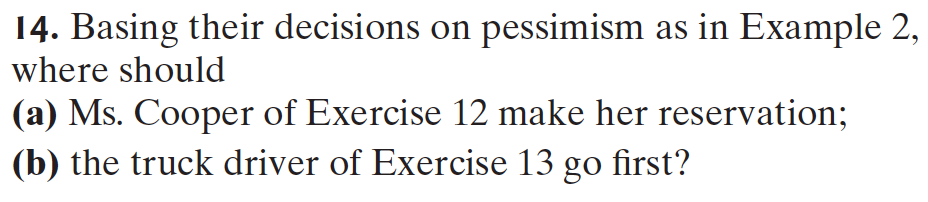
 14. Basing their decisions on pessimism as in Example 2,
where should
(a) Ms. Cooper of Exercise 12 make her reservation;
(b) the truck driver of Exercise 13 go first?
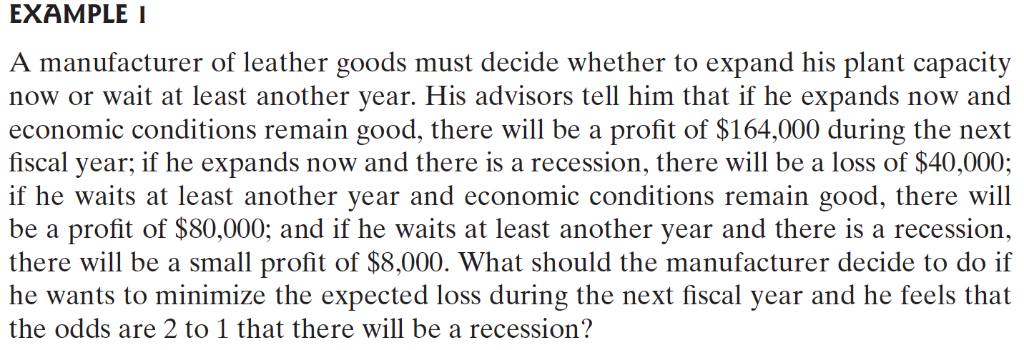
EXAMPLE |
A manufacturer of leather goods must decide whether to expand his plant capacity
now or wait at least another year. His advisors tell him that if he expands now and
economic conditions remain good, there will be a profit of $164,000 during the next
fiscal year; if he expands now and there is a recession, there will be a loss of $40,000;
if he waits at least another year and economic conditions remain good, there will
be a profit of $80,000; and if he waits at least another year and there is a recession,
there will be a small profit of $8,000. What should the manufacturer decide to do if
he wants to minimize the expected loss during the next fiscal year and he feels that
the odds are 2 to 1 that there will be a recession?
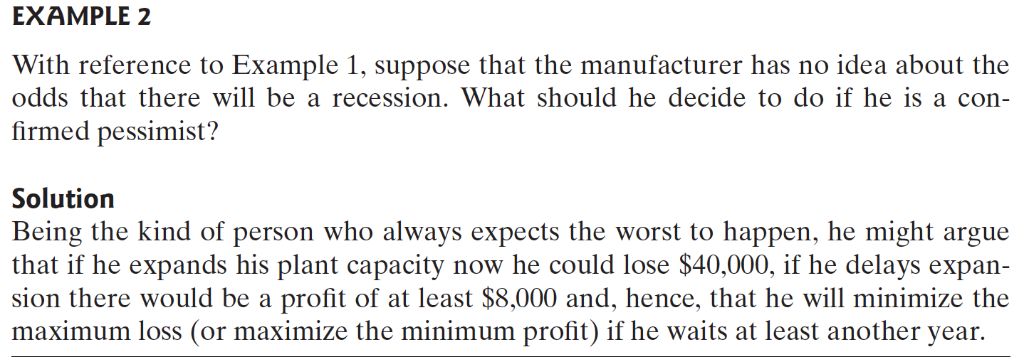
EXAMPLE 2
With reference to Example 1, suppose that the manufacturer has no idea about the
odds that there will be a recession. What should he decide to do if he is a con-
firmed pessimist?
Solution
Being the kind of person who always expects the worst to happen, he might argue
that if he expands his plant capacity now he could lose $40,000, if he delays expan-
sion there would be a profit of at least $8,000 and, hence, that he will minimize the
maximum loss (or maximize the minimum profit) if he waits at least another year.
Asked by: venkatesh
Created at: 2025-10-06 11:46:30
Final Answer:
📢 Instructions:
- Ask anything relatd to above question only.
- For new Question goto :