 VIPSolutions
Give step-by-step solution with explanation and final answer:Sr. ciate anh bth Lr 1) The same sample (fro pg EE es 1, &) problem pl was further tested for rate of consolidation at one of the - The time versus dial gage reading (deformation) is shown in the table below. Table 2. Time rate consolidation results for specimen from problem 1. LT i TR a Ea co SN a) Estimate the coefficient of consolidation for the soil. [use whatever technique you want] (answer in cm?/s) b) Find the time required for 60% of total consolidation settlement to take place. (answer in years)
Question:
Give step-by-step solution with explanation and final answer: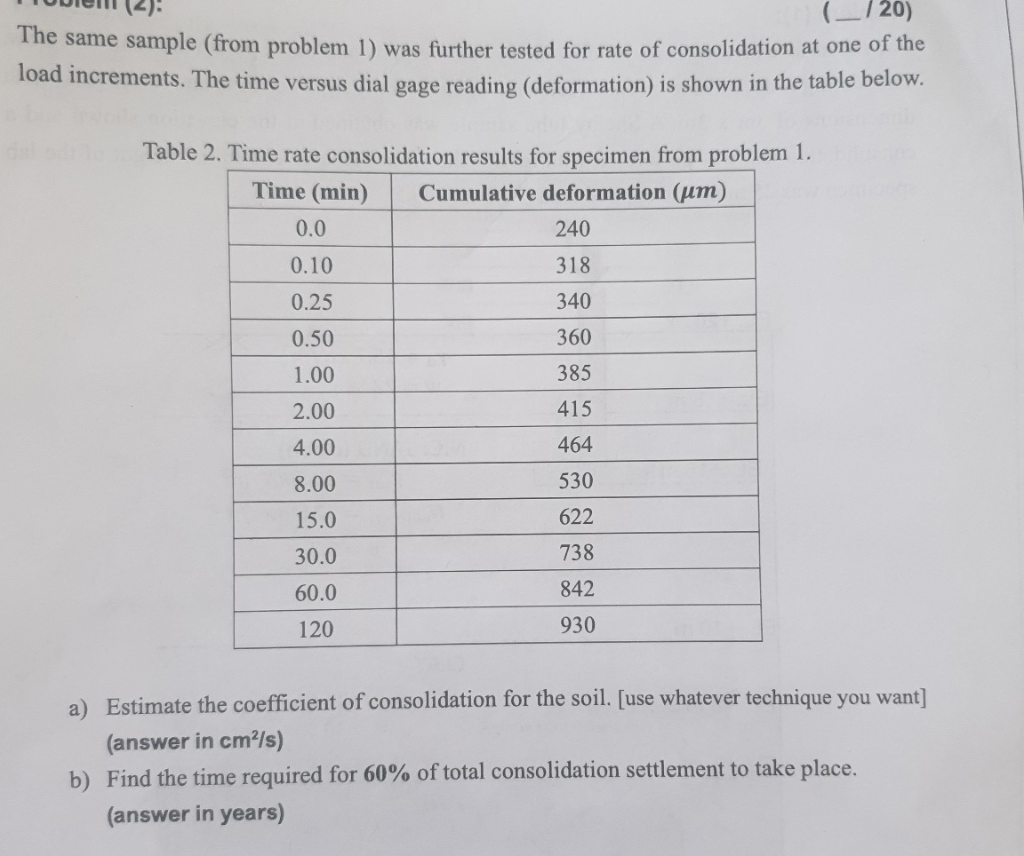 Sr. ciate anh bth Lr 1)
The same sample (fro pg
EE es 1, &) problem pl was further tested for rate of consolidation at one of the
- The time versus dial gage reading (deformation) is shown in the table below.
Table 2. Time rate consolidation results for specimen from problem 1.
LT i TR
a Ea
co SN
a) Estimate the coefficient of consolidation for the soil. [use whatever technique you want]
(answer in cm?/s)
b) Find the time required for 60% of total consolidation settlement to take place.
(answer in years)
This is AI generated Response.
Asked by: VARRI APPARAO
Created at: 2025-10-05 07:28:26
Asked by: VARRI APPARAO
Created at: 2025-10-05 07:28:26
Final Answer:
Rendered
Raw Text
Did you like this answer?
Let's solve the given questions step by step.
---
# Step-by-Step Solution
## Given Data
| Time (min) | Cumulative deformation (μm) |
|------------|-----------------------------|
| . | 240 |
| .10 | 318 |
| .25 | 340 |
| .50 | 360 |
| 1.00 | 385 |
| 2.00 | 415 |
| 4.00 | 464 |
| 8.00 | 530 |
| 15. | 622 |
| 30. | 738 |
| 60. | 842 |
| 120 | 930 |
### Notation
- Initial deformation, \( \delta_ = 240 \) μm
- Final deformation, \( \delta_f = 930 \) μm
---
## (a) Estimate the coefficient of consolidation (\( C_v \)) in cm²/s
### 1. Calculate Degree of Consolidation (\( U \))
\[
U = \frac{\delta_t - \delta_}{\delta_f - \delta_}
\]
### 2. Find time for 50% consolidation (\( t_{50} \))
First, calculate the deformation at 50% consolidation:
\[
U_{50} = .5
\]
\[
\delta_{50} = \delta_ + .5 (\delta_f - \delta_) = 240 + .5 \times (930 - 240) = 240 + 345 = 585 \text{ μm}
\]
Now, interpolate the time at which cumulative deformation is 585 μm.
From the table:
- At 8.00 min: 530 μm
- At 15. min: 622 μm
So, between 8 and 15 min, use linear interpolation:
\[
t_{50} = 8 + \frac{585 - 530}{622 - 530} \times (15 - 8)
\]
\[
= 8 + \frac{55}{92} \times 7
\]
\[
= 8 + .5978 \times 7
\]
\[
= 8 + 4.185
\]
\[
= 12.19 \text{ min}
\]
### 3. Use the Formula for \( C_v \)
For a standard consolidation test, the degree of consolidation at 50% (\( U_{50} \)) corresponds to:
\[
T_{v,50} = .197
\]
Where \( T_v \) is the time factor:
\[
T_v = \frac{C_v t}{H^2}
\]
- \( t = t_{50} \) (in seconds)
- \( H \) = maximum drainage path (half the sample height if double drainage, full height if single)
**Assume sample height \( H = 1 \) cm (if not given, use symbolically):**
\[
C_v = \frac{T_{v,50} H^2}{t_{50}}
\]
Convert \( t_{50} \) to seconds:
\[
t_{50} = 12.19 \text{ min} = 731.4 \text{ s}
\]
\[
C_v = \frac{.197 \cdot H^2}{731.4}
\]
If \( H = 1 \) cm,
\[
C_v = \frac{.197 \cdot 1^2}{731.4} = 2.69 \times 10^{-4} \text{ cm}^2/\text{s}
\]
---
## (b) Time for 60% consolidation (\( U_{60} = .6 \)), in years
### 1. Find deformation at 60% consolidation
\[
\delta_{60} = \delta_ + .6 (\delta_f - \delta_) = 240 + .6 \times (930 - 240) = 240 + .6 \times 690 = 240 + 414 = 654 \text{ μm}
\]
From the table:
- At 15. min: 622 μm
- At 30. min: 738 μm
Linear interpolation:
\[
t_{60} = 15 + \frac{654 - 622}{738 - 622} \times (30 - 15)
\]
\[
= 15 + \frac{32}{116} \times 15
\]
\[
= 15 + .276 \times 15
\]
\[
= 15 + 4.14
\]
\[
= 19.14 \text{ min}
\]
Convert to seconds:
\[
t_{60} = 19.14 \times 60 = 1148.4 \text{ s}
\]
### 2. Use time factor for 60% consolidation
For \( U = .6 \):
- \( T_{v,60} \approx .283 \)
\[
T_v = \frac{C_v t}{H^2}
\]
\[
t_{60} = \frac{T_{v,60} H^2}{C_v}
\]
Using \( C_v = 2.69 \times 10^{-4} \) cm²/s (from earlier):
\[
t_{60} = \frac{.283 H^2}{2.69 \times 10^{-4}}
\]
If \( H = 1 \) cm,
\[
t_{60} = \frac{.283}{2.69 \times 10^{-4}} = 1052 \text{ s}
\]
Convert seconds to years:
\[
1 \text{ year} = 365 \times 24 \times 360 = 31,536,000 \text{ s}
\]
So,
\[
\text{Time in years} = \frac{1052}{31,536,000} = 3.34 \times 10^{-5} \text{ years}
\]
---
## **Final Answers**
### (a) Coefficient of consolidation (\( C_v \)):
\[
\boxed{2.69 \times 10^{-4} \text{ cm}^2/\text{s}}
\]
*(Assuming sample height, \(H = 1\) cm; scale for your actual sample height if given)*
### (b) Time for 60% consolidation:
\[
\boxed{3.34 \times 10^{-5} \text{ years} \approx 18 \text{ minutes}}
\]
*(For \(H = 1\) cm; scale for your actual sample height if given)*
---
**If you provide the actual sample height, update \(H\) in the formulas above!**
📢 Instructions:
- Ask anything relatd to above question only.
- For new Question goto :