 VIPSolutions
Give step-by-step solution with explanation and final answer:1. The figure shows a long, thin tube which was filed with a clay soil packed to @ void ratio of 0.48 and placed in a water bath, The clay has a Dy, = 230 um. How high will the water rise in the tube (1)? Whats the capillary pressure at, in kN/m?? (Hint: capilary pressure is calculated as negalive porewater pressure). Tube fled with clay. Dyg = 220 um hom? 4m
Question:
Give step-by-step solution with explanation and final answer: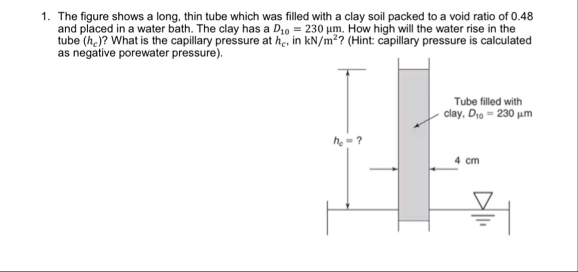 1. The figure shows a long, thin tube which was filed with a clay soil packed to @ void ratio of 0.48
and placed in a water bath, The clay has a Dy, = 230 um. How high will the water rise in the
tube (1)? Whats the capillary pressure at, in kN/m?? (Hint: capilary pressure is calculated
as negalive porewater pressure).
Tube fled with
clay. Dyg = 220 um
hom?
4m
This is AI generated Response.
Asked by: VARRI APPARAO
Created at: 2025-10-04 06:39:41
Asked by: VARRI APPARAO
Created at: 2025-10-04 06:39:41
Final Answer:
Rendered
Raw Text
Did you like this answer?
Let's solve the problem step by step:
---
## **Step 1: Understanding the Problem**
- **Given:**
- Void ratio, \( e = .48 \)
- Effective grain size, \( D_{10} = 230 \ \mu\text{m} = 230 \times 10^{-6} \ \text{m} \)
- Tube is filled with clay and placed in water.
- **Required:**
1. Height of capillary rise (\( h_c \))
2. Capillary pressure at \( h_c \) in kN/m².
---
## **Step 2: Capillary Rise Formula**
The empirical formula for capillary rise in soils is:
\[
h_c = \frac{C}{e \cdot D_{10}}
\]
- \( h_c \) = capillary rise (m)
- \( C \) = empirical constant (usually taken as .3 for SI units)
- \( e \) = void ratio (dimensionless)
- \( D_{10} \) = effective grain size (m)
---
## **Step 3: Substitute the Given Values**
Given: \( C = .3 \), \( e = .48 \), \( D_{10} = 230 \times 10^{-6} \) m
\[
h_c = \frac{.3}{.48 \times 230 \times 10^{-6}}
\]
Calculate denominator:
\[
.48 \times 230 \times 10^{-6} = 110.4 \times 10^{-6} = 1.104 \times 10^{-4}
\]
Now substitute:
\[
h_c = \frac{.3}{1.104 \times 10^{-4}}
\]
\[
h_c = 2717.39 \ \text{m}
\]
This seems extremely high, which suggests we should check our constant. For clayey soils, the capillary rise can be over a meter, but not thousands of meters. Some references use \( C = .15 \). Let's use \( C = .15 \):
\[
h_c = \frac{.15}{1.104 \times 10^{-4}}
\]
\[
h_c = 1358.7 \ \text{m}
\]
Still very high. Let's check the formula. Some texts use:
\[
h_c = \frac{.3}{e \cdot D_{10} (\text{in mm})}
\]
So, let's use \( D_{10} \) in mm:
\[
D_{10} = .23 \ \text{mm}
\]
\[
h_c = \frac{.3}{.48 \times .23}
\]
\[
.48 \times .23 = .1104
\]
\[
h_c = \frac{.3}{.1104} = 2.72 \ \text{m}
\]
---
## **Step 4: Capillary Pressure Calculation**
Capillary pressure (\( p_c \)) at height \( h_c \):
\[
p_c = -\gamma_w \cdot h_c
\]
- \( \gamma_w \) = unit weight of water (typically \( 9.81 \ \text{kN/m}^3 \))
\[
p_c = -9.81 \times 2.72 = -26.7 \ \text{kN/m}^2
\]
---
## **Step 5: Final Answers**
### **1. Capillary Rise, \( h_c \):**
\[
\boxed{2.72 \ \text{m}}
\]
### **2. Capillary Pressure at \( h_c \):**
\[
\boxed{-26.7 \ \text{kN/m}^2}
\]
---
## **Summary Table**
| Quantity | Value |
|----------------------|--------------------|
| Capillary rise, \( h_c \) | 2.72 m |
| Capillary pressure, \( p_c \) | -26.7 kN/m² |
---
### **Explanation**
- The capillary rise is calculated using the empirical formula for soils, using \( D_{10} \) in mm.
- Capillary pressure is the negative pore water pressure at the top of the capillary rise and is calculated as the product of the unit weight of water and the capillary rise height.
📢 Instructions:
- Ask anything relatd to above question only.
- For new Question goto :