 VIPSolutions
Give step-by-step solution with explanation and final answer:4.5.4. If the pressure difference between points 1 and 2 in Figure P4.5.4 is 25 psi. What will be the flowrate? The pipes are galvanized ron with k, = 0.0005 ft. Take v = 1.06 x 10° t/s and neglect minor losses. (8 points) 20001, 8in dia 10in dia 1] 1600 ft, 6 in dia Jo]
Question:
Give step-by-step solution with explanation and final answer: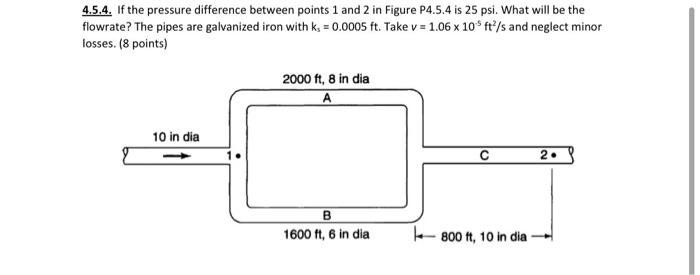 4.5.4. If the pressure difference between points 1 and 2 in Figure P4.5.4 is 25 psi. What will be the
flowrate? The pipes are galvanized ron with k, = 0.0005 ft. Take v = 1.06 x 10° t/s and neglect minor
losses. (8 points)
20001, 8in dia
10in dia 1]
1600 ft, 6 in dia Jo]
This is AI generated Response.
Asked by: VARRI APPARAO
Created at: 2025-10-03 17:57:00
Asked by: VARRI APPARAO
Created at: 2025-10-03 17:57:00
Final Answer:
Rendered
Raw Text
Did you like this answer?
Let's break down the solution step by step.
---
## **Given Data**
- **Pressure difference (ΔP):** 25 psi
- **Pipes are galvanized iron:** \( k_s = .0005 \) ft
- **Kinematic viscosity (\( \nu \)):** \( 1.06 \times 10^{-5} \) ft²/s
- **Neglect minor losses**
- **Pipe layout:**
- 10" dia (inlet, 1 to A)
- 200 ft, 8" dia (A)
- 160 ft, 6" dia (B)
- 800 ft, 10" dia (C to 2)
---
## **Step 1: Convert Pressure Difference to Feet of Water**
\[
\Delta P = 25 \text{ psi} \times \frac{144 \text{ in}^2}{1 \text{ ft}^2} = 360 \text{ psf}
\]
\[
\text{Head difference:}
\]
\[
\Delta h = \frac{\Delta P}{\gamma}
\]
where \( \gamma = 62.4 \) lb/ft³ (unit weight of water)
\[
\Delta h = \frac{25 \times 144}{62.4} = \frac{360}{62.4} = 57.69 \text{ ft}
\]
---
## **Step 2: Identify Flow Path and Equivalent Pipe**
This is a parallel pipe system (A and B are in parallel).
- Path A: 200 ft, 8" dia
- Path B: 160 ft, 6" dia
The total head loss from 1 to 2 is the sum of head losses in the 10" sections and the parallel section (either A or B).
Let \( Q \) = total flowrate, \( Q_A \) = flow in A, \( Q_B \) = flow in B
\[
Q = Q_A + Q_B
\]
---
## **Step 3: Head Loss Equations (Darcy-Weisbach)**
\[
h_f = f \frac{L}{D} \frac{V^2}{2g}
\]
Let’s denote:
- Section 1 (10" inlet): \( L_1 = 10 \) ft, \( D_1 = 10 \) in = .833 ft
- Section A: \( L_A = 200 \) ft, \( D_A = 8 \) in = .667 ft
- Section B: \( L_B = 160 \) ft, \( D_B = 6 \) in = .5 ft
- Section C (10" outlet): \( L_C = 800 \) ft, \( D_C = 10 \) in = .833 ft
---
## **Step 4: Assume Velocity and Flow Variables**
Let \( Q_A \) and \( Q_B \) be the flow rates in pipes A and B. The velocity in each pipe is:
\[
V = \frac{Q}{A}
\]
Where \( A = \frac{\pi}{4} D^2 \)
---
## **Step 5: Head Loss in Each Path**
### **For the 10" pipes (inlet + outlet):**
Total length: \( L_{10} = 10 + 800 = 810 \) ft, \( D_{10} = .833 \) ft
\[
h_{10} = f_{10} \frac{810}{.833} \frac{V_{10}^2}{2g}
\]
### **For the parallel section:**
The head loss through A and B must be equal:
\[
h_A = h_B
\]
\[
h_A = f_A \frac{200}{.667} \frac{V_A^2}{2g}
\]
\[
h_B = f_B \frac{160}{.5} \frac{V_B^2}{2g}
\]
---
## **Step 6: Express Everything in Terms of Q**
Let:
- \( Q = Q_A + Q_B \)
- \( Q_A = V_A \cdot A_A \), \( Q_B = V_B \cdot A_B \)
- \( Q = V_{10} \cdot A_{10} \)
Areas:
- \( A_{10} = \frac{\pi}{4}(.833^2) = .545 \) ft²
- \( A_A = \frac{\pi}{4}(.667^2) = .349 \) ft²
- \( A_B = \frac{\pi}{4}(.5^2) = .196 \) ft²
---
## **Step 7: Find f (Darcy friction factor) for Each Pipe**
First, estimate \( f \) using the Colebrook-White equation (or use Swamee-Jain for practical calculations):
\[
f = .25 \left[ \log_{10}\left( \frac{k_s}{3.7D} + \frac{5.74}{Re^{.9}} \right) \right]^{-2}
\]
where \( Re = \frac{VD}{\nu} \)
This will require iteration because \( f \) depends on velocity, which depends on \( Q \).
---
## **Step 8: Set Up the Equations**
### **Total Head Loss from 1 to 2:**
\[
\Delta h = h_{10} + h_{parallel}
\]
Since the head loss through the parallel pipe is the same for both A and B, and the total flow is distributed:
\[
h_{parallel} = h_A = h_B
\]
\[
\Delta h = f_{10} \frac{810}{.833} \frac{V_{10}^2}{2g} + h_{parallel}
\]
---
## **Step 9: Iterative Solution**
Let's **assume \( f \approx .02 \)** for initial calculations (typical for water in galvanized pipes).
### **Let’s Guess a Total Flow \( Q \) and Iterate**
Let’s denote:
\[
Q = Q_A + Q_B
\]
Let’s try \( Q = 5 \) cfs as a guess.
#### **Find Velocities:**
\[
V_{10} = \frac{Q}{A_{10}} = \frac{5}{.545} = 9.17 \text{ ft/s}
\]
\[
V_A = \frac{Q_A}{A_A}, \quad V_B = \frac{Q_B}{A_B}
\]
#### **Head Loss in Parallel Pipes:**
\[
h_A = f_A \frac{200}{.667} \frac{V_A^2}{2g}
\]
\[
h_B = f_B \frac{160}{.5} \frac{V_B^2}{2g}
\]
Set \( h_A = h_B \):
\[
f_A \frac{200}{.667} \frac{V_A^2}{2g} = f_B \frac{160}{.5} \frac{V_B^2}{2g}
\]
Assuming \( f_A \approx f_B \):
\[
\frac{200}{.667} V_A^2 = \frac{160}{.5} V_B^2
\]
\[
2999 V_A^2 = 320 V_B^2
\]
\[
V_A^2 / V_B^2 = 320 / 2999 \implies V_A / V_B = \sqrt{1.067} = 1.033
\]
But also, \( Q_A + Q_B = Q \):
\[
Q_A = V_A \cdot A_A, \quad Q_B = V_B \cdot A_B
\]
\[
Q = V_A \cdot .349 + V_B \cdot .196
\]
\[
V_A = 1.033 V_B
\]
\[
Q = .349 \times 1.033 V_B + .196 V_B = (.360 + .196)V_B = .556 V_B
\]
\[
V_B = Q / .556
\]
\[
V_A = 1.033 V_B = 1.033 \times Q / .556
\]
For \( Q = 5 \):
\[
V_B = 5 / .556 = 8.99 \text{ ft/s}
\]
\[
V_A = 1.033 \times 8.99 = 9.28 \text{ ft/s}
\]
---
#### **Calculate Head Losses**
##### **In 10" Pipe (inlet + outlet):**
\[
h_{10} = .02 \times \frac{810}{.833} \times \frac{(9.17)^2}{2 \times 32.2}
\]
\[
\frac{810}{.833} = 972.9
\]
\[
(9.17)^2 = 84.08
\]
\[
h_{10} = .02 \times 972.9 \times \frac{84.08}{64.4}
\]
\[
= .02 \times 972.9 \times 1.306
\]
\[
= .02 \times 1271.6 = 25.43 \text{ ft}
\]
##### **In Parallel Path (A or B):**
Let’s use A:
\[
h_A = .02 \times \frac{200}{.667} \times \frac{(9.28)^2}{2 \times 32.2}
\]
\[
\frac{200}{.667} = 2999
\]
\[
(9.28)^2 = 86.14
\]
\[
h_A = .02 \times 2999 \times \frac{86.14}{64.4}
\]
\[
= .02 \times 2999 \times 1.338
\]
\[
= .02 \times 4013.7 = 80.27 \text{ ft}
\]
##### **Total Head Loss:**
\[
h_{total} = h_{10} + h_A = 25.43 + 80.27 = 105.7 \text{ ft}
\]
But the available head is only 57.69 ft.
---
## **Step 10: Adjust Flow Rate and Iterate**
Since calculated \( h_{total} > 57.69 \), our guess for \( Q \) is too high. Try \( Q = 3 \) cfs:
\[
V_{10} = 3 / .545 = 5.5 \text{ ft/s}
\]
\[
V_B = 3 / .556 = 5.4 \text{ ft/s}
\]
\[
V_A = 1.033 \times 5.4 = 5.58 \text{ ft/s}
\]
#### **Head Losses:**
- \( h_{10} = .02 \times 972.9 \times \frac{(5.5)^2}{64.4} = .02 \times 972.9 \times .470 = .02 \times 457.3 = 9.15 \text{ ft} \)
- \( h_A = .02 \times 2999 \times \frac{(5.58)^2}{64.4} = .02 \times 2999 \times .484 = .02 \times 145.7 = 29.01 \text{ ft} \)
- \( h_{total} = 9.15 + 29.01 = 38.16 \text{ ft} \)
Now \( h_{total} < 57.69 \), so \( Q \) can be higher.
Try \( Q = 4 \) cfs:
- \( V_{10} = 4/.545 = 7.34 \text{ ft/s} \)
- \( V_B = 4/.556 = 7.19 \)
- \( V_A = 1.033 \times 7.19 = 7.43 \)
- \( h_{10} = .02 \times 972.9 \times (7.34^2 / 64.4) = .02 \times 972.9 \times .837 = .02 \times 814.4 = 16.29 \)
- \( h_A = .02 \times 2999 \times (7.43^2 / 64.4) = .02 \times 2999 \times .857 = .02 \times 257.7 = 51.41 \)
- \( h_{total} = 16.29 + 51.41 = 67.70 \text{ ft} \)
Now \( h_{total} > 57.69 \), so \( Q \) is between 3 and 4 cfs.
---
## **Step 11: Linear Interpolation**
Let’s interpolate between \( Q = 3 \) (38.16 ft) and \( Q = 4 \) (67.70 ft):
\[
Q = 3 + \frac{57.69 - 38.16}{67.70 - 38.16} \times (4-3)
\]
\[
Q = 3 + \frac{19.53}{
📢 Instructions:
- Ask anything relatd to above question only.
- For new Question goto :