 VIPSolutions
Give step-by-step solution with explanation and final answer:Probl No.1) Compute the moment capacty and ing ura of th beam scton show. Consider fe=300ps. Pe Le & . . 209 > G6 pe
Question:
Give step-by-step solution with explanation and final answer: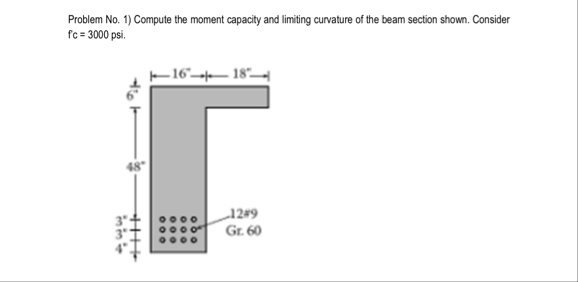 Probl No.1) Compute the moment capacty and ing ura of th beam scton show. Consider
fe=300ps.
Pe Le
&
.
. 209
> G6
pe
This is AI generated Response.
Asked by: VARRI APPARAO
Created at: 2025-10-03 16:20:43
Asked by: VARRI APPARAO
Created at: 2025-10-03 16:20:43
Final Answer:
Rendered
Raw Text
Did you like this answer?
Let's break down the solution for the **T-beam section** as shown:
## **Given Data**
- **Concrete compressive strength,** \( f'_c = 300 \) psi
- **Number of rebars:** 8 bars of No. 9 (\( A_s = 8 \times 1.00 = 8.00 \text{ in}^2 \))
- (Area of No. 9 rebar = 1.00 in²)
- **Yield strength of rebar,** \( f_y = 60,000 \) psi (Grade 60)
- **Dimensions:**
- Flange width, \( b_f = 34 \) in (16 + 18)
- Flange thickness, \( h_f = 6 \) in
- Web width, \( b_w = 16 \) in
- Total height, \( h = 48 \) in
- Distance from top to centroid of rebars, \( d = 48 - 3 - .5 \times 1.128 \approx 44.44 \) in (diameter of #9 bar ≈ 1.128 in)
---
## **Step 1: Calculate Depth to Steel (\(d\))**
- **Effective depth (\( d \)):**
\[
d = 48 - 3 - .5 \times 1.128 \approx 44.44 \text{ in}
\]
---
## **Step 2: Check Flange or Web Controls**
- **Neutral axis depth (\( c \)) will be checked later**. Assume flange is effective (i.e., neutral axis in flange).
---
## **Step 3: Calculate the Ultimate Strength of Concrete**
### **Assume Neutral Axis in Flange**
- **Maximum compressive force in concrete:**
\[
C = .85 f'_c b_f a
\]
where \( a = \beta_1 c \), \( \beta_1 = .85 \) for \( f'_c \leq 400 \) psi.
- **Steel tension:**
\[
T = A_s f_y
\]
\[
T = 8 \times 1.00 \times 60,000 = 480,000 \text{ lbs}
\]
### **Equilibrium: \( T = C \)**
\[
T = .85 f'_c b_f a
\]
\[
480,000 = .85 \times 300 \times 34 \times a
\]
\[
480,000 = 86,700 a
\]
\[
a = \frac{480,000}{86,700} = 5.54 \text{ in}
\]
- **Check if neutral axis is in flange:**
- \( a = 5.54 \) in \( < 6 \) in (flange thickness) → **OK!**
---
## **Step 4: Calculate Neutral Axis Depth (\( c \))**
\[
a = \beta_1 c = .85 c
\]
\[
c = \frac{a}{.85} = \frac{5.54}{.85} = 6.52 \text{ in}
\]
---
## **Step 5: Nominal Moment Capacity (\( M_n \))**
- **Distance from compression resultant to tension resultant:**
\[
\text{Lever arm} = d - \frac{a}{2} = 44.44 - \frac{5.54}{2} = 44.44 - 2.77 = 41.67 \text{ in}
\]
- **Nominal moment:**
\[
M_n = T \times (\text{lever arm})
\]
\[
M_n = 480,000 \times 41.67 = 20,001,600 \text{ in-lb}
\]
\[
M_n = \frac{20,001,600}{12} = 1,666,800 \text{ ft-lb}
\]
\[
M_n = \frac{1,666,800}{12} = 138,900 \text{ ft-kip}
\]
- **Factored moment (\( \phi M_n \)), \( \phi = .9 \) for flexure**
\[
\phi M_n = .9 \times 1,666,800 = 1,500,120 \text{ ft-lb}
\]
\[
\phi M_n = \frac{1,500,120}{12} = 125,010 \text{ ft-kip}
\]
---
## **Step 6: Limiting Curvature (\( \phi \))**
- **Strain in steel at ultimate (\( \epsilon_{su} \)):**
- For tension-controlled section, \( \epsilon_{su} \geq .005 \)
- **Neutral axis depth \( c \):**
\[
\epsilon_{su} = \frac{d-c}{c} \times .003
\]
\[
\epsilon_{su} = \frac{44.44 - 6.52}{6.52} \times .003 = \frac{37.92}{6.52} \times .003 \approx .0174
\]
- **Curvature (\( \phi \)):**
\[
\phi = \frac{\epsilon_{cu}}{c} = \frac{.003}{6.52} = .000460 \text{ in}^{-1}
\]
---
## **Summary of Answers**
### **1. Moment Capacity (\( \phi M_n \)):**
\[
\boxed{1,500,120 \text{ in-lb} \ (\approx 125 \text{ ft-kip})}
\]
### **2. Limiting Curvature (\( \phi \)):**
\[
\boxed{.000460 \text{ in}^{-1}}
\]
---
## **Assumptions/Notes**
- All rebar yields; section is tension-controlled.
- Compression block entirely within the flange.
- Ignore self-weight for this calculation.
- Units are consistent.
If you need a more detailed check for flange/web control or interaction with code provisions, let me know!
📢 Instructions:
- Ask anything relatd to above question only.
- For new Question goto :