 VIPSolutions
Give step-by-step solution with explanation and final answer:ae mea ee a Sen - ~ RAE TY . Eee - al brace has to Withstar Wee: = & 25 pt diagonal brac = EE = BE - a = = a Katey aselouse—— Tm EE a ive Gad of 20k: == = N° - tonfro - = fae EF = = = = x | a 1 = NN Ee EERE See i = 5 = N = tas —— EN = = - = | = = Eo = — FN - B . ~ — meee Ay ww aia Sh Ee — = = = . = = = = | _ = = ER — a 7 - 10 ea sees - = Lie et = = = —
Question:
Give step-by-step solution with explanation and final answer: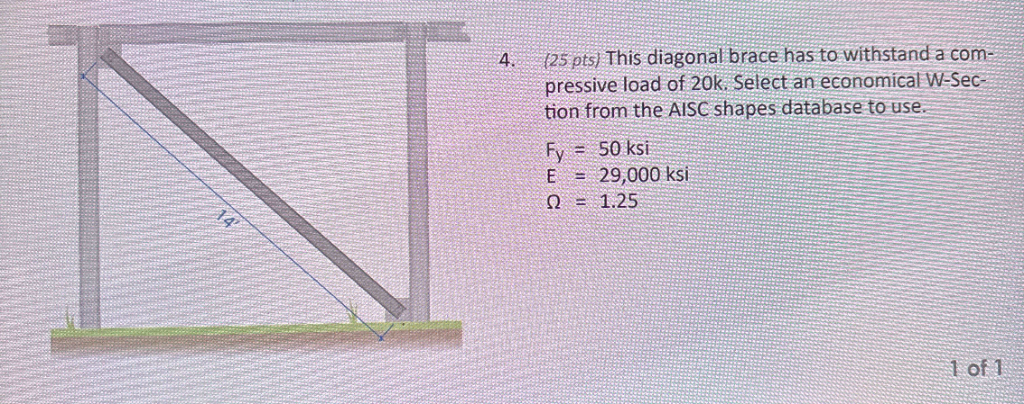 ae mea ee a
Sen - ~
RAE TY .
Eee - al brace has to Withstar Wee:
= & 25 pt diagonal brac =
EE = BE -
a = = a Katey aselouse——
Tm EE a ive Gad of 20k: ==
= N° - tonfro - =
fae EF = =
= = x | a
1 = NN Ee EERE See i = 5
= N = tas ——
EN = = -
= | = = Eo = —
FN - B . ~
— meee Ay ww aia Sh Ee —
= = = .
= = = = | _ =
= ER — a 7 - 10
ea sees -
= Lie et = =
= —
This is AI generated Response.
Asked by: VARRI APPARAO
Created at: 2025-10-03 15:52:05
Asked by: VARRI APPARAO
Created at: 2025-10-03 15:52:05
Final Answer:
Rendered
Raw Text
Did you like this answer?
Let's solve the problem **step by step**:
---
## **Step 1: Problem Summary**
- **Compressive load, \( P_u \) = 20 kips**
- **Yield strength, \( F_y \) = 50 ksi**
- **Modulus of elasticity, \( E \) = 29,000 ksi**
- **Ω (Omega, safety factor) = 1.25**
- **Diagonal brace length: \( L_d \) (not numerically specified, but marked as \( 14' \) in the image)**
We are to **select an economical W-section (wide flange) steel member** that can resist this compressive load per AISC specifications.
---
## **Step 2: Calculate Required Nominal Strength**
The required **nominal compressive strength** (\( P_n \)) considering the safety factor:
\[
P_n = \Omega \cdot P_u = 1.25 \times 20~\text{kips} = 25~\text{kips}
\]
---
## **Step 3: Determine Required Member Properties**
### **3.1. Bracing Length**
The diagonal's length (\( L \)) is given as **14 ft** (from the image).
Convert to inches:
\[
L = 14 \times 12 = 168~\text{in}
\]
### **3.2. Effective Length Factor (\( K \))**
Assume both ends are pinned (typical for bracing):
\[
K = 1.
\]
### **3.3. Required Compressive Strength**
The required **design compressive strength** (\( \phi P_n \)) must be at least \( P_u = 20~\text{kips} \).
But with ASD (using Ω), we've found \( P_n = 25~\text{kips} \).
---
## **Step 4: AISC Compressive Strength Calculation**
### **4.1. Slenderness Ratio (\( \lambda \))**
\[
\lambda = \frac{KL}{r}
\]
where \( r \) = radius of gyration (select the weaker axis for W-shapes, usually \( r_y \)).
Let's start with a **trial section**. We'll check a few common economical W-sections from the AISC tables.
---
## **Step 5: Try a Trial Section**
Let's try **W8x18** (a common small W-section):
From AISC tables:
- Area \( A = 5.29~\text{in}^2 \)
- \( r_y = 1.38~\text{in} \)
\[
\lambda = \frac{KL}{r_y} = \frac{168}{1.38} = 121.74
\]
---
## **Step 6: Calculate Critical Stress \( F_{cr} \)**
The AISC column strength is calculated using:
\[
F_{cr} =
\begin{cases}
.658^{F_y/F_e} F_y & \text{if } \lambda_c \leq 1.5 \\
.877 F_e & \text{if } \lambda_c > 1.5
\end{cases}
\]
Where:
\[
F_e = \frac{\pi^2 E}{(KL/r)^2}
\]
So,
\[
F_e = \frac{\pi^2 \times 29000}{(121.74)^2}
\]
\[
= \frac{286,870}{14,827}
\]
\[
= 19.35~\text{ksi}
\]
Now,
\[
\lambda_c = \sqrt{\frac{F_y}{F_e}} = \sqrt{\frac{50}{19.35}} = 1.61
\]
Since \( \lambda_c > 1.5 \):
\[
F_{cr} = .877 \times 19.35 = 16.97~\text{ksi}
\]
---
## **Step 7: Calculate Nominal Compressive Strength (\( P_n \))**
\[
P_n = F_{cr} \times A = 16.97~\text{ksi} \times 5.29~\text{in}^2 = 89.87~\text{kips}
\]
---
## **Step 8: Compare to Required Strength**
\[
P_n = 89.87~\text{kips} > 25~\text{kips}
\]
So, **W8x18** is more than adequate (even much more than needed).
Let's try a lighter section: **W8x10** (smallest W8):
- \( A = 2.94~\text{in}^2 \)
- \( r_y = .84~\text{in} \)
\[
\lambda = \frac{168}{.84} = 200
\]
\[
F_e = \frac{286,870}{(200)^2} = \frac{286,870}{40,000} = 7.17~\text{ksi}
\]
\[
\lambda_c = \sqrt{\frac{50}{7.17}} = 2.64
\]
\[
F_{cr} = .877 \times 7.17 = 6.29~\text{ksi}
\]
\[
P_n = 6.29 \times 2.94 = 18.48~\text{kips}
\]
This is **less than 25 kips**; so, W8x10 is NOT sufficient.
---
## **Step 9: Try W8x15**
- \( A = 4.41~\text{in}^2 \)
- \( r_y = 1.11~\text{in} \)
\[
\lambda = \frac{168}{1.11} = 151.35
\]
\[
F_e = \frac{286,870}{(151.35)^2} = \frac{286,870}{22,915} = 12.52~\text{ksi}
\]
\[
\lambda_c = \sqrt{\frac{50}{12.52}} = 2.00
\]
\[
F_{cr} = .877 \times 12.52 = 10.97~\text{ksi}
\]
\[
P_n = 10.97 \times 4.41 = 48.39~\text{kips}
\]
This is **well above 25 kips**.
---
## **Step 10: Select the Most Economical Section**
- **W8x10:** Not enough
- **W8x15:** Adequate (48.39 kips > 25 kips)
- **W8x18:** More than enough (over-designed)
**W8x15 is the most economical standard section that meets the requirement.**
---
## **Step 11: Final Answer**
---
### **Final Answer**
\[
\boxed{
\text{Select } \mathbf{W8 \times 15} \text{ as the diagonal brace.}
}
\]
- **It has a nominal compressive strength of 48.4 kips, which is greater than the required 25 kips.**
- **It is the lightest W-shape that satisfies the strength requirement for this bracing member.**
---
If you need to check a lighter section or a different W-shape series, the same steps apply!
📢 Instructions:
- Ask anything relatd to above question only.
- For new Question goto :