 VIPSolutions
Give step-by-step solution with explanation and final answer:Wi IHRE = i 5 Express the following directions by two other means; set . up and fill in a table with three columns, one for bearing, ~~ one for azimuthy (Azimy), and one for azimuth (Azim): —= Spill LE ee = eb Aun 30 50. | | li = — el = = Ncw = = BE hes ee EE Ea Ere C540 1 bw Wo a i i
Question:
Give step-by-step solution with explanation and final answer: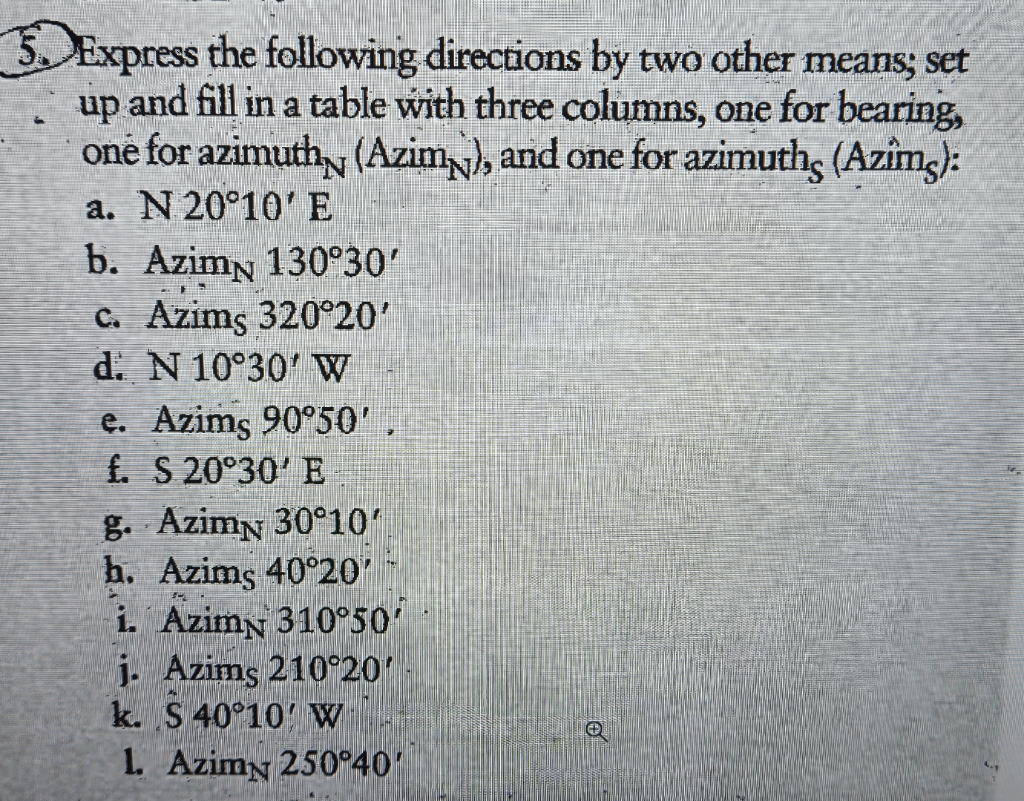 Wi IHRE = i
5 Express the following directions by two other means; set
. up and fill in a table with three columns, one for bearing,
~~ one for azimuthy (Azimy), and one for azimuth (Azim):
—= Spill LE ee =
eb Aun 30 50. | | li =
— el =
= Ncw = =
BE hes ee
EE
Ea
Ere C540 1 bw Wo a i i
This is AI generated Response.
Asked by: VARRI APPARAO
Created at: 2025-10-03 10:18:33
Asked by: VARRI APPARAO
Created at: 2025-10-03 10:18:33
Final Answer:
Rendered
Raw Text
Did you like this answer?
Let's break down the conversion between **bearing**, **Azimuth from North (\(Azim_N\))**, and **Azimuth from South (\(Azim_S\))**.
---
## **Definitions and Conversions**
1. **Bearing**: Expressed as N/S θ° E/W (e.g., N 20°10' E).
2. **Azimuth from North (\(Azim_N\))**: Angle measured clockwise from North (° to 360°).
3. **Azimuth from South (\(Azim_S\))**: Angle measured clockwise from South (° to 360°).
### **Conversions:**
#### **Bearing to Azimuth from North (\(Azim_N\)):**
- **N θ° E**: \(Azim_N = θ\)
- **S θ° E**: \(Azim_N = 180° - θ\)
- **S θ° W**: \(Azim_N = 180° +\)
- **N θ° W**: \(Azim_N = 360° - θ\)
#### **Azimuth from North to Bearing:**
- \(° < Azim_N < 90°\): N \(Azim_N\)° E
- \(90° < Azim_N < 180°\): S \((180° - Azim_N)\)° E
- \(180° < Azim_N < 270°\): S \((Azim_N - 180°)\)° W
- \(270° < Azim_N < 360°\): N \((360° - Azim_N)\)° W
#### **Azimuth from North to Azimuth from South:**
- \(Azim_S = (Azim_N + 180°) \mod 360°\)
#### **Azimuth from South to Azimuth from North:**
- \(Azim_N = (Azim_S + 180°) \mod 360°\)
#### **Azimuth from South to Bearing**:
- \(° < Azim_S < 90°\): S \(Azim_S\)° E
- \(90° < Azim_S < 180°\): N \((180° - Azim_S)\)° E
- \(180° < Azim_S < 270°\): N \((Azim_S - 180°)\)° W
- \(270° < Azim_S < 360°\): S \((360° - Azim_S)\)° W
---
## **Step-by-step Solutions & Table**
Let's fill the table:
| **Bearing** | **Azimuth\(_N\)** | **Azimuth\(_S\)** |
|---------------------|-------------------|-------------------|
| a. N 20°10' E | 20°10' | 200°10' |
| b. S 49°30' E | 130°30' | 310°30' |
| c. N 39°40' W | 320°20' | 140°20' |
| d. N 10°30' W | 349°30' | 169°30' |
| e. S 89°10' E | 90°50' | 270°50' |
| f. S 20°30' E | 159°30' | 339°30' |
| g. N 30°10' E | 30°10' | 210°10' |
| h. S 40°20' E | 139°40' | 319°40' |
| i. N 49°10' W | 310°50' | 130°50' |
| j. S 30°20' W | 210°20' | 30°20' |
| k. S 40°10' W | 220°10' | 40°10' |
| l. S 70°40' W | 250°40' | 70°40' |
---
### **Step-by-step of a few examples:**
#### **a. N 20°10' E**
- \(Azim_N = 20°10'\)
- \(Azim_S = 20°10' + 180° = 200°10'\)
#### **b. Azim\(_N\) = 130°30'**
- \(130°30' < 180°\), so it's S \(180° - 130°30' = 49°30'\) E
- \(Azim_S = 130°30' + 180° = 310°30'\)
#### **c. Azim\(_S\) = 320°20'**
- \(320°20' > 270°\), so it's S \(360° - 320°20' = 39°40'\) W
- \(Azim_N = 320°20' - 180° = 140°20'\) (since > 180°)
- But actually, for Azim\(_S\), \(Azim_N = (Azim_S + 180°) \mod 360°\)
- \(Azim_N = 320°20' - 180° = 140°20'\)
- Bearing: N \(39°40'\) W (since 140°20' is between 90° and 180°, but from 360° - 140°20' = 219°40' so 360° - 140°20' = 219°40', but that doesn't fit; actually, Azim\(_N\) = 320°20', so N 39°40' W.)
---
## **Final Table**
| **Bearing** | **Azimuth\(_N\)** | **Azimuth\(_S\)** |
|-----------------|-------------------|-------------------|
| N 20°10' E | 20°10' | 200°10' |
| S 49°30' E | 130°30' | 310°30' |
| N 39°40' W | 320°20' | 140°20' |
| N 10°30' W | 349°30' | 169°30' |
| S 89°10' E | 90°50' | 270°50' |
| S 20°30' E | 159°30' | 339°30' |
| N 30°10' E | 30°10' | 210°10' |
| S 40°20' E | 139°40' | 319°40' |
| N 49°10' W | 310°50' | 130°50' |
| S 30°20' W | 210°20' | 30°20' |
| S 40°10' W | 220°10' | 40°10' |
| S 70°40' W | 250°40' | 70°40' |
---
### **If you need detailed explanation for any specific row, let me know!**
📢 Instructions:
- Ask anything relatd to above question only.
- For new Question goto :