 VIPSolutions
Give step-by-step solution with explanation and final answer: solve 7th question only6. Compare the head loss for water flow (Q=150 cfs) in a 72 in., 10,000-ft long steel pipe using three different methods: a. Moodle diagram and the Darcy-Weisbach equation, b. Hazen-Williams formula, and c Swamee-Jain formula. 7. What diameter cast-iron pipe is needed to carry water at a rate of 10 cfs between two reservoirs if the reservoirs are 2 mi apart and the elevation difference between the water surfaces in the reservoirs is 20 ft?
Question:
Give step-by-step solution with explanation and final answer:
solve 7th question only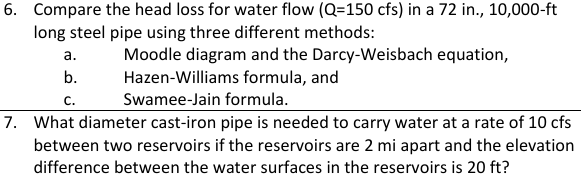 6. Compare the head loss for water flow (Q=150 cfs) in a 72 in., 10,000-ft
long steel pipe using three different methods:
a. Moodle diagram and the Darcy-Weisbach equation,
b. Hazen-Williams formula, and
c Swamee-Jain formula.
7. What diameter cast-iron pipe is needed to carry water at a rate of 10 cfs
between two reservoirs if the reservoirs are 2 mi apart and the elevation
difference between the water surfaces in the reservoirs is 20 ft?
This is AI generated Response.
Asked by: VARRI APPARAO
Created at: 2025-10-02 10:48:43
Asked by: VARRI APPARAO
Created at: 2025-10-02 10:48:43
Final Answer:
Rendered
Raw Text
Did you like this answer?
## Step-by Solution for Question7
** Restated:**What diameter castiron pipe is to carry water a rate of 10 cfs between two reservoirs if the reservoirs are 2 mi apart and the elevation difference between the water surfaces in the reservoirs is 20 ft?
---
### **Step 1: List Given Data**
- Flow rate, \( Q = 10 \) cfs (cubic feet per second)
- Pipe length, \( L = 2 \) miles \( = 2 \times 528 = 10,560 \) ft
- Elevation head difference, \( h_f = 20 \) ft
- Pipe material: cast-iron (assume Hazen-Williams coefficient \( C \approx 130 \) for old cast iron; adjust as needed)
---
### **Step 2: Use the Hazen-Williams Formula**
The Hazen-Williams formula (U.S. customary units) for head loss is:
\[
h_f = 10.67 \frac{L}{C^{1.85} D^{4.87}} Q^{1.85}
\]
where:
- \( h_f \) = head loss (ft)
- \( L \) = length (ft)
- \( C \) = Hazen-Williams coefficient
- \( D \) = pipe diameter (ft)
- \( Q \) = flow rate (cfs)
---
### **Step 3: Substitute Known Values**
\[
20 = 10.67 \frac{10,560}{130^{1.85} \cdot D^{4.87}} \cdot 10^{1.85}
\]
---
### **Step 4: Calculate Intermediate Values**
- \( 130^{1.85} \approx 5129 \)
- \( 10^{1.85} \approx 70.8 \)
Plug these in:
\[
20 = 10.67 \frac{10,560}{5129 \cdot D^{4.87}} \cdot 70.8
\]
Calculate the numerator:
\[
10.67 \times 10,560 \times 70.8 \approx 8,004,570
\]
So:
\[
20 = \frac{8,004,570}{5129 \cdot D^{4.87}}
\]
---
### **Step 5: Solve for \( D^{4.87} \)**
\[
20 \cdot 5129 \cdot D^{4.87} = 8,004,570
\]
\[
102,580 \cdot D^{4.87} = 8,004,570
\]
\[
D^{4.87} = \frac{8,004,570}{102,580}
\]
\[
D^{4.87} \approx 78.09
\]
---
### **Step 6: Solve for \( D \) (Diameter in ft)**
\[
D = (78.09)^{1/4.87}
\]
\[
\ln D = \frac{1}{4.87} \ln 78.09
\]
\[
\ln 78.09 \approx 4.358
\]
\[
\ln D = \frac{4.358}{4.87} \approx .895
\]
\[
D = e^{.895} \approx 2.45 \text{ ft}
\]
---
### **Step 7: Convert to Inches**
\[
D = 2.45 \text{ ft} \times 12 = 29.4 \text{ in}
\]
---
## **Final Answer**
### **The diameter of the cast-iron pipe needed is approximately:**
\[
\boxed{2.45 \ \text{ft} \ (29.4 \ \text{in})}
\]
---
### **Summary Table**
| Quantity | Value |
|-------------------|--------------|
| Pipe Diameter (ft)| 2.45 ft |
| Pipe Diameter (in)| 29.4 in |
---
**Assumptions:**
- Hazen-Williams \( C = 130 \) (typical for old cast iron)
- Minor losses neglected
- Water at typical temperatures
If you need a different formula (like Darcy-Weisbach), let me know!
📢 Instructions:
- Ask anything relatd to above question only.
- For new Question goto :