 VIPSolutions
Give step-by-step solution with explanation and final answer:713 A constant-head hydraulic conductivity test has been conducted on a 110-mm diameter, 270-mm tall fine sand specimen in a permeameter similar to the one shown in Figure 7.18. The upper and lower reservoir elevations were 2010 mm and 1671 mm above the lab floor. The piezometers, whose tips are spaced 200 mm apart, had readings of 1809 and 1578 mm, and the graduated cylinder collected 910 ml of water in 25 min 15 s. Using the best available data, compute the hydraulic conductivity. Does the result seem reasonable? Why or why not?
Question:
Give step-by-step solution with explanation and final answer: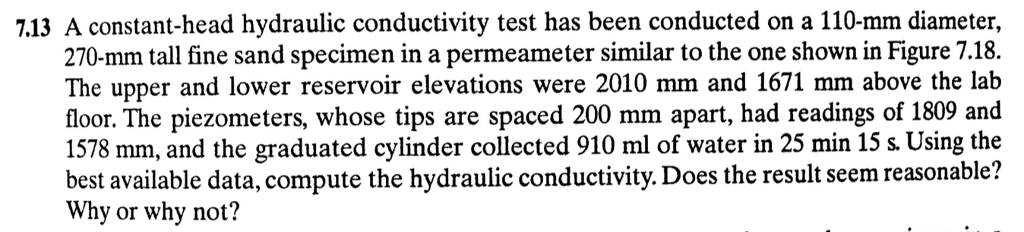 713 A constant-head hydraulic conductivity test has been conducted on a 110-mm diameter,
270-mm tall fine sand specimen in a permeameter similar to the one shown in Figure 7.18.
The upper and lower reservoir elevations were 2010 mm and 1671 mm above the lab
floor. The piezometers, whose tips are spaced 200 mm apart, had readings of 1809 and
1578 mm, and the graduated cylinder collected 910 ml of water in 25 min 15 s. Using the
best available data, compute the hydraulic conductivity. Does the result seem reasonable?
Why or why not?
This is AI generated Response.
Asked by: Sanju
Created at: 2025-10-01 21:07:46
Asked by: Sanju
Created at: 2025-10-01 21:07:46
Final Answer:
Rendered
Raw Text
Did you like this answer?
Let's solve the problem step by step:
---
## **Given Data**
- **Diameter of specimen:** \( d = 110 \) mm \( = .110 \) m
- **Height of specimen:** \( L = 270 \) mm \( = .270 \) m
- **Upper reservoir elevation:** \( h_1 = 201 \) mm
- **Lower reservoir elevation:** \( h_2 = 1671 \) mm
- **Piezometer readings (200 mm apart):**
- \( h_a = 1809 \) mm
- \( h_b = 1578 \) mm
- **Collected volume:** \( V = 910 \) ml \( = 9.10 \times 10^{-4} \) m³
- **Time:** \( t = 25 \) min \( 15 \) s \( = 1515 \) s
---
## **Step 1: Calculate Cross-sectional Area**
\[
A = \pi \left(\frac{d}{2}\right)^2 = \pi \left(\frac{.110}{2}\right)^2 = \pi \times (.055)^2 = \pi \times .003025 = .00951 \text{ m}^2
\]
---
## **Step 2: Calculate Discharge Rate (\( Q \))**
\[
Q = \frac{V}{t} = \frac{9.10 \times 10^{-4}}{1515} = 6.01 \times 10^{-7} \text{ m}^3/\text{s}
\]
---
## **Step 3: Calculate Hydraulic Gradient (\( i \))**
Piezometer difference: \( h_a - h_b = 1809 - 1578 = 231 \) mm \( = .231 \) m
Distance between piezometers: \( \Delta L = 200 \) mm \( = .200 \) m
\[
i = \frac{\Delta h}{\Delta L} = \frac{.231}{.200} = 1.155
\]
---
## **Step 4: Use Darcy's Law to Find Hydraulic Conductivity (\( k \))**
Darcy's Law:
\[
Q = k \cdot i \cdot A
\]
So,
\[
k = \frac{Q}{i \cdot A}
\]
Plug in values:
\[
k = \frac{6.01 \times 10^{-7}}{1.155 \times .00951}
\]
\[
k = \frac{6.01 \times 10^{-7}}{.01099}
\]
\[
k = 5.47 \times 10^{-5} \text{ m/s}
\]
---
## **Step 5: Reasonableness Check**
- **For fine sand:** Typical values for hydraulic conductivity (\( k \)) range from \( 10^{-5} \) to \( 10^{-4} \) m/s.
- Our result, \( 5.47 \times 10^{-5} \) m/s, falls within this range, so it seems reasonable.
---
## **Final Answer**
### **Hydraulic conductivity, \( k \), is:**
\[
\boxed{5.5 \times 10^{-5} \ \text{m/s}}
\]
### **Reasonableness:**
Yes, this value is reasonable for fine sand, as it falls within the expected range for such materials.
📢 Instructions:
- Ask anything relatd to above question only.
- For new Question goto :