 VIPSolutions
Give step-by-step solution with explanation and final answer:QUESTION 6 (12 marks) A circular slab with a diameter of 6 m shown in Figure 6(a) below is subjected to a uniformly distributed load of 7 kPa and supported along the edges as simply supported. The yield line of the slab is shown in Figure 6(b). Calculate the bending moment capacity required for the slab assuming that the slab is isotropically reinforced. / / v [ « \¢ Figure 6 (a) Figure 6 (b)
Question:
Give step-by-step solution with explanation and final answer: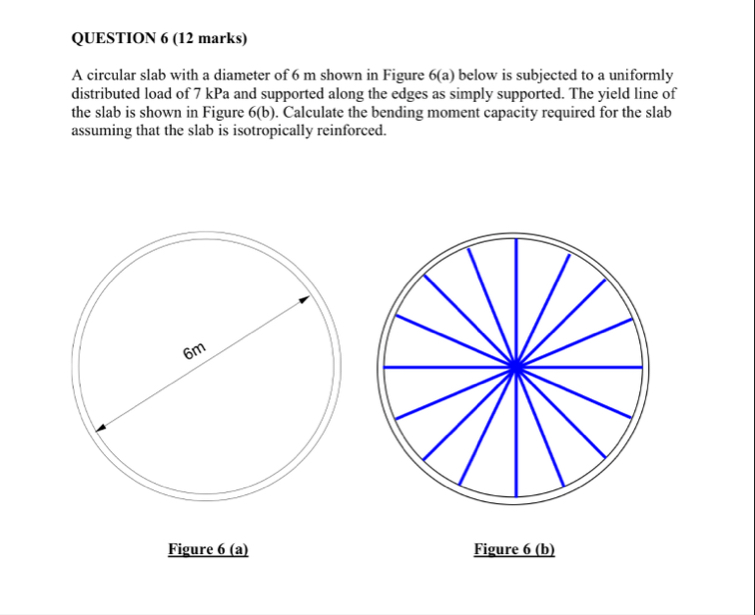 QUESTION 6 (12 marks)
A circular slab with a diameter of 6 m shown in Figure 6(a) below is subjected to a uniformly
distributed load of 7 kPa and supported along the edges as simply supported. The yield line of
the slab is shown in Figure 6(b). Calculate the bending moment capacity required for the slab
assuming that the slab is isotropically reinforced.
/ / v
[ «
\¢
Figure 6 (a) Figure 6 (b)
This is AI generated Response.
Asked by: Sanju
Created at: 2025-10-01 19:19:18
Asked by: Sanju
Created at: 2025-10-01 19:19:18
Final Answer:
Rendered
Raw Text
Did you like this answer?
# Solution
Given:
- **Diameter of slab, \( D = 6 \) m**
- **Radius, \( r = \frac{D}{2} = 3 \) m**
- **Uniform distributed load, \( w = 7 \) kPa = 7 kN/m²**
- **Slab is simply supported at the edge**
- **Yield line pattern is radial (as shown in Figure 6(b))**
- **Slab is isotropically reinforced**
Let's use the **yield line theory** for a simply supported circular slab under uniform load.
---
## 1. **Work Done by External Load**
The total load on the slab:
\[
W_{\text{total}} = w \cdot \text{Area}
\]
\[
\text{Area} = \pi r^2 = \pi (3^2) = 9\pi \text{ m}^2
\]
\[
W_{\text{total}} = 7 \times 9\pi = 63\pi \text{ kN}
\]
The **deflection at the center** (let's call it \(\delta\)) is the maximum vertical displacement.
The **work done by the external load**:
\[
\text{External Work} = W_{\text{total}} \times \frac{\delta}{2}
\]
(The average load moves through half the deflection.)
---
## 2. **Internal Work (Yield Line Mechanism)**
For a **radial yield line pattern** (fan mechanism), each radial segment rotates about the support.
The **internal work** done by the slab (using moment capacity \(m_u\) per unit length):
\[
\text{Internal Work} = (\text{Total length of yield lines}) \times m_u \times \theta
\]
- **Total length of yield lines** = \(2\pi r\) (circumference of the circle)
- **\(\theta\)** is the rotation at the edge
For a simply supported circular slab, the **vertical displacement at the center is \(\delta\)** and the **rotation at the edge** is:
\[
\theta = \frac{\delta}{r}
\]
So,
\[
\text{Internal Work} = (2\pi r) m_u \left(\frac{\delta}{r}\right) = 2\pi m_u \delta
\]
---
## 3. **Equate External and Internal Work**
\[
\text{External Work} = \text{Internal Work}
\]
\[
63\pi \cdot \frac{\delta}{2} = 2\pi m_u \delta
\]
Divide both sides by \(\delta\) (since \(\delta \neq \)):
\[
\frac{63\pi}{2} = 2\pi m_u
\]
Divide both sides by \(2\pi\):
\[
m_u = \frac{63\pi}{2 \times 2\pi} = \frac{63}{4} = 15.75 \text{ kNm/m}
\]
---
## 4. **Final Answer**
\[
\boxed{m_u = 15.75 \text{ kNm/m}}
\]
---
### **Summary of Steps**
1. **Calculate total load:** \(W_{\text{total}} = 63\pi\) kN
2. **External work:** \(W_{\text{total}} \cdot \frac{\delta}{2}\)
3. **Internal work:** \(2\pi m_u \delta\)
4. **Equate and solve:** \(m_u = 15.75\) kNm/m
---
### **Assumption**
- Slab yields along radial lines (fan mechanism).
- Isotropic reinforcement, so capacity per meter is constant.
---
**The required bending moment capacity for the slab is \( \boxed{15.75 \text{ kNm/m}} \).**
📢 Instructions:
- Ask anything relatd to above question only.
- For new Question goto :