 VIPSolutions
Give step-by-step solution with explanation and final answer:When a transformer operates under no-load conditions, the secondary winding is open and no current flows through it. In this case, the primary winding draws a small current from the supply, known as no-load current. This no-load current produces a flux in the transformer’s core. As a result, a voltage is induced in the secondary winding, termed as the secondary voltage. The understanding of these quantities is important for grasping the basic principles of transformer operation. Given: 1. Supply voltage V;= 230 V, Secondary turns N,=1200 2. Formula for no-load current: I= n I i= Le 27tf L, ST eR ee i ela current [p= 230 ve VN, 4. Expression 27x50x0,5 M
Question:
Give step-by-step solution with explanation and final answer: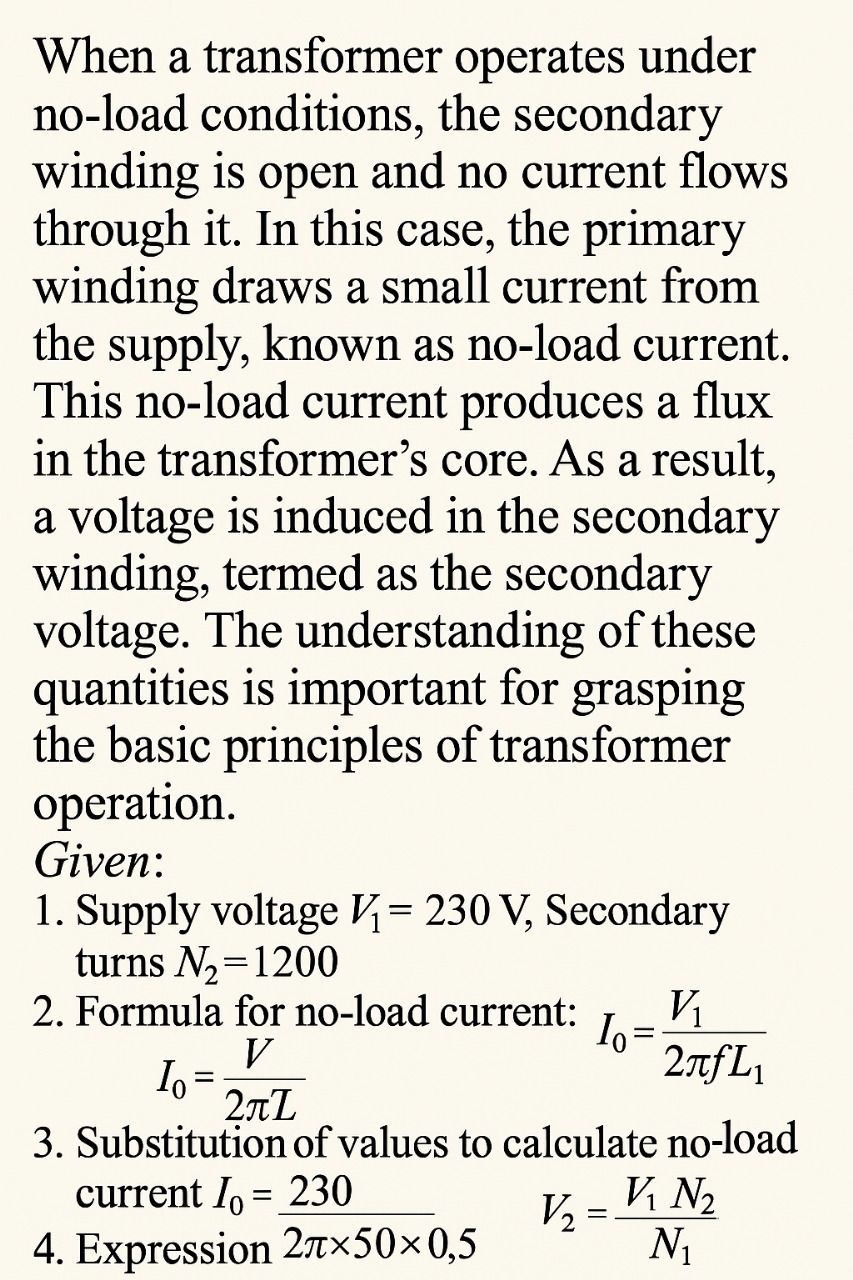 When a transformer operates under
no-load conditions, the secondary
winding is open and no current flows
through it. In this case, the primary
winding draws a small current from
the supply, known as no-load current.
This no-load current produces a flux
in the transformer’s core. As a result,
a voltage is induced in the secondary
winding, termed as the secondary
voltage. The understanding of these
quantities is important for grasping
the basic principles of transformer
operation.
Given:
1. Supply voltage V;= 230 V, Secondary
turns N,=1200
2. Formula for no-load current: I= n
I i= Le 27tf L,
ST eR ee i ela
current [p= 230 ve VN,
4. Expression 27x50x0,5 M
This is AI generated Response.
Asked by: Aman
Created at: 2025-09-30 08:15:02
Asked by: Aman
Created at: 2025-09-30 08:15:02
Final Answer:
Rendered
Raw Text
Did you like this answer?
Let's break down and solve the problem step by step using the given information and formulas.
---
## **Step 1: List the Given Data**
- **Supply voltage, \( V_1 \) = 230 V**
- **Secondary turns, \( N_2 \) = 120**
- **Frequency, \( f \) = 50 Hz** (from the formula context)
- **Inductance, \( L_1 \) = .5 H** (from substitution step)
- **Formula for no-load current:**
\( I_ = \frac{V_1}{2\pi f L_1} \)
---
## **Step 2: Substitute Values for No-load Current**
Using:
\[
I_ = \frac{V_1}{2\pi f L_1}
\]
Substitute the values:
- \( V_1 = 230 \) V
- \( f = 50 \) Hz
- \( L_1 = .5 \) H
\[
I_ = \frac{230}{2\pi \times 50 \times .5}
\]
---
## **Step 3: Calculate the Denominator**
Calculate \( 2\pi \times 50 \times .5 \):
- \( 2\pi = 6.2832 \)
- \( 6.2832 \times 50 = 314.16 \)
- \( 314.16 \times .5 = 157.08 \)
---
## **Step 4: Calculate No-load Current \( I_ \)**
\[
I_ = \frac{230}{157.08}
\]
\[
I_ \approx 1.464 \text{ A}
\]
---
## **Step 5: Write the Final Answer**
### **Final Answer**
\[
\boxed{I_ \approx 1.46 \text{ A}}
\]
---
### **Explanation**
- The no-load current (\(I_\)) is the current drawn by the primary winding of a transformer when the secondary is open (no load).
- It is calculated using the primary voltage, frequency, and inductance.
- Here, the answer is approximately **1.46 A**.
---
**If you need to calculate the secondary voltage using the turns ratio, provide the value of \(N_1\) (primary turns) to proceed further!**
📢 Instructions:
- Ask anything relatd to above question only.
- For new Question goto :