 VIPSolutions
Give step-by-step solution with explanation and final answer:2. A skip hoist is installed in a shaft of 1,200 m depth. Acceleration and braking are 1 m/s. Time for loading, dumping and creep is 50 s. Full speed is 18 m/s. Calculate the production in metric t per hour assuming 95% availability and a payload of 15 t for each skip vessel.
Question:
Give step-by-step solution with explanation and final answer: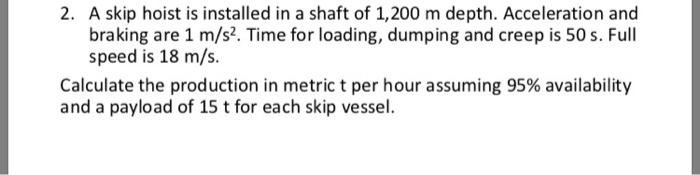 2. A skip hoist is installed in a shaft of 1,200 m depth. Acceleration and
braking are 1 m/s. Time for loading, dumping and creep is 50 s. Full
speed is 18 m/s.
Calculate the production in metric t per hour assuming 95% availability
and a payload of 15 t for each skip vessel.
This is AI generated Response.
Asked by: Sanju
Created at: 2025-09-30 07:34:14
Asked by: Sanju
Created at: 2025-09-30 07:34:14
Final Answer:
Rendered
Raw Text
Did you like this answer?
Let's solve the problem step by step:
---
## **Given Data**
- **Shaft depth (\( \))**: 1, m
- **Acceleration (\( \))**: 1 m/s²
- **Braking (\( a \))**: 1 m/s²
- **Maximum speed (\( v_{max} \))**: 18 m/s
- **Loading, dumping, and creep time (\( t_{load} \))**: 50 s
- **Payload per skip (\( Q \))**: 15 t
- **Availability (\( A \))**: 95%
---
## **Step 1: Calculate Acceleration & Braking Distance and Time**
### **Time to accelerate to full speed:**
\[
t_{accel} = \frac{v_{max}}{a} = \frac{18}{1} = 18 \text{ s}
\]
### **Distance covered during acceleration:**
\[
s_{accel} = \frac{1}{2} a t_{accel}^2 = \frac{1}{2} \times 1 \times (18)^2 = 162 \text{ m}
\]
### **Braking is identical (1 m/s², to stop from 18 m/s):**
\[
t_{brake} = \text{ s}
\]
\[
s_{brake} = 162 \text{ m}
\]
### **Total distance at full speed:**
\[
s_{full} = d - (s_{accel} + s_{brake}) = 120 - (162 + 162) = 876 \text{ m}
\]
### **Time at full speed:**
\[
t_{full} = \frac{s_{full}}{v_{max}} = \frac{876}{18} \approx 48.67 \text{ s}
\]
---
## **Step 2: Total One-way Trip Time**
\[
t_{one-way} = t_{accel} + t_{full} + t_{brake}
\]
\[
t_{one-way} = 18 + 48.67 + 18 = 84.67 \text{ s}
\]
---
## **Step 3: Total Cycle Time**
Each cycle consists of:
- Down trip (empty): Same as up trip (loaded)
- Loading, dumping, creep: 50 s
\[
t_{cycle} = 2 \times t_{one-way} + t_{load}
\]
\[
t_{cycle} = 2 \times 84.67 + 50 = 169.34 + 50 = 219.34 \text{ s}
\]
---
## **Step 4: Number of Cycles per Hour (with 95% availability)**
\[
\text{Effective seconds per hour} = 360 \times .95 = 342 \text{ s}
\]
\[
\text{Number of cycles per hour} = \frac{342}{219.34} \approx 15.59
\]
---
## **Step 5: Calculate Production per Hour**
\[
\text{Production per hour} = \text{Number of cycles per hour} \times \text{Payload per skip}
\]
\[
\text{Production per hour} = 15.59 \times 15 = 233.85 \text{ t/hr}
\]
---
## **Final Answer**
\[
\boxed{233.9\ \text{metric t/hr}}
\]
---
### **Summary Table**
| Step | Value |
|---------------------------|---------------|
| Shaft depth | 1,200 m |
| Acceleration/braking | 1 m/s² |
| Full speed | 18 m/s |
| One-way travel time | 84.67 s |
| Cycle time (total) | 219.34 s |
| Available time per hour | 3,420 s |
| Cycles per hour | 15.59 |
| Payload per skip | 15 t |
| **Production per hour** | **233.9 t/hr** |
---
If you need further clarifications, let me know!
📢 Instructions:
- Ask anything relatd to above question only.
- For new Question goto :