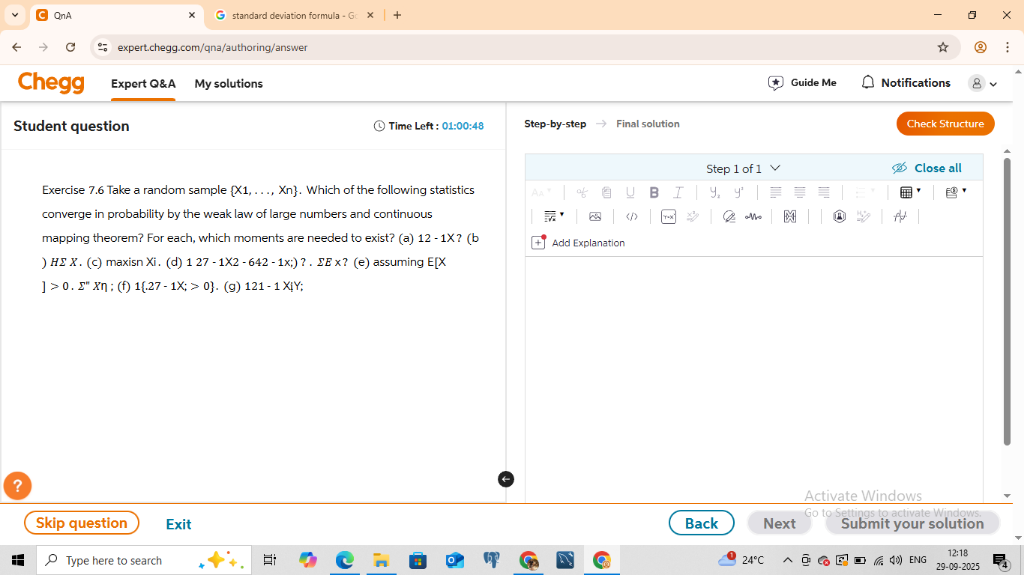
Question:
Give step-by-step solution with explanation and final answer:
Did you like this answer?
👍 0
👎 0
Let's break down the problem **step-by-step**:
## Problem Restatement
Given a random sample \( (X_1, ..., X_n) \), determine which statistics converge in probability by the **Weak Law of Large Numbers (WLLN)** and the **Continuous Mapping Theorem (CMT)**, and for each, which moments must exist.
---
## **Step 1: Recall the Theorems**
### Weak Law of Large Numbers (WLLN)
If \( X_1, ..., X_n \) are i.i.d. with mean \( \mu \) and finite variance, then:
\[
\overline{X}_n = \frac{1}{n}\sum_{i=1}^n X_i \xrightarrow{P} \mu
\]
as \( n \to \infty \).
### Continuous Mapping Theorem (CMT)
If \( Y_n \xrightarrow{P} \theta \), and \( g \) is continuous at \( \theta \), then \( g(Y_n) \xrightarrow{P} g(\theta) \).
---
## **Step 2: Analyze Each Statistic**
### (a) \( 12 - 1\overline{X} \)
- \( \overline{X} \xrightarrow{P} E[X] \) by WLLN, if \( E[X] \) exists.
- \( 12 - 1\overline{X} \) is a continuous function, so by CMT:
\[
12 - 1\overline{X} \xrightarrow{P} 12 - 1E[X]
\]
- **Moment needed**: \( E[X] \).
---
### (b) \( h(\overline{X}) \)
- Same reasoning as above; by WLLN and CMT, \( h(\overline{X}) \xrightarrow{P} h(E[X]) \) if \( h \) is continuous at \( E[X] \).
- **Moment needed**: \( E[X] \).
---
### (c) \( \max_i X_i \)
- The maximum does **not** converge in probability to \( E[X] \) (unless \( X \) is degenerate).
- The maximum converges to the **essential supremum** of the distribution (if it exists).
- **WLLN does not apply**; this statistic does **not** converge by WLLN.
---
### (d) \( \frac{1}{n} \sum_{i=1}^n (27 - 1X_i^2 - 64 \cdot 1X_i^2) \)
- This is a sample mean. By WLLN, it converges to the expected value if \( E[27 - 1X^2 - 64 \cdot 1X^2] \) exists.
- **Moment needed**: \( E[X^2] \).
---
### (e) \( \frac{1}{n} \sum_{i=1}^n X_i^2 \) assuming \( E[X] > \)
- Sample mean of \( X_i^2 \) converges to \( E[X^2] \) if \( E[X^2] \) exists.
- **Moment needed**: \( E[X^2] \).
---
### (f) \( \frac{1}{n} \sum_{i=1}^n 1\{27 - 1X_i > \} \)
- This is the sample proportion where \( 27 - 1X_i > \).
- By WLLN, converges to \( P(27 - 1X > ) \).
- **Moment needed**: None (just probability exists).
---
### (g) \( 121 - 1X_i Y_i \)
- If \( (X_i, Y_i) \) are i.i.d., \( \frac{1}{n} \sum_{i=1}^n (121 - 1X_i Y_i) \) converges to \( 121 - E[X Y] \) if \( E[X Y] \) exists.
- **Moment needed**: \( E[X Y] \).
---
## **Step 3: Summary Table**
| Statistic | Converges by WLLN + CMT? | Moment Needed |
|---------------------------------------------|--------------------------|----------------------|
| (a) \( 12 - 1\overline{X} \) | Yes | \( E[X] \) |
| (b) \( h(\overline{X}) \) | Yes (if \( h \) cont.) | \( E[X] \) |
| (c) \( \max_i X_i \) | No | — |
| (d) \( \frac{1}{n}\sum (27-1X_i^2-64\cdot 1X_i^2) \) | Yes | \( E[X^2] \) |
| (e) \( \frac{1}{n} \sum X_i^2 \) | Yes | \( E[X^2] \) |
| (f) \( \frac{1}{n} \sum 1\{27-1X_i > \} \) | Yes | None |
| (g) \( 121 - 1X_iY_i \) | Yes | \( E[X Y] \) |
---
## **Final Answers**
### **Converge by WLLN + CMT:**
- **(a), (b), (d), (e), (f), (g)**
### **Moments Needed:**
- (a): \( E[X] \)
- (b): \( E[X] \)
- (d): \( E[X^2] \)
- (e): \( E[X^2] \)
- (f): None
- (g): \( E[XY] \)
**(c) does NOT converge by WLLN.**
 VIPSolutions
 v Qo XG standard deviation formula -G. X | + - 8 x
€ 5 © = expertchegg.com/qna/authoring/answer x @ i
Chegg Esertosa Mysolutions ®) cudeme 0) Notifications 8 v
Student question OTmelen;cioods | Spbysen © Foaisaiution
Steplofl Vv # Close all
Exercise 7:6 Take a random sample (XL, .., Xn). Which ofthe following statistics 8 5 9 Be
converge in probability by the weak law of large numbers and continuous. EL NR] @ we |B @ [3
mapping theorem? For each, which moments are needed fo ext? (2) 12 -1X7 (b [EP
YHEX. ( maxisn Xi. (127-102 -642-1x)7. SEX? (&) assuming E[X
120.5740; (f) 1(27- 1X > 0}. (9) 121-1 XI¥;
() ¢
Exit Next Submit your solution
8B OTperecosean 4 BH BO @ ww BEY GEG Qc Ada@manoe 2h B