 VIPSolutions
Give step-by-step solution with explanation and final answer:33 gee Ha §17 |e 13 8 i : i : i I oll i l wr . i
Question:
Give step-by-step solution with explanation and final answer: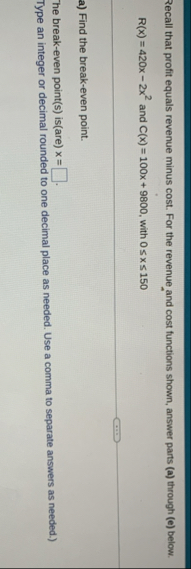 33 gee
Ha
§17 |e
13 8
i
: i
: i
I oll
i l
wr
. i
This is AI generated Response.
Asked by: anil
Created at: 2025-09-29 08:46:13
Asked by: anil
Created at: 2025-09-29 08:46:13
Final Answer:
Rendered
Raw Text
Did you like this answer?
Let's solve the problem step by step:
### **Given:**
- Revenue function: \( R(x) = 20x - x^2 \)
- Cost function: \( C(x) = 10x + 800 \)
- \( \leq x \leq 15 \)
We need to **find the break-even points** (where revenue equals cost).
---
## **Step 1: Set Revenue Equal to Cost**
\[
R(x) = C(x)
\]
\[
20x - x^2 = 10x + 800
\]
---
## **Step 2: Rearrange the Equation**
Move all terms to one side:
\[
20x - x^2 - 10x - 800 =
\]
\[
- x^2 + 10x - 800 =
\]
Multiply both sides by \(-1\):
\[
x^2 - 10x + 800 =
\]
---
## **Step 3: Solve the Quadratic Equation**
This is of the form \( ax^2 + bx + c = \):
\[
x^2 - 10x + 800 =
\]
Use the quadratic formula:
\[
x = \frac{-b \pm \sqrt{b^2 - 4ac}}{2a}
\]
where \( a = 1 \), \( b = -10 \), \( c = 800 \):
\[
x = \frac{-(-10) \pm \sqrt{(-10)^2 - 4 \cdot 1 \cdot 800}}{2 \cdot 1}
\]
\[
x = \frac{10 \pm \sqrt{100 - 320}}{2}
\]
\[
x = \frac{10 \pm \sqrt{-310}}{2}
\]
\[
\sqrt{-310} = i\sqrt{310}
\]
---
## **Step 4: Interpret the Result**
The discriminant is **negative** (\(-310\)), so the equation has **no real solutions**.
This means **the revenue never equals the cost** in the given interval (\( \leq x \leq 15\)), so there is **no break-even point**.
---
## **Final Answer**
\[
\boxed{\text{No real break-even point; revenue never equals cost in the given range.}}
\]
**Explanation:** The quadratic equation yields imaginary solutions, indicating that the break-even point does not occur for any real value of \(x\) within the range \( \leq x \leq 15\).
Question:
0≤x≤150
This is AI generated Response.
Asked by: anil
Created at: 2025-09-29 08:47:40
Asked by: anil
Created at: 2025-09-29 08:47:40
Final Answer:
Rendered
Raw Text
Did you like this answer?
# Step-by-Step Solution
## **Given:**
- Revenue function: \( R(x) = 20x - x^2 \)
- Cost function: \( C(x) = 10x + 800 \)
- Interval: \( 0 \leq x \leq 15 \)
We need to **find the break-even points** where revenue equals cost.
---
## **Step 1: Set Revenue Equal to Cost**
Set the revenue equal to the cost:
\[
R(x) = C(x)
\]
Substituting the functions:
\[
20x - x^2 = 10x + 800
\]
---
## **Step 2: Rearrange the Equation**
Move all terms to one side:
\[
20x - x^2 - 10x - 800 = 0
\]
Simplify the equation:
\[
-x^2 + 10x - 800 = 0
\]
Multiply both sides by \(-1\):
\[
x^2 - 10x + 800 = 0
\]
---
## **Step 3: Solve the Quadratic Equation**
This is a quadratic equation in the form \( ax^2 + bx + c = 0 \):
- \( a = 1 \)
- \( b = -10 \)
- \( c = 800 \)
Use the quadratic formula:
\[
x = \frac{-b \pm \sqrt{b^2 - 4ac}}{2a}
\]
Substituting the values:
\[
x = \frac{-(-10) \pm \sqrt{(-10)^2 - 4 \cdot 1 \cdot 800}}{2 \cdot 1}
\]
Calculate the discriminant:
\[
x = \frac{10 \pm \sqrt{100 - 3200}}{2}
\]
\[
x = \frac{10 \pm \sqrt{-3100}}{2}
\]
The square root of a negative number:
\[
\sqrt{-3100} = i\sqrt{3100}
\]
---
## **Step 4: Interpret the Result**
The discriminant is **negative** (\(-3100\)), indicating that the equation has **no real solutions**. This means that **the revenue never equals the cost** in the given interval \( 0 \leq x \leq 15\).
---
## **Final Answer**
\[
\boxed{\text{No real break-even point; revenue never equals cost in the given range.}}
\]
### **Explanation:**
The quadratic equation yields imaginary solutions, indicating that the break-even point does not occur for any real value of \(x\) within the specified interval.
📢 Instructions:
- Ask anything relatd to above question only.
- For new Question goto :