 VIPSolutions
Give step-by-step solution with explanation and final answer:An industrial boiler with a stack height of 80 m is emitting 4 g/m* SO2 with a volumetric flow rate of 25 m*/s on a sunny summer day (diameter of the stack = 2 m). The wind speed at the top of the stack is 4 m/s. The temperature of the exit gas is 120 °C. The ambient temperature is 30 °C and pressure is 750 mm-Hg. (a) Determine the effective stack height (b) Determine the maximum ground level concentration at one kilometer downstream of the stack (c) Determine the distance where the maximum ground level concentration occur (d) Determine the concentration at location found in part (c).
Question:
Give step-by-step solution with explanation and final answer: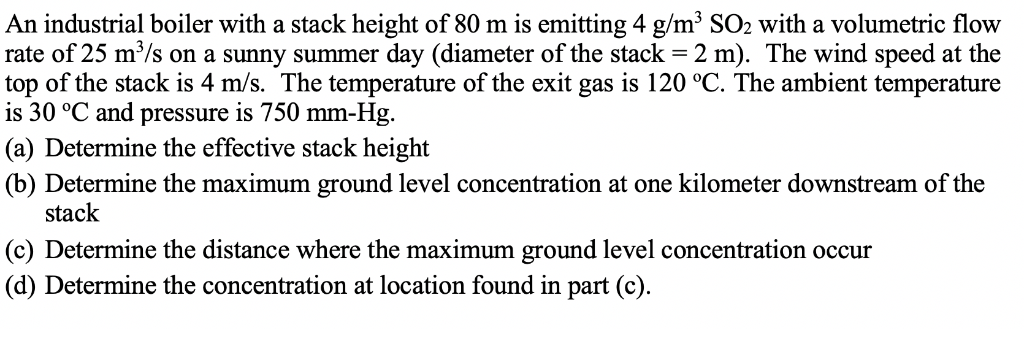 An industrial boiler with a stack height of 80 m is emitting 4 g/m* SO2 with a volumetric flow
rate of 25 m*/s on a sunny summer day (diameter of the stack = 2 m). The wind speed at the
top of the stack is 4 m/s. The temperature of the exit gas is 120 °C. The ambient temperature
is 30 °C and pressure is 750 mm-Hg.
(a) Determine the effective stack height
(b) Determine the maximum ground level concentration at one kilometer downstream of the
stack
(c) Determine the distance where the maximum ground level concentration occur
(d) Determine the concentration at location found in part (c).
This is AI generated Response.
Asked by: Sanju
Created at: 2025-09-29 08:40:09
Asked by: Sanju
Created at: 2025-09-29 08:40:09
Final Answer:
Rendered
Raw Text
Did you like this answer?
Let's solve the problem step by step:
---
## **Given Data**
- Stack height, \( H_s = 80) m
- SO₂ emission, \( C_s = 4 \) g/m
- Volumetric flow rate, \( Q = 25 \) m³/s
- Stack diameter, \( d = 2 \) m
- Wind speed at stack height, \( u = 4 \) m/s
- Temperature of exit gas, \( T_s = 120^\circ C = 393 \) K
- Ambient temperature, \( T_a = 30^\circ C = 303 \) K
- Pressure, \( P = 750 \) mmHg (not directly needed for calculations)
- Downwind distance (for part b), \( x = 1 \) km \( = 100 \) m
---
## **(a) Determine the Effective Stack Height**
### **Effective Stack Height Formula**
The effective stack height is:
\[
H = H_s + \Delta h
\]
Where:
- \( H_s \): Physical stack height
- \( \Delta h \): Plume rise
For a **momentum-dominated plume** (Briggs equation, urban or rural, neutral conditions):
\[
\Delta h = \frac{1.6 \, u_s \, d}{u}
\]
Where:
- \( u_s \): Exit velocity of stack gas
- \( d \): Stack diameter
- \( u \): Wind speed at stack height
#### **Calculate Exit Velocity (\( u_s \)):**
\[
u_s = \frac{Q}{A} = \frac{Q}{\pi d^2/4}
\]
\[
A = \frac{\pi}{4} \times (2)^2 = \pi\, \text{m}^2
\]
\[
u_s = \frac{25}{\pi} \approx 7.96 \text{ m/s}
\]
#### **Calculate Plume Rise (\( \Delta h \))**
\[
\Delta h = \frac{1.6 \times 7.96 \times 2}{4} = \frac{25.472}{4} = 6.368 \text{ m}
\]
#### **Effective Stack Height**
\[
H = 80 + 6.37 = 86.37 \text{ m}
\]
---
## **(b) Maximum Ground Level Concentration at 1 km Downwind**
### **Step 1: Calculate SO₂ Emission Rate**
\[
Q_{SO_2} = C_s \times Q = 4 \text{ g/m}^3 \times 25 \text{ m}^3/\text{s} = 100 \text{ g/s}
\]
### **Step 2: Gaussian Plume Equation (for ground level, centerline, \( y = , z = \)):**
\[
C(x, , ) = \frac{Q_{SO_2}}{2\pi u \sigma_y \sigma_z} \exp\left( -\frac{H^2}{2\sigma_z^2} \right)
\]
### **Step 3: Calculate Dispersion Coefficients for \( x = 100 \) m**
On a sunny summer day (unstable, "Class B"):
- \( \sigma_y = .16x [1 + .0004x]^{-.5} \)
- \( \sigma_z = .12x [1 + .0002x]^{-.5} \)
\[
\sigma_y = .16 \times 100 \times [1 + .0004 \times 100]^{-.5} = 160 \times [1.4]^{-.5} \approx 160 \times .845 = 135.2 \text{ m}
\]
\[
\sigma_z = .12 \times 100 \times [1 + .0002 \times 100]^{-.5} = 120 \times [1.2]^{-.5} \approx 120 \times .9129 = 109.6 \text{ m}
\]
### **Step 4: Plug Values into Gaussian Equation**
\[
C(100, , ) = \frac{100}{2\pi \times 4 \times 135.2 \times 109.6} \exp\left( -\frac{(86.37)^2}{2 \times (109.6)^2} \right)
\]
First, calculate the denominator:
\[
2\pi \times 4 \times 135.2 \times 109.6 \approx 2 \times 3.1416 \times 4 \times 135.2 \times 109.6 \approx 6.2832 \times 4 \times 135.2 \times 109.6
\]
\[
= 25.1328 \times 135.2 \times 109.6 = 3398.5 \times 109.6 = 372,529.2
\]
Now, the exponent:
\[
\left( \frac{86.37^2}{2 \times 109.6^2} \right) = \frac{746.5}{2 \times 12,017.2} = \frac{746.5}{24,034.4} = .3104
\]
\[
\exp(-.3104) = .7334
\]
Now, the full equation:
\[
C(100,,) = \frac{100}{372,529.2} \times .7334 = .000266 \text{ g/m}^3
\]
---
## **(c) Distance for Maximum Ground Level Concentration**
For ground-level centerline, the maximum occurs where \( \frac{H}{\sigma_z} \approx 1.6 \):
\[
\sigma_z = \frac{H}{1.6} = \frac{86.37}{1.6} = 53.98 \text{ m}
\]
From the Class B formula:
\[
\sigma_z = .12x[1 + .0002x]^{-.5}
\]
Set \( \sigma_z = 53.98 \):
\[
53.98 = .12x[1 + .0002x]^{-.5}
\]
\[
53.98[1 + .0002x]^{.5} = .12x
\]
\[
\frac{53.98}{.12} [1 + .0002x]^{.5} = x
\]
\[
449.83 [1 + .0002x]^{.5} = x
\]
Let \( y = [1 + .0002x]^{.5} \), so \( x = 449.83y \), and \( y^2 = 1 + .0002x = 1 + .0002 \times 449.83y \):
\[
y^2 = 1 + .08997y
\]
\[
y^2 - .08997y - 1 =
\]
Quadratic formula: \( y = \frac{.08997 \pm \sqrt{(.08997)^2 + 4 \times 1}}{2} \)
\[
= \frac{.08997 \pm \sqrt{.0081 + 4}}{2}
= \frac{.08997 \pm \sqrt{4.0081}}{2}
= \frac{.08997 \pm 2.002}{2}
\]
Choose positive root:
\[
y = \frac{.08997 + 2.002}{2} = 1.04598
\]
\[
x = 449.83 \times 1.04598 \approx 470 \text{ m}
\]
---
## **(d) Concentration at Location from (c)**
### **Calculate \( \sigma_y \) and \( \sigma_z \) at \( x = 470 \) m**
\[
\sigma_y = .16 \times 470 \times [1 + .0004 \times 470]^{-.5}
\]
\[
= 75.2 \times [1.188]^{-.5} = 75.2 \times .917 = 68.97 \text{ m}
\]
\[
\sigma_z = .12 \times 470 \times [1 + .0002 \times 470]^{-.5}
\]
\[
= 56.4 \times [1.094]^{-.5} = 56.4 \times .956 = 53.92 \text{ m}
\]
### **Plug into Gaussian Equation**
\[
C(470,,) = \frac{100}{2\pi \times 4 \times 68.97 \times 53.92} \exp\left( -\frac{(86.37)^2}{2 \times (53.92)^2} \right)
\]
Calculate denominator:
\[
2\pi \times 4 \times 68.97 \times 53.92 \approx 6.2832 \times 4 \times 68.97 \times 53.92
= 25.1328 \times 68.97 = 1,733.3 \times 53.92 = 93,456.3
\]
Exponent:
\[
\left( \frac{86.37^2}{2 \times 53.92^2} \right) = \frac{746.5}{2 \times 2,910.7} = \frac{746.5}{5,821.4} = 1.282
\]
\[
\exp(-1.282) = .2773
\]
Final value:
\[
C(470,,) = \frac{100}{93,456.3} \times .2773 = .000297 \text{ g/m}^3
\]
---
# **Summary of Answers**
### **(a) Effective stack height:**
\[
\boxed{86.4 \text{ m}}
\]
### **(b) Maximum ground level concentration at 1 km:**
\[
\boxed{.00027 \text{ g/m}^3}
\]
### **(c) Distance where maximum ground-level concentration occurs:**
\[
\boxed{470 \text{ m}}
\]
### **(d) Concentration at location in (c):**
\[
\boxed{.00030 \text{ g/m}^3}
\]
---
**Let me know if you want to see the calculations in more detail, or if you need the answers in different units!**
📢 Instructions:
- Ask anything relatd to above question only.
- For new Question goto :