 VIPSolutions
Give step-by-step solution with explanation and final answer:ee) Inscribed in a semicircle with BC as Its diameter. If further two semicircles are drawn taking AB and AC as their diameters as shown below, then which of the following represents the area of the shaded region? A ND 1 Area of AABC 2° Twice the area of AABC 3° Area of semicircle BAC 4 None of these
Question:
Give step-by-step solution with explanation and final answer: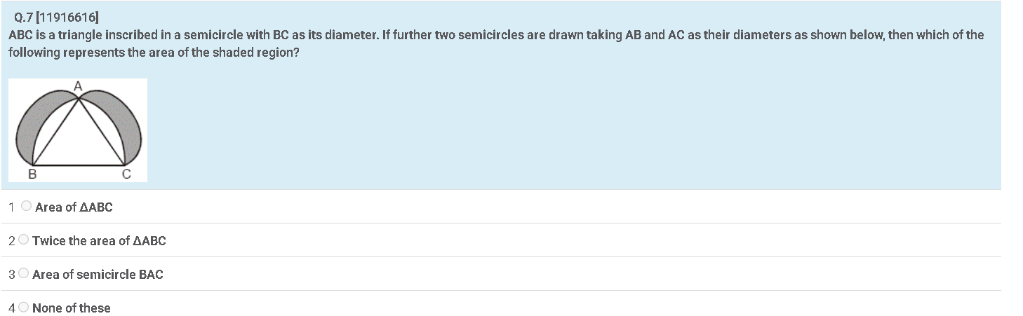 ee) Inscribed in a semicircle with BC as Its diameter. If further two semicircles are drawn taking AB and AC as their diameters as shown below, then which of the
following represents the area of the shaded region?
A
ND
1 Area of AABC
2° Twice the area of AABC
3° Area of semicircle BAC
4 None of these
This is AI generated Response.
Asked by: Rahul kumar
Created at: 2025-09-28 12:53:51
Asked by: Rahul kumar
Created at: 2025-09-28 12:53:51
Final Answer:
Rendered
Raw Text
Did you like this answer?
Let's break down the problem step by step:
## **Step 1: Understanding the Figure**
- \( \triangle ABC \) is inscribed in a semicircle with \( BC \) as its diameter.
- Two more semicircles are drawn with \( AB \) and \( AC \) as their diameters.
- The shaded region is *inside* the large semicircle but *outside* the two smaller semicircles.
## **Step 2: Expressing Areas in Terms of the Triangle**
Let the length \( BC = d \) (diameter of the large semicircle).
Let the lengths \( AB = x \) and \( AC = y \) (diameters of the two smaller semicircles).
- **Area of large semicircle:**
\[
A_1 = \frac{1}{2} \pi \left(\frac{d}{2}\right)^2 = \frac{\pi d^2}{8}
\]
- **Area of semicircle with diameter AB:**
\[
A_2 = \frac{1}{2} \pi \left(\frac{x}{2}\right)^2 = \frac{\pi x^2}{8}
\]
- **Area of semicircle with diameter AC:**
\[
A_3 = \frac{1}{2} \pi \left(\frac{y}{2}\right)^2 = \frac{\pi y^2}{8}
\]
- **Area of shaded region:**
\[
\text{Shaded Area} = A_1 - (A_2 + A_3)
\]
## **Step 3: Relation to Triangle Area**
Recall an important result:
For a triangle inscribed in a semicircle (with the triangle’s base as the diameter),
the **sum of the areas of the semicircles on the three sides** minus the area of the triangle equals **the area of the semicircle on the diameter**.
But here, the shaded region is the area between the large semicircle and the sum of the two smaller semicircles (not including the triangle).
**Key geometric result:**
The area of the large semicircle minus the sum of the areas of the two smaller semicircles (on sides \( AB \) and \( AC \)) equals the area of \( \triangle ABC \).
## **Step 4: Final Answer**
So, the **shaded area** is **equal to the area of \( \triangle ABC \)**.
---
## **Final Answer**
\[
\boxed{\text{Area of } \triangle ABC}
\]
So, the correct option is **1) Area of \( \triangle ABC \)**.
📢 Instructions:
- Ask anything relatd to above question only.
- For new Question goto :