 VIPSolutions
Give step-by-step solution with explanation and final answer:Consider a system with matrices: 0 1 0 a=] J; =i] ¢=0 0], D=o. i) Find the state transition matrix using the Laplace inverse method. ii) Determine the time response y(t) for input u(t) = e~, initial state z(0) = [1 0]. iii) Compute the transfer function and comment on pole locations and system stability.
Question:
Give step-by-step solution with explanation and final answer: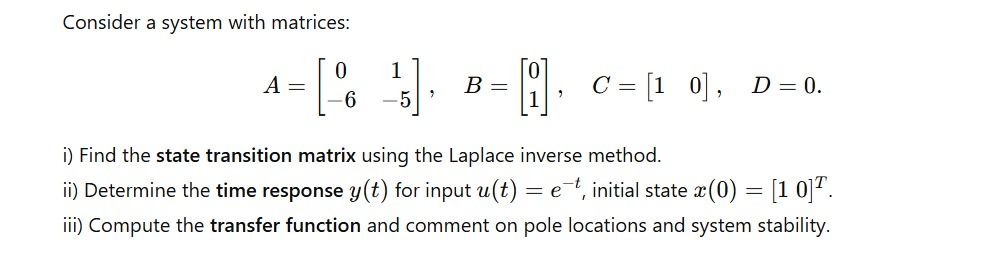 Consider a system with matrices:
0 1 0
a=] J; =i] ¢=0 0], D=o.
i) Find the state transition matrix using the Laplace inverse method.
ii) Determine the time response y(t) for input u(t) = e~, initial state z(0) = [1 0].
iii) Compute the transfer function and comment on pole locations and system stability.
This is AI generated Response.
Asked by: Aman
Created at: 2025-09-27 23:26:43
Asked by: Aman
Created at: 2025-09-27 23:26:43
Final Answer:
Rendered
Raw Text
Did you like this answer?
Let's solve each part step by step:
---
## **Given:**
\[
A = \begin{bmatrix} & 1 \\ -6 & -5 \end{bmatrix}, \quad B = \begin{bmatrix} \\ 1 \end{bmatrix}, \quad C = \begin{bmatrix} 1 & \end{bmatrix}, \quad D =
\]
---
## **i) State Transition Matrix** \(\Phi(t) = e^{At}\):
**Laplace inverse method:**
\[
\Phi(t) = \mathcal{L}^{-1}\{ (sI - A)^{-1} \}
\]
### **Step 1: Find \( sI - A \)**
\[
sI - A = \begin{bmatrix} s & \\ & s \end{bmatrix} - \begin{bmatrix} & 1 \\ -6 & -5 \end{bmatrix} = \begin{bmatrix} s & -1 \\ 6 & s + 5 \end{bmatrix}
\]
### **Step 2: Find \( (sI - A)^{-1} \)**
For a 2x2 matrix \( M = \begin{bmatrix} a & b \\ c & d \end{bmatrix} \):
\[
M^{-1} = \frac{1}{ad - bc} \begin{bmatrix} d & -b \\ -c & a \end{bmatrix}
\]
- **Determinant:**
\[
\det(sI - A) = (s)(s+5) - (-1)(6) = s^2 + 5s + 6
\]
- **Inverse:**
\[
(sI - A)^{-1} = \frac{1}{s^2 + 5s + 6} \begin{bmatrix} s+5 & 1 \\ -6 & s \end{bmatrix}
\]
### **Step 3: Find Laplace inverse**
Factor denominator:
\[
s^2 + 5s + 6 = (s+2)(s+3)
\]
- **First Element (\(s+5\)):**
\[
\frac{s+5}{(s+2)(s+3)} = \frac{A}{s+2} + \frac{B}{s+3}
\]
\[
s+5 = A(s+3) + B(s+2)
\]
Let \(s = -3\): \(2 = B(-1) \implies B = -2\)
Let \(s = -2\): \(3 = A(1) \implies A = 3\)
So,
\[
\frac{s+5}{(s+2)(s+3)} = \frac{3}{s+2} - \frac{2}{s+3}
\]
- **Second Element (\(1\)):**
\[
\frac{1}{(s+2)(s+3)} = \frac{C}{s+2} + \frac{D}{s+3}
\]
\[
1 = C(s+3) + D(s+2)
\]
Let \(s=-3\): \(1 = D(-1) \implies D = -1\)
Let \(s = -2\): \(1 = C(1) \implies C = 1\)
So,
\[
\frac{1}{(s+2)(s+3)} = \frac{1}{s+2} - \frac{1}{s+3}
\]
- **Third Element (\(-6\)):**
\[
\frac{-6}{(s+2)(s+3)} = -6 \left(\frac{1}{s+2} - \frac{1}{s+3}\right)
\]
- **Fourth Element (\(s\)):**
\[
\frac{s}{(s+2)(s+3)} = \frac{E}{s+2} + \frac{F}{s+3}
\]
\[
s = E(s+3) + F(s+2)
\]
Let \(s=-3\): \(-3 = F(-1) \implies F = 3\)
Let \(s=-2\): \(-2 = E(1) \implies E = -2\)
So,
\[
\frac{s}{(s+2)(s+3)} = \frac{-2}{s+2} + \frac{3}{s+3}
\]
### **Step 4: Inverse Laplace**
\[
\mathcal{L}^{-1}\left\{\frac{1}{s+a}\right\} = e^{-at}
\]
So,
\[
\Phi(t) = e^{At} =
\begin{bmatrix}
3e^{-2t} - 2e^{-3t} & e^{-2t} - e^{-3t} \\
-6e^{-2t} + 6e^{-3t} & -2e^{-2t} + 3e^{-3t}
\end{bmatrix}
\]
---
## **ii) Time Response \(y(t)\) for \(u(t) = e^{-t}\), \(x() = \begin{bmatrix} 1 \\ \end{bmatrix}\):**
General solution:
\[
x(t) = \Phi(t)x() + \int_^t \Phi(t-\tau) B u(\tau) d\tau
\]
\[
y(t) = Cx(t)
\]
### **Step 1: Compute \(\Phi(t)x()\):**
\[
\Phi(t)x() =
\begin{bmatrix}
3e^{-2t} - 2e^{-3t} \\
-6e^{-2t} + 6e^{-3t}
\end{bmatrix}
\]
### **Step 2: Compute Forced Response**
\[
\int_^t \Phi(t-\tau) B u(\tau) d\tau
\]
Here, \(B = \begin{bmatrix} \\ 1 \end{bmatrix}\), so only the second column of \(\Phi(t-\tau)\) matters.
\[
\int_^t
\begin{bmatrix}
e^{-2(t-\tau)} - e^{-3(t-\tau)} \\
-2e^{-2(t-\tau)} + 3e^{-3(t-\tau)}
\end{bmatrix}
e^{-\tau} d\tau
\]
Let’s write the first entry (which is what \(y(t)\) will be, since \(C = [1 \quad ]\)):
\[
y(t) = [1 \quad ] \Bigg(
\begin{bmatrix}
3e^{-2t} - 2e^{-3t} \\
-6e^{-2t} + 6e^{-3t}
\end{bmatrix}
+ \int_^t
\begin{bmatrix}
e^{-2(t-\tau)} - e^{-3(t-\tau)} \\
-2e^{-2(t-\tau)} + 3e^{-3(t-\tau)}
\end{bmatrix}
e^{-\tau} d\tau
\Bigg)
\]
So,
\[
y(t) = 3e^{-2t} - 2e^{-3t} + \int_^t [e^{-2(t-\tau)} - e^{-3(t-\tau)}] e^{-\tau} d\tau
\]
\[
= 3e^{-2t} - 2e^{-3t} + \int_^t \left(e^{-2(t-\tau)} e^{-\tau} - e^{-3(t-\tau)} e^{-\tau}\right) d\tau
\]
\[
= 3e^{-2t} - 2e^{-3t} + \int_^t \left(e^{-2t+\tau} e^{-\tau} - e^{-3t+2\tau} e^{-\tau}\right) d\tau
\]
\[
= 3e^{-2t} - 2e^{-3t} + \int_^t \left(e^{-2t+\tau} e^{-\tau} - e^{-3t+\tau}\right) d\tau
\]
But actually, let's keep it simple:
Note that \(e^{-2(t-\tau)} e^{-\tau} = e^{-2t+2\tau} e^{-\tau} = e^{-2t+\tau}\)
Similarly, \(e^{-3(t-\tau)} e^{-\tau} = e^{-3t+3\tau} e^{-\tau} = e^{-3t+2\tau}\)
So,
\[
y(t) = 3e^{-2t} - 2e^{-3t} + \int_^t \left( e^{-2t+\tau} - e^{-3t+2\tau} \right) d\tau
\]
Evaluate the integrals:
- For \(e^{-2t+\tau}\):
\[
\int_^t e^{-2t+\tau} d\tau = e^{-2t} \int_^t e^{\tau} d\tau = e^{-2t} [e^{\tau}]_^t = e^{-2t} (e^{t} - 1)
\]
- For \(e^{-3t+2\tau}\):
\[
\int_^t e^{-3t+2\tau} d\tau = e^{-3t} \int_^t e^{2\tau} d\tau = e^{-3t} \left[ \frac{1}{2} e^{2\tau} \right]_^t = e^{-3t} \left( \frac{1}{2} e^{2t} - \frac{1}{2} \right)
\]
Plug back in:
\[
y(t) = 3e^{-2t} - 2e^{-3t} + \left[ e^{-2t} (e^{t} - 1) - e^{-3t} \frac{1}{2} (e^{2t} - 1) \right]
\]
\[
= 3e^{-2t} - 2e^{-3t} + e^{-2t} e^{t} - e^{-2t} - \frac{1}{2} e^{-3t} e^{2t} + \frac{1}{2} e^{-3t}
\]
\[
= 3e^{-2t} - 2e^{-3t} + e^{-t} - e^{-2t} - \frac{1}{2} e^{-t} + \frac{1}{2} e^{-3t}
\]
Now, combine like terms:
- \(e^{-t}\): \(e^{-t} - \frac{1}{2} e^{-t} = \frac{1}{2} e^{-t}\)
- \(e^{-2t}\): \(3e^{-2t} - e^{-2t} = 2e^{-2t}\)
- \(e^{-3t}\): \(-2e^{-3t} + \frac{1}{2} e^{-3t} = -\frac{3}{2} e^{-3t}\)
So, **final answer:**
\[
\boxed{
y(t) = \frac{1}{2} e^{-t} + 2 e^{-2t} - \frac{3}{2} e^{-3t}
}
\]
---
## **iii) Transfer Function**
\[
H(s) = C (sI - A)^{-1} B + D
\]
Recall:
\[
(sI - A)^{-1} = \frac{1}{(s+2)(s+3)} \begin{bmatrix} s+5 & 1 \\ -6 & s \end{bmatrix}
\]
and \(B = \begin{bmatrix} \\ 1 \end{bmatrix}\), \(C = \begin{bmatrix} 1 & \end{bmatrix}\), \(D = \)
So,
\[
H(s) = \begin{bmatrix} 1 & \end{bmatrix} \left( \frac{1}{(s+2)(s+3)} \begin{bmatrix} s+5 & 1 \\ -6 & s \end{bmatrix} \right) \begin{bmatrix} \\ 1 \end{bmatrix}
\]
Only the (1,2) entry is used:
\[
H(s) = \frac{1}{(s+2)(s+3)} \cdot 1 = \frac{1}{(s+2)(s+3)}
\]
### **Poles and Stability:**
Poles at \(s = -2, -3\) (both negative real parts).
**Conclusion:**
**The system is stable** (all poles in the left half-plane).
---
## **Summary of Answers**
### **i) State Transition Matrix**
\[
\boxed{
\Phi(t) = e^{At} =
\begin{bmatrix}
3e^{-2t} - 2e^{-3t} & e^{-2t} - e^{-3t} \\
-6e^{-2t} + 6e^{-3t} & -2e^{-2t} + 3e
📢 Instructions:
- Ask anything relatd to above question only.
- For new Question goto :