 VIPSolutions
Give step-by-step solution with explanation and final answer:¢ % A PARTICLE MOVING INA CIRCLE OF 09sh RADIVS R CENTRED AT O WITH CONSTANT SPEED V. WHAT 1S THE CHANGE IN VELOCITY IN MOVING =~ o FROM A To B ? TN . GIVEN £ A0B=6. ( £8 A ® 2 so le + [ rotserped | V ®s9 © YL Gso © ou of toe SE —— — a LE
Question:
Give step-by-step solution with explanation and final answer: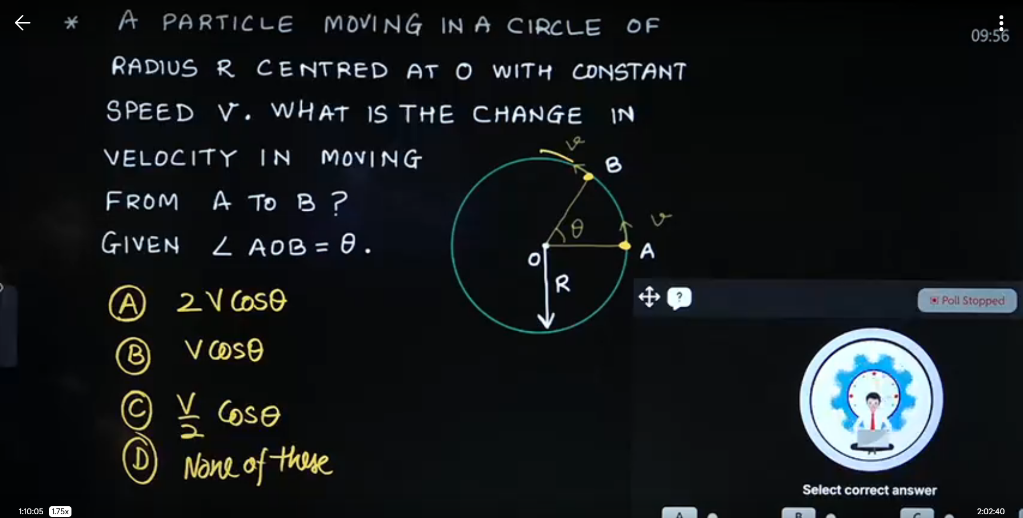 ¢ % A PARTICLE MOVING INA CIRCLE OF 09sh
RADIVS R CENTRED AT O WITH CONSTANT
SPEED V. WHAT 1S THE CHANGE IN
VELOCITY IN MOVING =~ o
FROM A To B ? TN .
GIVEN £ A0B=6. ( £8 A
® 2 so le + [ rotserped |
V ®s9
© YL Gso
© ou of toe SE
—— — a LE
This is AI generated Response.
Asked by: Priyanshu Yadav
Created at: 2025-09-27 15:24:04
Asked by: Priyanshu Yadav
Created at: 2025-09-27 15:24:04
Final Answer:
Rendered
Raw Text
Did you like this answer?
# Step-by-Step Solution
## Problem Recap
A particle moves in a circle of radius \( r \) with center \( O \) and constant speed v \).
It moves from \( A \) to point \( B \), where \( \angle AOB = \theta \).
**Question:** What is the change in velocity (\(\Delta \vec{v}\)) as it moves from \( A \) to \( B \)?
---
## Step 1: Understanding the Problem
- The velocity at any point is tangent to the circle.
- At \( A \) and \( B \), the magnitudes of velocity are equal (\( v \)), but the directions are different.
- We are asked for the change in the velocity vector (i.e., \(\vec{v}_B - \vec{v}_A\)), **not** the change in speed.
---
## Step 2: Drawing the Velocity Vectors
Let’s assume:
- The velocity at \( A \) is tangent to the circle at \( A \).
- The velocity at \( B \) is tangent to the circle at \( B \).
- Both vectors have magnitude \( v \).
- The angle between these two velocity vectors is exactly equal to the angle at the center: \( \theta \).
---
## Step 3: Using Vector Subtraction
The change in velocity vector is:
\[
\Delta \vec{v} = \vec{v}_B - \vec{v}_A
\]
The magnitude of the change is given by the chord length in the velocity space:
\[
|\Delta \vec{v}| = \sqrt{v^2 + v^2 - 2vv\cos\theta}
\]
\[
|\Delta \vec{v}| = \sqrt{2v^2(1 - \cos\theta)}
\]
\[
|\Delta \vec{v}| = v\sqrt{2(1 - \cos\theta)}
\]
---
## Step 4: Matching with the Answers
Let’s simplify \( v\sqrt{2(1 - \cos\theta)} \):
\[
1 - \cos\theta = 2\sin^2\left(\frac{\theta}{2}\right)
\]
So,
\[
|\Delta \vec{v}| = v\sqrt{2 \cdot 2\sin^2\left(\frac{\theta}{2}\right)}
= v\sqrt{4\sin^2\left(\frac{\theta}{2}\right)}
= 2v\sin\left(\frac{\theta}{2}\right)
\]
None of the given options match this value.
---
## Step 5: **Final Answer**
### **Correct Answer:**
**D) None of these**
**Explanation:**
The actual change in velocity is \( 2v\sin\left(\frac{\theta}{2}\right) \), which is not present among the options.
---
### **Summary Table**
| Step | Calculation/Reasoning | Result |
|------|----------------------------------------|-----------------------------|
| 1 | Velocity vectors at \( A \) and \( B \)| Separated by angle \( \theta \) |
| 2 | Magnitude of change in velocity | \( v\sqrt{2(1-\cos\theta)} \) |
| 3 | Trig simplification | \( 2v\sin(\theta/2) \) |
| 4 | Matching with options | **Not present** |
| 5 | **Correct Option** | **D) None of these** |
📢 Instructions:
- Ask anything relatd to above question only.
- For new Question goto :