Give step-by-step solution with explanation and final answer:wi.
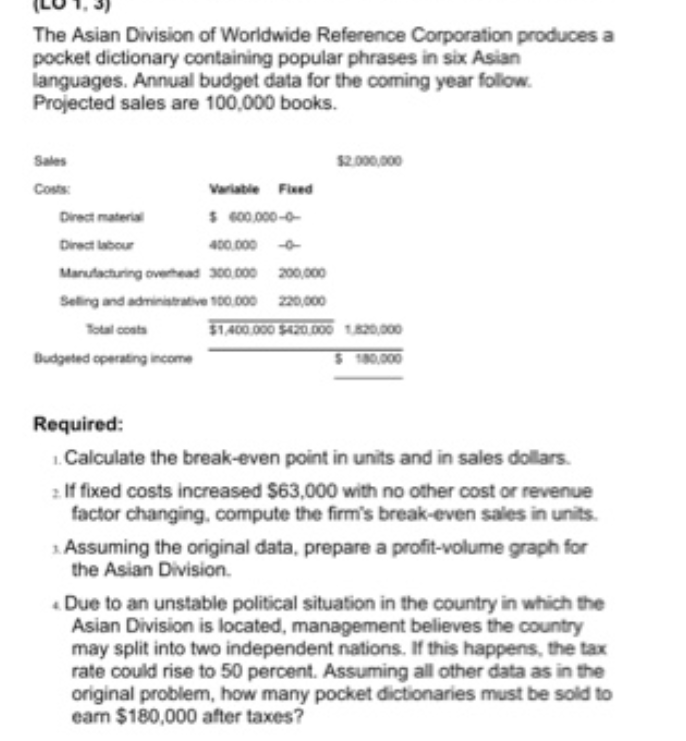
The Asian Division of Worldwide Reference Corporation produces a
pocket dictionary containing popular phrases in six Asian
languages. Annual budget data for the coming year follow.
Projected sales are 100,000 books.
Sakes. $2,000,000
Coss: Varlatie Fined
Owe: mater $600 .000-0-
Dwect ladour “0000 -0-
Manutachring overhead 300.000 200,000
Selig and admatatve O000 220,000
Total cents $7400.00 SA 000 1420.00
Oudgeted cpmrating come § W080
Required:
1 Calculate the break-even point in units and in sales dollars.
+ If fixed costs increased $63,000 with no other cost or revenue
factor changing, compute the firm's break-even sales in units.
+ Assuming the original data, prepare a profit-volume graph for
the Asian Division.
« Due to an unstable political situation in the country in which the
Asian Division is located, management believes the country
may split into two independent nations. If this happens, the tax
rate could rise to 50 percent. Assuming all other data as in the
onginal problem, how many pocket dictionaries must be soid to
eam $180,000 after taxes?
Question:
Give step-by-step solution with explanation and final answer:wi.
The Asian Division of Worldwide Reference Corporation produces a
pocket dictionary containing popular phrases in six Asian
languages. Annual budget data for the coming year follow.
Projected sales are 100,000 books.
Sakes. $2,000,000
Coss: Varlatie Fined
Owe: mater $600 .000-0-
Dwect ladour “0000 -0-
Manutachring overhead 300.000 200,000
Selig and admatatve O000 220,000
Total cents $7400.00 SA 000 1420.00
Oudgeted cpmrating come § W080
Required:
1 Calculate the break-even point in units and in sales dollars.
+ If fixed costs increased $63,000 with no other cost or revenue
factor changing, compute the firm's break-even sales in units.
+ Assuming the original data, prepare a profit-volume graph for
the Asian Division.
« Due to an unstable political situation in the country in which the
Asian Division is located, management believes the country
may split into two independent nations. If this happens, the tax
rate could rise to 50 percent. Assuming all other data as in the
onginal problem, how many pocket dictionaries must be soid to
eam $180,000 after taxes?
This is AI generated Response.
Asked by: Nishant Saini
Created at: 2025-09-27 14:42:15
Thought Process:
RenderedRaw Text
**Calculating profit requirements**
I'm preparing a profit-volume graph for the Asian Division, considering that a political split could raise tax rates to 50%. I need to figure out how many pocket dictionaries must be sold to net $180,000 after taxes.
Assuming 100,000 projected book sales at $20 each, with variable costs at $1.4 million ($14 per book), I find the contribution margin is $6 per book. So, with fixed costs of $420,000, my projected operating income checks out as $180,000.**Calculating break-even analysis**
First, I'm calculating the break-even point. The break-even in units is found using fixed costs divided by contribution margin per unit, which is 70,000 units. For sales dollars, that translates to $1,400,000.
Now, if fixed costs increase by $63,000, the new total is $483,000. This means the new break-even units are 80,500, which checks out.
Next, for the profit-volume graph: I can't draw it out here, but I can explain. The x-axis should represent either units or sales dollars, while the y-axis represents profit, with the line's slope based on the contribution margin.**Describing the profit-volume graph**
To plot this profit-volume graph, I'd choose the sales dollars for the x-axis with a slope of 0.30 based on the contribution margin ratio. The intercept would be -$420,000, and I might provide sample points at $0 and $2,000,000. For instance, at $2 million in sales, the profit would be $180,000.
Now, for the after-tax target profit of $180,000 with a 50% tax rate, I'd need a pre-tax operating income of $360,000. This translates to needing 130,000 units to cover both fixed costs and targeted profit!**Describing the profit-volume graph**
I'm outlining the profit-volume graph, where the intercept is at -$420,000. The break-even point is at $1,400,000 in sales or 70,000 units. The slope reflects the contribution margin ratio of 0.30 or $6 per unit, and at $2,000,000 in sales, the profit reaches $180,000.
Now, for the unit calculations: the selling price per unit is $20, the variable cost is $14, resulting in a contribution margin of $6. The new break-even with increased fixed costs leads to 80,500 units. The graph will also show points at different unit sales reflecting respective profits.**Explaining the plotting process**
To plot the profit-volume graph, I need to show the method clearly. First, for after-tax profit, I’ll convert it to before-tax so I can compute the required number of units sold. I should also consider the impact of a 50% tax on contributions, noting that taxes apply only to profits, not fixed or variable costs.
I’ll organize this with a horizontal axis for sales dollars and a vertical axis for profit. For clarity, I’ll include step-by-step calculations and present final answers in a simple, numbered format without heavy formatting. Let's craft this thoroughly!
Final Answer:
RenderedRaw Text
Did you like this answer?
Step 0. Pull unit data from the budget
- Projected units: 100,000 books
- Sales dollars: $2,000,000 → Selling price per unit = 2,000,000 / 100,000 = $20
- Total variable costs: $1,400,000 → Variable cost per unit = 1,400,000 / 100,000 = $14
- Contribution margin (CM) per unit = $20 − $14 = $6
- CM ratio = 6 / 20 = 0.30 (30%)
- Fixed costs (total) = $420,000
- Check: Total CM at 100,000 units = 100,000 × 6 = $600,000; Profit = 600,000 − 420,000 = $180,000 (matches the budget)
1) Break-even point
- In units: BEU = Fixed costs / CM per unit = 420,000 / 6 = 70,000 units
- In sales dollars: BES$ = Fixed costs / CM ratio = 420,000 / 0.30 = $1,400,000
(Consistent: 70,000 units × $20 = $1,400,000)
Final answer for (1): 70,000 units; $1,400,000 of sales.
2) Break-even with fixed costs up by $63,000
- New fixed costs = 420,000 + 63,000 = $483,000
- New BE in units = 483,000 / 6 = 80,500 units
Final answer for (2): 80,500 units.
3) Profit–volume (P–V) graph (how to plot)
- Horizontal axis: sales volume (units) or sales dollars; vertical axis: profit (loss).
- Intercept at zero sales: profit = −Fixed costs = −$420,000.
- Slope of the profit line: CM per unit = $6 per unit (or CM ratio = 0.30 if plotting against sales dollars).
- Break-even point: 70,000 units (or $1,400,000 of sales) where profit = $0.
- Example points to place on the line:
- 0 units → −$420,000
- 70,000 units → $0
- 100,000 units → 100,000 × $6 − 420,000 = $180,000
- 120,000 units → 120,000 × $6 − 420,000 = $300,000
Connect these points with a straight line; the line crosses the horizontal axis at 70,000 units ($1,400,000).
4) Units needed to earn180,000 after taxes at a 50% tax rate
- Required before-tax operating income = After-tax / (1 − tax rate) = 180,000 / (1 − 0.50) = 180,000 / 0.50 = $360,000
- Required total CM = Fixed costs + required before-tax income = 420,000 + 360,000 = $780,000
- Required units = 780,000 / 6 = 130,000 units
Final answer for (4): 130,000 pocket dictionaries.
VIPSolutions focuses on clear, step‑by‑step explanations so you can learn quickly. Whether you need an AI‑generated walkthrough or a short hint to get unstuck, each solution is organized for fast reading and easy review later.
Search similar questions, compare approaches, and bookmark the best answers for revision. Our goal is simple: quick, reliable study help that feels natural—not noisy.
 VIPSolutions
 wi.
The Asian Division of Worldwide Reference Corporation produces a
pocket dictionary containing popular phrases in six Asian
languages. Annual budget data for the coming year follow.
Projected sales are 100,000 books.
Sakes. $2,000,000
Coss: Varlatie Fined
Owe: mater $600 .000-0-
Dwect ladour “0000 -0-
Manutachring overhead 300.000 200,000
Selig and admatatve O000 220,000
Total cents $7400.00 SA 000 1420.00
Oudgeted cpmrating come § W080
Required:
1 Calculate the break-even point in units and in sales dollars.
+ If fixed costs increased $63,000 with no other cost or revenue
factor changing, compute the firm's break-even sales in units.
+ Assuming the original data, prepare a profit-volume graph for
the Asian Division.
« Due to an unstable political situation in the country in which the
Asian Division is located, management believes the country
may split into two independent nations. If this happens, the tax
rate could rise to 50 percent. Assuming all other data as in the
onginal problem, how many pocket dictionaries must be soid to
eam $180,000 after taxes?