 VIPSolutions
Give step-by-step solution with explanation and final answer:Electric circuits are not limited to purely resistive elements; many practical systems involve recistors in combination with capacitors or inductors, Capaci- tors, for example, play an important role in storing and releasing energy, filtering signals, and managing voltage fluctuations in electrical networks. Underst- anding the charging and discharging behavior of a capacitor in a DC-circult is a key step for engineers learning how to analyze time-dependent electrical responses. A DC circuit consist of a 9 V battery connected in series with a resistor of 3Q and a capacitor of 10000 iF This circuit illustrates the concept of transient behavi- or, where the capacitor gradually charges until it reaches the supply voltage. Such circuits are fundamental in designing electronic filters, timers, and memory elements Given: » Battery Voltage, V=9V « Resistor, R=3Q « Capacitor, C = 1000 uF Determine: 1. The time constant of the RC circuit. 2. Formula for time constant: z= R- C 3. Substitution of values to calculate the time constant. 4. Expression for capacitor voltage during charging: V,.t)=V({1 —e i) 5. Calculate the capacitor voltage after t = 3 s.
Question:
Give step-by-step solution with explanation and final answer: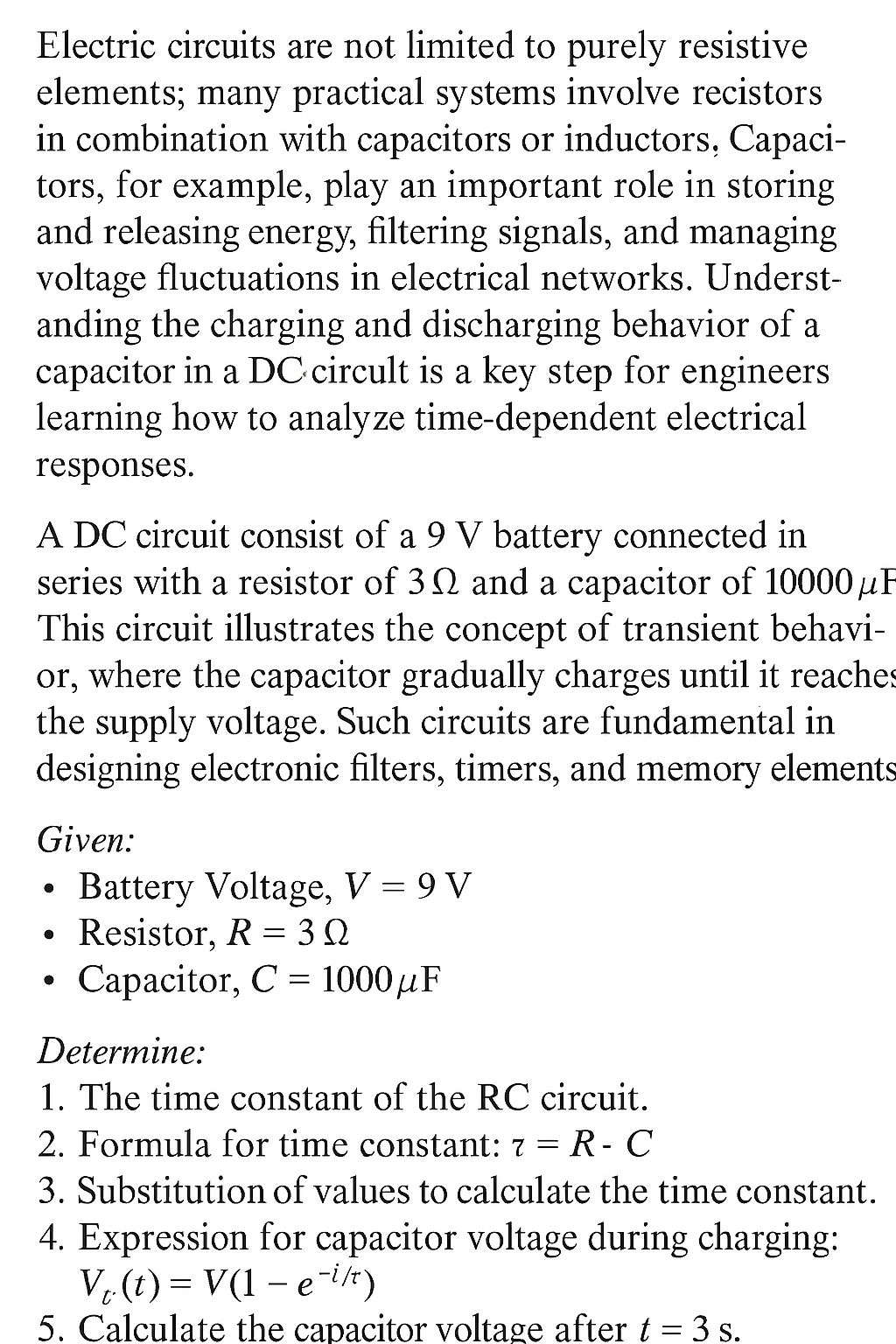 Electric circuits are not limited to purely resistive
elements; many practical systems involve recistors
in combination with capacitors or inductors, Capaci-
tors, for example, play an important role in storing
and releasing energy, filtering signals, and managing
voltage fluctuations in electrical networks. Underst-
anding the charging and discharging behavior of a
capacitor in a DC-circult is a key step for engineers
learning how to analyze time-dependent electrical
responses.
A DC circuit consist of a 9 V battery connected in
series with a resistor of 3Q and a capacitor of 10000 iF
This circuit illustrates the concept of transient behavi-
or, where the capacitor gradually charges until it reaches
the supply voltage. Such circuits are fundamental in
designing electronic filters, timers, and memory elements
Given:
» Battery Voltage, V=9V
« Resistor, R=3Q
« Capacitor, C = 1000 uF
Determine:
1. The time constant of the RC circuit.
2. Formula for time constant: z= R- C
3. Substitution of values to calculate the time constant.
4. Expression for capacitor voltage during charging:
V,.t)=V({1 —e i)
5. Calculate the capacitor voltage after t = 3 s.
Asked by: Aman
Created at: 2025-09-27 12:26:27
Final Answer:
📢 Instructions:
- Ask anything relatd to above question only.
- For new Question goto :