 VIPSolutions
Give step-by-step solution with explanation and final answer:Electric circuits form the foundation of electrical engineering, as all machines and systems ultimately rely on current and volfage behaivior in resistive, inductive, or capacitive eiements. lniderstanding simple resistive circuits is the first step toward mastering more advanced elec- trical networks. The ability to apply Ohm's Law and basic power form- ulas is essential for engineers to analyze ad design practical systems such as lighting circuits, battery chargers, and household appliances. A DC circuit consists of a 12 V battery connected across a resistor of 6 Q. This is one of the simplest examples of an electrical network, yet it dem- onstrates the basic consepts of current flow, voltage drop, and power dissipation. Engineers often begin with such elementary circuits to understand how electrical energy is converted into heat or Given: + Battery Voltage, V=12V » Resistor, R=6Q Determine: 1. The current flowing through the resistor. 2. Formula for current: I = z 3. Substitution of values to calculate current: P=VxIor P=I*R 4. Substitution of calculated current to find power. 6. Final numerical results with correct units (Amperes an Watts).
Question:
Give step-by-step solution with explanation and final answer: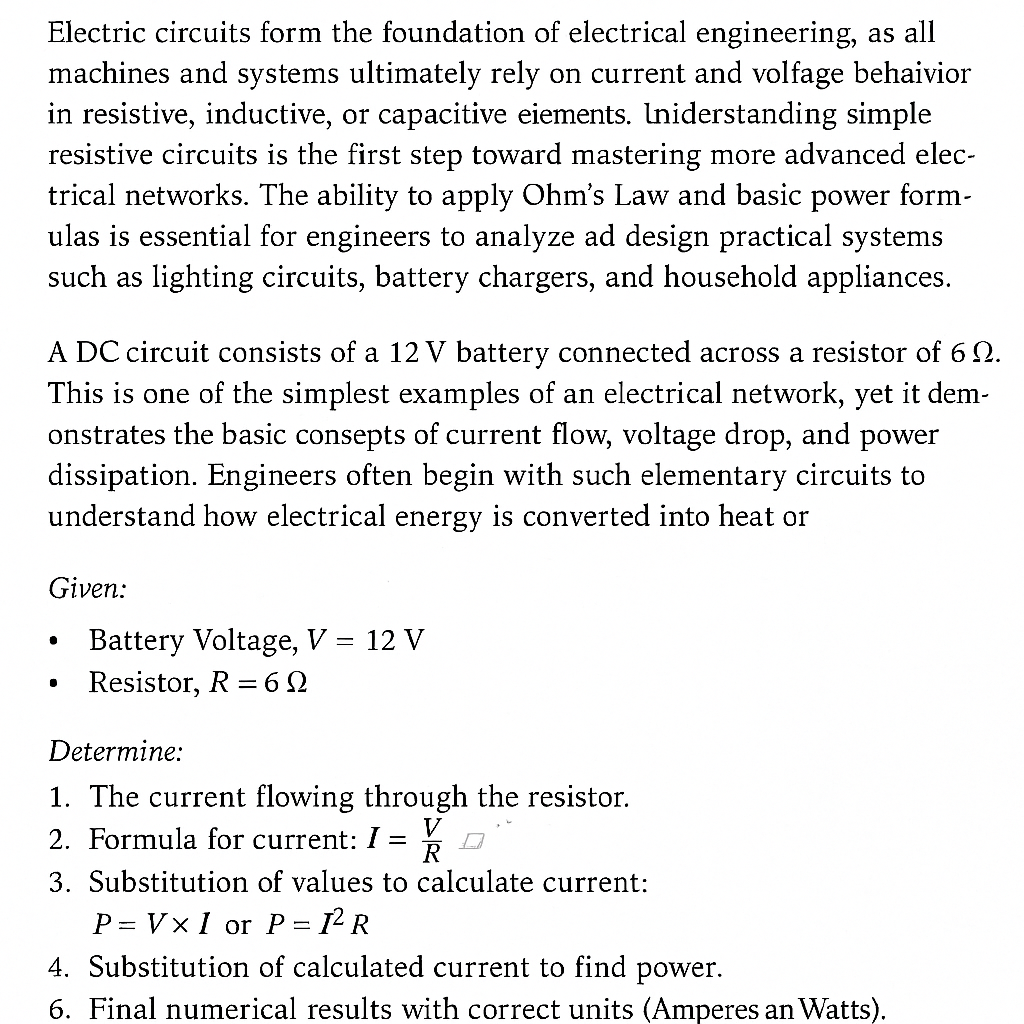 Electric circuits form the foundation of electrical engineering, as all
machines and systems ultimately rely on current and volfage behaivior
in resistive, inductive, or capacitive eiements. lniderstanding simple
resistive circuits is the first step toward mastering more advanced elec-
trical networks. The ability to apply Ohm's Law and basic power form-
ulas is essential for engineers to analyze ad design practical systems
such as lighting circuits, battery chargers, and household appliances.
A DC circuit consists of a 12 V battery connected across a resistor of 6 Q.
This is one of the simplest examples of an electrical network, yet it dem-
onstrates the basic consepts of current flow, voltage drop, and power
dissipation. Engineers often begin with such elementary circuits to
understand how electrical energy is converted into heat or
Given:
+ Battery Voltage, V=12V
» Resistor, R=6Q
Determine:
1. The current flowing through the resistor.
2. Formula for current: I = z
3. Substitution of values to calculate current:
P=VxIor P=I*R
4. Substitution of calculated current to find power.
6. Final numerical results with correct units (Amperes an Watts).
Asked by: Aman
Created at: 2025-09-27 12:13:04
Final Answer:
📢 Instructions:
- Ask anything relatd to above question only.
- For new Question goto :