 VIPSolutions
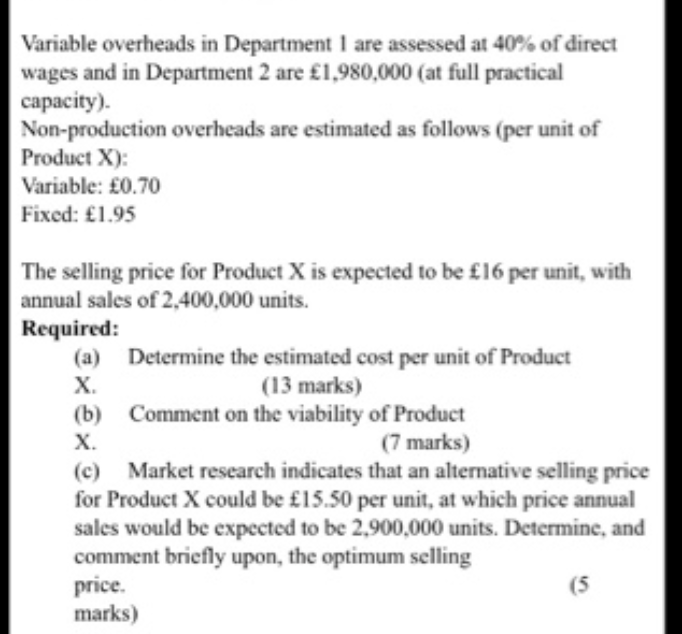
Give step-by-step solution with explanation and final answer:Decision on whether to launch a new product A company is currently manufacturing at only 60% of full practical capacity, in each of its two production departments, due 10 a reduction in market share. The company is secking to launch a new product which it is hoped will recover some lost sales. The estimated direct costs of the new product, Product X, are to be established from the following information: Direct materials: Every 100 units of the product will require 30 kilos net of Material A. Losses of 10% of materials input are to be expected. Material A costs £5.40 per kilo before discount. A quantity discount of 5% is given on all purchases if the monthly purchase quantity exceeds 25,000 kilos, Other materials are expected to cost £1.34 per unit of Product X. Direct labour (per hundred units): Department 1: 40 hours at £12.00 per hour. Department 2: 15 hours at £13.00 per hour. Scparate overhead absorption rates arc established for cach production department. Department | overheads are absorbed at 130% of direct wages, which is based upon the expected overhead costs and usage of capacity if Product X is launched. The rate in Department 2 is to be established as a rate per direct labour hour also based on expected usage of capacity. The following annual figures for Department 2 are based on full practical capacity: Overhead: £5,424,000 Direct labour hours: 2,200,000 Variable overheads in Department | are assessed at 40% of direct wages and in Department 2 are £1,980,000 (at full practical capacity). Variable overheads in Department | are assessed at 40% of direct wages and in Department 2 are £1,980,000 (at full practical capacity). Non-production overheads are estimated as follows (per unit of Product X) Variable: £0.70 Fixed: £1.95 The selling price for Product X is expected to be £16 per unit, with annual sales of 2,400,000 units. Required: (a) Determine the estimated cost per unit of Product X. (13 marks) (b) Comment on the viability of Product X. (7 marks) (¢) Market research indicates that an alternative selling price for Product X could be £15.50 per unit, at which price annual sales would be expected to be 2,900,000 units. Determine, and comment briefly upon, the optimum selling price & marks)
Question:
Give step-by-step solution with explanation and final answer: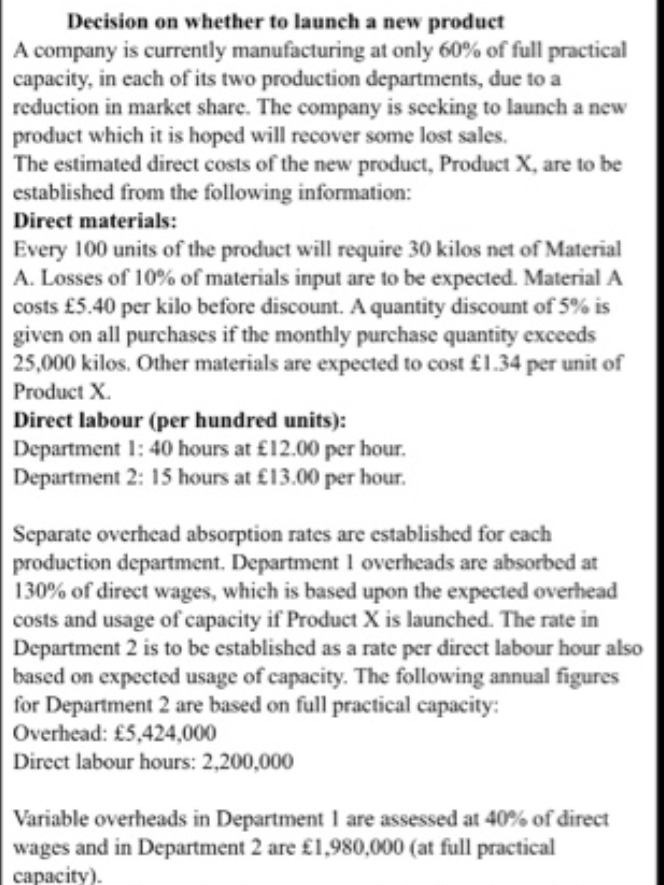
 Decision on whether to launch a new product
A company is currently manufacturing at only 60% of full practical
capacity, in each of its two production departments, due 10 a
reduction in market share. The company is secking to launch a new
product which it is hoped will recover some lost sales.
The estimated direct costs of the new product, Product X, are to be
established from the following information:
Direct materials:
Every 100 units of the product will require 30 kilos net of Material
A. Losses of 10% of materials input are to be expected. Material A
costs £5.40 per kilo before discount. A quantity discount of 5% is
given on all purchases if the monthly purchase quantity exceeds
25,000 kilos, Other materials are expected to cost £1.34 per unit of
Product X.
Direct labour (per hundred units):
Department 1: 40 hours at £12.00 per hour.
Department 2: 15 hours at £13.00 per hour.
Scparate overhead absorption rates arc established for cach
production department. Department | overheads are absorbed at
130% of direct wages, which is based upon the expected overhead
costs and usage of capacity if Product X is launched. The rate in
Department 2 is to be established as a rate per direct labour hour also
based on expected usage of capacity. The following annual figures
for Department 2 are based on full practical capacity:
Overhead: £5,424,000
Direct labour hours: 2,200,000
Variable overheads in Department | are assessed at 40% of direct
wages and in Department 2 are £1,980,000 (at full practical
capacity).
Variable overheads in Department | are assessed at 40% of direct
wages and in Department 2 are £1,980,000 (at full practical
capacity).
Non-production overheads are estimated as follows (per unit of
Product X)
Variable: £0.70
Fixed: £1.95
The selling price for Product X is expected to be £16 per unit, with
annual sales of 2,400,000 units.
Required:
(a) Determine the estimated cost per unit of Product
X. (13 marks)
(b) Comment on the viability of Product
X. (7 marks)
(¢) Market research indicates that an alternative selling price
for Product X could be £15.50 per unit, at which price annual
sales would be expected to be 2,900,000 units. Determine, and
comment briefly upon, the optimum selling
price &
marks)
Asked by: Nishant Saini
Created at: 2025-09-27 10:34:05
Final Answer:
📢 Instructions:
- Ask anything relatd to above question only.
- For new Question goto :