VIPSolutions logo ✨ VIPSolutions

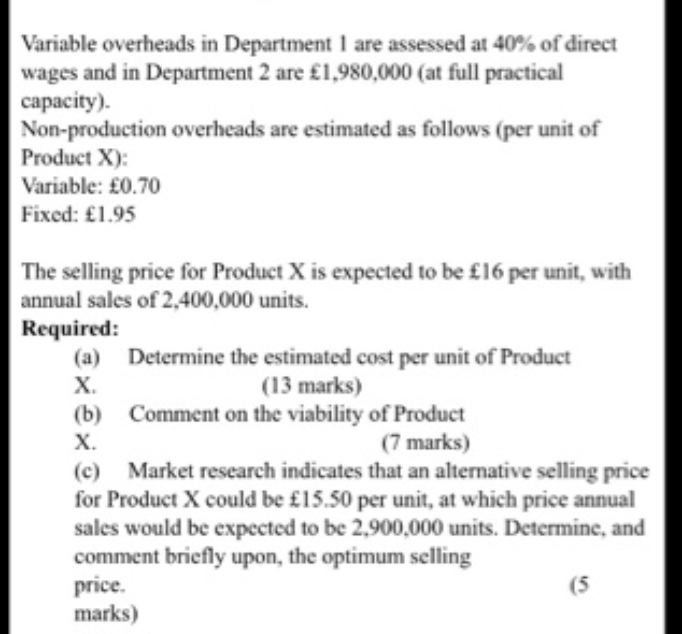
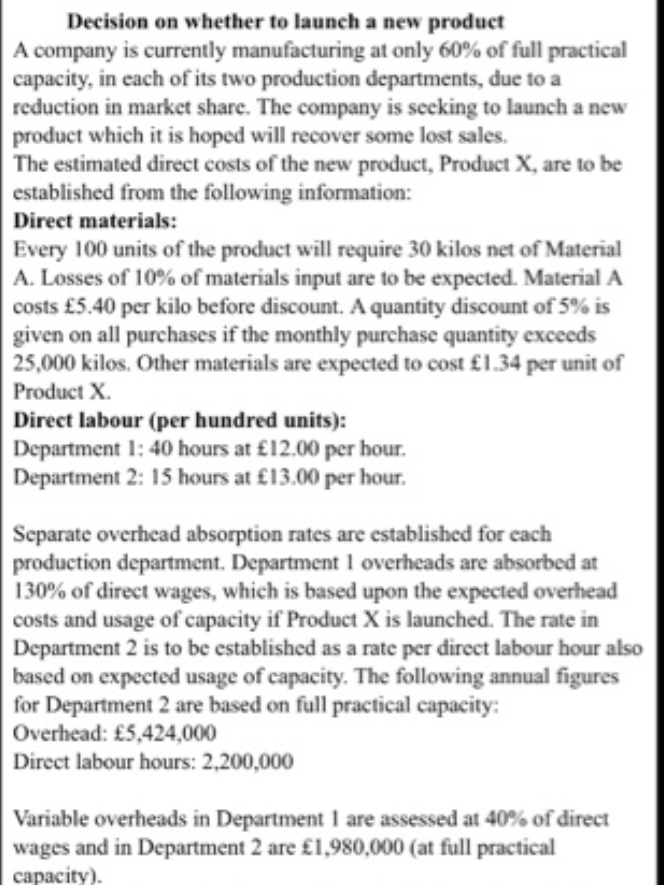
Give step-by-step solution with explanation and final answer:Decision on whether to launch a new product A company is currently manufacturing at only 60% of full practical capacity, in each of its two production departments, due 10 a reduction in market share. The company is secking to launch a new product which it is hoped will recover some lost sales. The estimated direct costs of the new product, Product X, are to be established from the following information: Direct materials: Every 100 units of the product will require 30 kilos net of Material A. Losses of 10% of materials input are to be expected. Material A costs £5.40 per kilo before discount. A quantity discount of 5% is given on all purchases if the monthly purchase quantity exceeds 25,000 kilos, Other materials are expected to cost £1.34 per unit of Product X. Direct labour (per hundred units): Department 1: 40 hours at £12.00 per hour. Department 2: 15 hours at £13.00 per hour. Scparate overhead absorption rates arc established for cach production department. Department | overheads are absorbed at 130% of direct wages, which is based upon the expected overhead costs and usage of capacity if Product X is launched. The rate in Department 2 is to be established as a rate per direct labour hour also based on expected usage of capacity. The following annual figures for Department 2 are based on full practical capacity: Overhead: £5,424,000 Direct labour hours: 2,200,000 Variable overheads in Department | are assessed at 40% of direct wages and in Department 2 are £1,980,000 (at full practical capacity). Variable overheads in Department | are assessed at 40% of direct wages and in Department 2 are £1,980,000 (at full practical capacity). Non-production overheads are estimated as follows (per unit of Product X) Variable: £0.70 Fixed: £1.95 The selling price for Product X is expected to be £16 per unit, with annual sales of 2,400,000 units. Required: (a) Determine the estimated cost per unit of Product X. (13 marks) (b) Comment on the viability of Product X. (7 marks) (¢) Market research indicates that an alternative selling price for Product X could be £15.50 per unit, at which price annual sales would be expected to be 2,900,000 units. Determine, and comment briefly upon, the optimum selling price & marks)

Question:

Give step-by-step solution with explanation and final answer:Uploaded ImageUploaded ImageDecision on whether to launch a new product A company is currently manufacturing at only 60% of full practical capacity, in each of its two production departments, due 10 a reduction in market share. The company is secking to launch a new product which it is hoped will recover some lost sales. The estimated direct costs of the new product, Product X, are to be established from the following information: Direct materials: Every 100 units of the product will require 30 kilos net of Material A. Losses of 10% of materials input are to be expected. Material A costs £5.40 per kilo before discount. A quantity discount of 5% is given on all purchases if the monthly purchase quantity exceeds 25,000 kilos, Other materials are expected to cost £1.34 per unit of Product X. Direct labour (per hundred units): Department 1: 40 hours at £12.00 per hour. Department 2: 15 hours at £13.00 per hour. Scparate overhead absorption rates arc established for cach production department. Department | overheads are absorbed at 130% of direct wages, which is based upon the expected overhead costs and usage of capacity if Product X is launched. The rate in Department 2 is to be established as a rate per direct labour hour also based on expected usage of capacity. The following annual figures for Department 2 are based on full practical capacity: Overhead: £5,424,000 Direct labour hours: 2,200,000 Variable overheads in Department | are assessed at 40% of direct wages and in Department 2 are £1,980,000 (at full practical capacity). Variable overheads in Department | are assessed at 40% of direct wages and in Department 2 are £1,980,000 (at full practical capacity). Non-production overheads are estimated as follows (per unit of Product X) Variable: £0.70 Fixed: £1.95 The selling price for Product X is expected to be £16 per unit, with annual sales of 2,400,000 units. Required: (a) Determine the estimated cost per unit of Product X. (13 marks) (b) Comment on the viability of Product X. (7 marks) (¢) Market research indicates that an alternative selling price for Product X could be £15.50 per unit, at which price annual sales would be expected to be 2,900,000 units. Determine, and comment briefly upon, the optimum selling price & marks)
This is AI generated Response.
Asked by: Nishant Saini
Created at: 2025-09-27 10:05:51

Final Answer:

Rendered Raw Text
Did you like this answer?
# Step-by-Step Solution Let's address each requirement **step by step** with explanations. --- ## (a) **Estimated Cost Per Unit of Product X** ### 1. **Direct Materials** #### - **Material A:** - Every 100 units requires 30 kg net - **Losses:** 10% input loss → Input required = \( \frac{30}{.9} = 33.33 \) kg per 100 units - **Cost per kg:** £5.40 (before discount) - **Quantity Discount:** 5% if monthly > 25,000 kg - **Annual production:** 2,400,000 units - 100 units batch: \( \frac{2,400,000}{100} = 24,000 \) batches - Total kg needed: \( 33.33 \text{ kg} \times 24,000 = 799,920 \text{ kg} \) - Monthly: \( \frac{799,920}{12} = 66,660 \) kg > 25,000 kg → **Discount applies** - **Discounted price per kg:** \( 5.40 \times .95 = £5.13 \) - **Cost per 100 units:** \( 33.33 \text{ kg} \times £5.13 = £171.10 \) - **Cost per unit:** \( \frac{£171.10}{100} = £1.711 \) #### - **Other Materials:** £1.34 per unit #### - **Total Direct Materials per unit:** \( 1.711 + 1.34 = £3.051 \) --- ### 2. **Direct Labour** (per 100 units): #### - **Department 1:** 40 hours × £12 = £480 #### - **Department 2:** 15 hours × £13 = £195 #### - **Total Direct Labour per 100 units:** £480 + £195 = £675 Per unit: \( \frac{£675}{100} = £6.75 \) --- ### 3. **Overheads** #### - **Department 1 Overheads (130% of direct wages):** - Direct wages (per 100 units): £480 - Overheads: £480 × 130% = £624 - Per unit: \( \frac{£624}{100} = £6.24 \) #### - **Department 2 Overheads (rate per direct labour hour):** - Overhead: £5,424,000 / 2,200,000 hours = **£2.465 per hour** - Department 2 hours per 100 units: 15 - Overheads per 100 units: 15 × £2.465 = £36.975 - Per unit: \( \frac{£36.975}{100} = £.3698 \) #### - **Variable Overheads:** - **Department 1:** 40% of direct wages 40% × £480 = £192 per 100 units → 1.92 per unit - **Department 2:** Total annual variable overheads: £1,980,000 / 2,200,000 = **£.90 per labour hour** 15 hours × £.90 = £13.50 per 100 units → .135 per unit #### - **Total Variable Overheads per unit:** Dept 1: 1.92 Dept 2: .135 **Total:** 2.055 #### - **Non-production Overheads:** - Variable: £.70 per unit - Fixed: £1.95 per unit --- ### 4. **Total Cost Per Unit Calculation** | Cost Component | Per Unit (£) | |---------------------------|------------------| | Direct material | 3.051 | | Direct labour | 6.75 | | Dept 1 overhead | 6.24 | | Dept 2 overhead | .3698 | | Dept 1 var. overhead | 1.92 | | Dept 2 var. overhead | .135 | | Non-prod var overhead | .70 | | Non-prod fixed overhead | 1.95 | | **Total Cost per unit** | **21.115** | --- ## (b) **Comment on the Viability** - **Selling price per unit:** £16 - **Cost per unit:** £21.115 - **Loss per unit:** £21.115 - £16 = **£5.115** - **Annual loss:** £5.115 × 2,400,000 = **£12,276,000** ### **Comment:** Launching Product X at the given price would result in a significant loss per unit. The cost structure is too high relative to the expected selling price. Unless costs can be reduced or the selling price increased, the product is not viable. --- ## (c) **Alternative Price Analysis** - **Alternative selling price:** £15.50 - **Expected annual sales:** 2,900,000 units - **Loss per unit:** £21.115 - £15.50 = **£5.615** - **Total loss:** £5.615 × 2,900,000 = **£16,283,500** ### **Optimum Selling Price:** - At £16 per unit: loss = **£12.28 million** - At £15.50 per unit: loss = **£16.28 million** **Therefore, the current price of £16 is preferable.** If the company cannot cut costs or increase the price, launching is not recommended. --- ## **Summary Table** | Scenario | Units | Selling Price | Cost per Unit | Loss per Unit | Total Loss | |--------------------|---------|---------------|---------------|---------------|--------------| | Current price | 2,400,000 | £16 | £21.115 | £5.115 | £12,276,000 | | Alternative price | 2,900,000 | £15.50 | £21.115 | £5.615 | £16,283,500 | --- ## **Final Answers** ### (a) **Estimated Cost per Unit:** **£21.12** (rounded to 2 decimal places) ### (b) **Viability:** Not viable at current costs and selling prices; would generate losses. ### (c) **Optimum Price:** £16 per unit (lower loss than at £15.50). Launch is not recommended unless costs are reduced or price increased. --- If you need the workings in spreadsheet form or further breakdown for each overhead, let me know!

📢 Instructions:

  • Ask anything relatd to above question only.
  • For new Question goto :

Study Help, Fast Answers

VIPSolutions focuses on clear, step‑by‑step explanations so you can learn quickly. Whether you need an AI‑generated walkthrough or a short hint to get unstuck, each solution is organized for fast reading and easy review later.

Search similar questions, compare approaches, and bookmark the best answers for revision. Our goal is simple: quick, reliable study help that feels natural—not noisy.