 VIPSolutions
Give step-by-step solution with explanation and final answer:LA (0,1), Forsch dfn econ ant drm eects we cat DEAXASR, f(a) = (1-2) fe FAXASA, so) =yia—) 3 ME—— | DEAXAS AXA, fo) = (23) inten Hen = 01% eal = (1-2) 9) DSA ASZ, fe =fpz-1l—y RAXASZ dap) (oali oh) DFA 4, S6)=v TAXA 4, Home
Question:
Give step-by-step solution with explanation and final answer: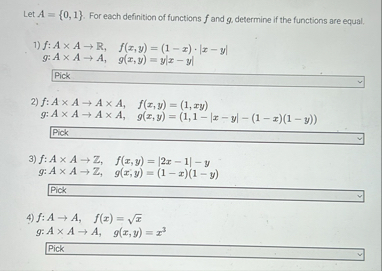 LA (0,1), Forsch dfn econ ant drm eects we cat
DEAXASR, f(a) = (1-2) fe
FAXASA, so) =yia—)
3 ME—— |
DEAXAS AXA, fo) = (23)
inten Hen = 01% eal = (1-2) 9)
DSA ASZ, fe =fpz-1l—y
RAXASZ dap) (oali oh)
DFA 4, S6)=v
TAXA 4, Home
This is AI generated Response.
Asked by: venky
Created at: 2025-09-27 10:01:27
Asked by: venky
Created at: 2025-09-27 10:01:27
Final Answer:
Rendered
Raw Text
Did you like this answer?
Let's analyze each pair of functions step by step.
Set \( A = \{, 1\} \).
---
## 1. \( f: A \times A \to \mathbb{R} \), \( f(x, y) = (1-x) \cdot |x-y| \)
\( g: A \times A \to \mathbb{R} \), \( g(x, y) = y|x-y| \)
Let's compute for all possible values of \( x \) and \( y \):
- **Case 1:** \( x = , y = \)
- \( f(, ) = (1-)|-| = 1 \cdot = \)
- \( g(, ) = |-| = \)
- **Case 2:** \( x = , y = 1 \)
- \( f(, 1) = (1-)|-1| = 1 \cdot 1 = 1 \)
- \( g(, 1) = 1|-1| = 1 \cdot 1 = 1 \)
- **Case 3:** \( x = 1, y = \)
- \( f(1, ) = (1-1)|1-| = \cdot 1 = \)
- \( g(1, ) = |1-| = \cdot 1 = \)
- **Case 4:** \( x = 1, y = 1 \)
- \( f(1, 1) = (1-1)|1-1| = \cdot = \)
- \( g(1, 1) = 1|1-1| = 1 \cdot = \)
**Conclusion:**
\( f(x, y) = g(x, y) \) for all \( x, y \in A \).
**Functions are equal.**
---
## 2. \( f: A \times A \to A \times A \), \( f(x, y) = (1, xy) \)
\( g: A \times A \to A \times A \), \( g(x, y) = (1, 1 - |x - y|) \)
- \( xy \) is 1 only if both \( x = 1 \) and \( y = 1 \), otherwise .
- \( |x - y| \) is if \( x = y \), 1 if \( x \neq y \).
- \( 1 - |x - y| \) is 1 if \( x = y \), if \( x \neq y \).
Let's check all cases for the second component:
- \( x = y \): \( xy = x \), \( 1 - |x-y| = 1 \), so if \( x = 1 \): \( xy = 1 \), \( 1 - |x-y| = 1 \),
if \( x = \): \( xy = \), \( 1 - |x-y| = 1 \). Not equal.
- \( x \neq y \): \( xy = \), \( 1 - |x-y| = \).
So, for \( (x, y) = (, ) \), \( f(, ) = (1, ) \), \( g(, ) = (1, 1) \). Not equal.
**Conclusion:**
**Functions are not equal.**
---
## 3. \( f: A \times A \to \mathbb{Z} \), \( f(x, y) = |2x - 1| - y \)
\( g: A \times A \to \mathbb{Z} \), \( g(x, y) = (1-x)(1-y) \)
Let's compute for all cases:
- \( x = , y = \):
\( f(,) = |2 \cdot - 1| - = | - 1| - = 1- = 1 \)
\( g(,) = (1-)(1-) = 1 \cdot 1 = 1 \)
- \( x = , y = 1 \):
\( f(,1) = | - 1| - 1 = 1 - 1 = \)
\( g(,1) = (1-)(1-1) = 1 \cdot = \)
- \( x = 1, y = \):
\( f(1,) = |2 \cdot 1 - 1| - = |2-1| - = 1- = 1 \)
\( g(1,) = (1-1)(1-) = \cdot 1 = \)
- \( x = 1, y = 1 \):
\( f(1,1) = |2-1| - 1 = 1-1 = \)
\( g(1,1) = (1-1)(1-1) = \cdot = \)
So, the functions differ for \( (1, ) \).
**Conclusion:**
**Functions are not equal.**
---
## 4. \( f: A \to A \), \( f(x) = \sqrt{x} \)
\( g: A \to A \), \( g(x) = x^3 \)
Values for \( x = , 1 \):
- \( x = \): \( f() = \sqrt{} = \), \( g() = ^3 = \)
- \( x = 1 \): \( f(1) = \sqrt{1} = 1 \), \( g(1) = 1^3 = 1 \)
**Conclusion:**
**Functions are equal.**
---
# **Final Answers**
1. **Equal**
2. **Not Equal**
3. **Not Equal**
4. **Equal**
📢 Instructions:
- Ask anything relatd to above question only.
- For new Question goto :