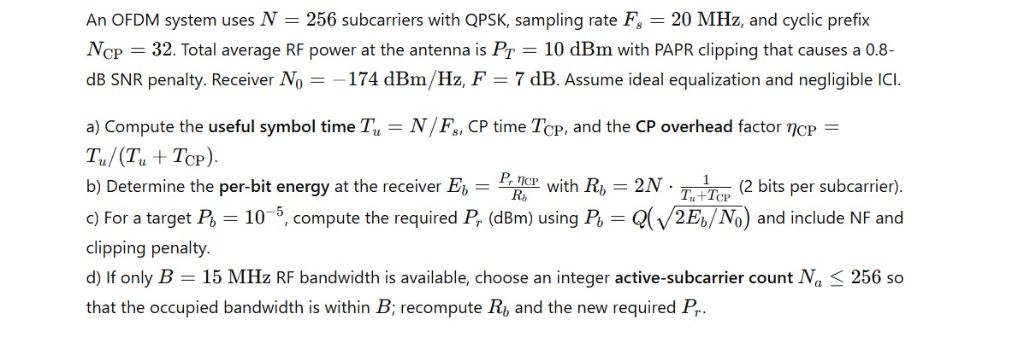
Give step-by-step solution with explanation and final answer:An OFDM system uses IV = 256 subcarriers with QPSK, sampling rate F, = 20 MHz, and cyclic prefix
Ncp = 32. Total average RF power at the antenna is Pp = 10 dBm with PAPR clipping that causes a 0.8-
dB SNR penalty. Receiver Ny = —174 dBm/Hz, F = 7 dB. Assume ideal equalization and negligible ICI.
a) Compute the useful symbol time 7, = N / F,, CP time Tp, and the CP overhead factor rcp =
T./(Tu + Tcp).-
b) Determine the per-bit energy at the receiver Ej, = Ler with Ry, = 2N + 7—L— (2 bits per subcarrier).
o) For a target P, = 10%, compute the required P, (dBm) using P, = Q(v/2E3/Ny) and include NF and
clipping penalty.
d) If only B = 15 MHz RF bandwidth is available, choose an integer active-subcarrier count N,, < 256 so
that the occupied bandwidth is within B; recompute Ry, and the new required P,..
Question:
Give step-by-step solution with explanation and final answer:An OFDM system uses IV = 256 subcarriers with QPSK, sampling rate F, = 20 MHz, and cyclic prefix
Ncp = 32. Total average RF power at the antenna is Pp = 10 dBm with PAPR clipping that causes a 0.8-
dB SNR penalty. Receiver Ny = —174 dBm/Hz, F = 7 dB. Assume ideal equalization and negligible ICI.
a) Compute the useful symbol time 7, = N / F,, CP time Tp, and the CP overhead factor rcp =
T./(Tu + Tcp).-
b) Determine the per-bit energy at the receiver Ej, = Ler with Ry, = 2N + 7—L— (2 bits per subcarrier).
o) For a target P, = 10%, compute the required P, (dBm) using P, = Q(v/2E3/Ny) and include NF and
clipping penalty.
d) If only B = 15 MHz RF bandwidth is available, choose an integer active-subcarrier count N,, < 256 so
that the occupied bandwidth is within B; recompute Ry, and the new required P,..
This is AI generated Response.
Asked by: Aman
Created at: 2025-09-27 08:53:23
Final Answer:
RenderedRaw Text
Did you like this answer?
Let's answer each part step by step:
---
## Given Data
- Number of subcarriers: \( N = 256 \)
- Sampling rate: \( F_s = 20\,\text{MHz} \)
- Cyclic prefix length: \( N_{CP} = 32 \)
- Total RF power at antenna: \( P_T = 10\,\text{dBm} \)
- PAPR clipping penalty: \( .8\,\text{dB SNR} \)
- Receiver noise power spectral density: \( N_ = -174\,\text{dBm/Hz} \)
- Noise figure: \( F = 7\,\text{dB} \)
- Available bandwidth: \( B = 15\,\text{MHz} \) (for part d)
---
## a) Useful Symbol Time and CP Overhead
### **1. Useful symbol time \(T_u\)**
\[
T_u = \frac{N}{F_s}
\]
\[
T_u = \frac{256}{20 \times 10^6} = 12.8\,\mu s
\]
### **2. Cyclic Prefix time \(T_{CP}\)**
\[
T_{CP} = \frac{N_{CP}}{F_s} = \frac{32}{20 \times 10^6} = 1.6\,\mu s
\]
### **3. CP overhead factor \( \eta_{CP} \)**
\[
\eta_{CP} = \frac{T_u}{T_u + T_{CP}} = \frac{12.8}{12.8 + 1.6} = \frac{12.8}{14.4} \approx .8889
\]
---
## b) Per-Bit Energy at the Receiver
\[
E_b = \frac{P_r \cdot \eta_{CP}}{R_b}
\]
Where,
\[
R_b = 2N \cdot \frac{1}{T_u + T_{CP}}
\]
- \(2\) bits per subcarrier (QPSK)
- Number of subcarriers: \(N = 256\)
- Symbol time: \(T_u + T_{CP} = 14.4\,\mu s\)
\[
R_b = 2 \times 256 \times \frac{1}{14.4 \times 10^{-6}} = 512 \times 69,444.4 = 35,555,555\,\text{bps} \approx 35.56\,\text{Mbps}
\]
So,
\[
E_b = \frac{P_r \cdot .8889}{35,555,555}
\]
---
## c) Required \( P_r \) for Target BER
**Given:**
\[
P_b = 10^{-5}
\]
For QPSK:
\[
P_b = Q\left(\sqrt{2 \frac{E_b}{N_}}\right)
\]
Find \(E_b/N_\) for \(P_b = 10^{-5}\):
From Q-function tables:
\[
Q(x) = 10^{-5} \implies x \approx 4.265
\]
So,
\[
2 \frac{E_b}{N_} = (4.265)^2 \implies \frac{E_b}{N_} = \frac{18.2}{2} = 9.1
\]
So,
\[
E_b = 9.1 \cdot N_
\]
**Include Noise Figure (NF) and Clipping Penalty:**
- \(NF = 7\,\text{dB}\) → Linear: \(10^{7/10} = 5.012\)
- Clipping penalty: \(.8\,\text{dB}\) → Linear: \(10^{.8/10} = 1.202\)
- Total: \(NF \times \text{Clipping Penalty} = 5.012 \times 1.202 = 6.026\)
So, required \(E_b\) increases by \(6.026\) times.
**Noise Power:**
\[
N_ = -174\,\text{dBm/Hz} = 10^{-17.4}\,\text{W/Hz} = 3.98 \times 10^{-18}\,\text{W/Hz}
\]
\[
E_b = 9.1 \cdot 3.98 \times 10^{-18} \cdot 6.026 = 2.18 \times 10^{-16}\,\text{J}
\]
Recall from (b):
\[
E_b = \frac{P_r \cdot .8889}{35,555,555}
\]
So,
\[
P_r = \frac{E_b \cdot 35,555,555}{.8889}
\]
\[
P_r = \frac{2.18 \times 10^{-16} \cdot 35,555,555}{.8889}
\]
\[
P_r = \frac{7.756 \times 10^{-9}}{.8889} = 8.73 \times 10^{-9}\,\text{W} = 8.73\,\text{nW}
\]
**Convert to dBm:**
\[
P_r (\text{dBm}) = 10 \log_{10}(8.73 \times 10^{-6}) = 10 \left(\log_{10}(8.73) - 6 \right) = 10 \times (-5.058) = -50.58\,\text{dBm}
\]
---
## d) Bandwidth Constraint
With \( B = 15\,\text{MHz} \):
\[
\text{Each subcarrier occupies: } \frac{F_s}{N}
\]
Total occupied bandwidth:
\[
B_{\text{occ}} = \frac{N_a}{N} F_s
\]
Set \( B_{\text{occ}} \leq 15\,\text{MHz} \):
\[
N_a = \frac{B \cdot N}{F_s} = \frac{15\,\text{MHz} \times 256}{20\,\text{MHz}} = 192
\]
So, use \( N_a = 192 \) active subcarriers.
**Update bitrate:**
\[
R_b = 2N_a \cdot \frac{1}{T_u + T_{CP}} = 2 \times 192 \times \frac{1}{14.4 \times 10^{-6}} = 384 \times 69,444.4 = 26,666,666 \approx 26.67\,\text{Mbps}
\]
**Update \(E_b\):**
\[
E_b = \frac{P_r \cdot .8889}{26,666,666}
\]
**Repeat step (c):**
\[
P_r = \frac{E_b \cdot 26,666,666}{.8889}
\]
\[
P_r = \frac{2.18 \times 10^{-16} \cdot 26,666,666}{.8889}
\]
\[
P_r = \frac{5.81 \times 10^{-9}}{.8889} = 6.54 \times 10^{-9}\,\text{W} = 6.54\,\text{nW}
\]
\[
P_r (\text{dBm}) = 10 \log_{10}(6.54 \times 10^{-6}) = 10 \times (\log_{10}(6.54) - 6) = 10 \times (-5.184) = -51.84\,\text{dBm}
\]
---
# **Summary Table**
| Part | Answer |
|------|--------|
| a) | \( T_u = 12.8\,\mu s \); \( T_{CP} = 1.6\,\mu s \); \( \eta_{CP} = .8889 \) |
| b) | \( E_b = \frac{P_r \cdot .8889}{35.56 \times 10^6} \) |
| c) | \( P_r \approx 8.73\,\text{nW} = -50.6\,\text{dBm} \) |
| d) | \( N_a = 192 \); \( R_b = 26.67\,\text{Mbps} \); \( P_r \approx 6.54\,\text{nW} = -51.8\,\text{dBm} \) |
---
**If you need clarification or further breakdown on any step, let me know!**
VIPSolutions focuses on clear, step‑by‑step explanations so you can learn quickly. Whether you need an AI‑generated walkthrough or a short hint to get unstuck, each solution is organized for fast reading and easy review later.
Search similar questions, compare approaches, and bookmark the best answers for revision. Our goal is simple: quick, reliable study help that feels natural—not noisy.
 VIPSolutions
 An OFDM system uses IV = 256 subcarriers with QPSK, sampling rate F, = 20 MHz, and cyclic prefix
Ncp = 32. Total average RF power at the antenna is Pp = 10 dBm with PAPR clipping that causes a 0.8-
dB SNR penalty. Receiver Ny = —174 dBm/Hz, F = 7 dB. Assume ideal equalization and negligible ICI.
a) Compute the useful symbol time 7, = N / F,, CP time Tp, and the CP overhead factor rcp =
T./(Tu + Tcp).-
b) Determine the per-bit energy at the receiver Ej, = Ler with Ry, = 2N + 7—L— (2 bits per subcarrier).
o) For a target P, = 10%, compute the required P, (dBm) using P, = Q(v/2E3/Ny) and include NF and
clipping penalty.
d) If only B = 15 MHz RF bandwidth is available, choose an integer active-subcarrier count N,, < 256 so
that the occupied bandwidth is within B; recompute Ry, and the new required P,..