 VIPSolutions
Give step-by-step solution with explanation and final answer:Ere— 0 Pushmnso (13) vx (24) rrr SERERE rennin RE oh HEE. te sss pestis cot = (D4 lg)» eee
Question:
Give step-by-step solution with explanation and final answer: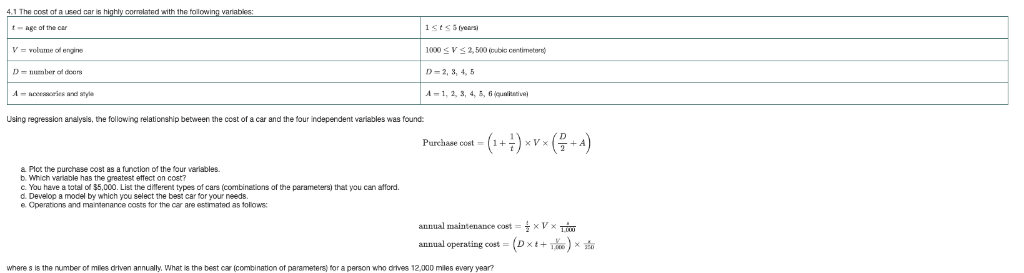 Ere—
0
Pushmnso (13) vx (24)
rrr
SERERE rennin
RE oh
HEE.
te
sss pestis cot = (D4 lg)»
eee
This is AI generated Response.
Asked by: venky
Created at: 2025-09-27 08:01:34
Asked by: venky
Created at: 2025-09-27 08:01:34
Final Answer:
Rendered
Raw Text
Did you like this answer?
Let's break down the problem step by step, using the information and equations provided.
---
## 1. **Variables and Equations**
### **Variables**
- **t** = age of the car (1 ≤ t ≤ 5 years)
- **V** = volume of engine (100 ≤ V ≤ 250 cc)
- **D** = number of doors (2, 3, 4, 5)
- **A** = accessories and style (A = 1, 2, 3, 4, 5)
- **x** = number of miles driven annually
### **Cost Equations**
- **Purchase cost:**
\[
\text{Purchase cost} = \left(1 + \frac{t}{5}\right) \times V \times \left(\frac{D}{7} + A\right)
\]
- **Annual maintenance cost:**
\[
\text{Annual maintenance cost} = \frac{t}{2} \times V \times \frac{x}{100}
\]
- **Annual operating cost:**
\[
\text{Annual operating cost} = (D \times t + \frac{V}{100}) \times \frac{x}{20}
\]
---
## 2. **Questions and Solutions**
---
### **a. Plot the purchase cost as a function of the four variables**
The purchase cost (PC) is:
\[
PC = \left(1 + \frac{t}{5}\right) \times V \times \left(\frac{D}{7} + A\right)
\]
- **t** increases → PC increases
- **V** increases → PC increases
- **D** increases → PC increases (since \( \frac{D}{7} \) increases)
- **A** increases → PC increases
**Graph:**
You would plot multiple 3D or 2D graphs by fixing two variables and varying the others. For example, plot PC vs V for different t, D, and A.
---
### **b. Which variable has the greatest effect on cost?**
**Effect on purchase cost:**
- **V (engine volume)** is multiplicative with the other terms, so increases in V will have a large effect.
- **A (accessories/style)** is additive to \( \frac{D}{7} \), but as A can go up to 5, it also has a significant impact.
- **t (age)** has a smaller effect since it's divided by 5 and added to 1 (i.e., range from 1.2 to 2).
- **D (doors)** ranges from 2 to 5, so \( \frac{D}{7} \) ranges from around .29 to .71.
**Greatest effect:** **V (engine volume)**, since it directly multiplies the entire expression.
---
### **c. You have a total of $5,000. List the different types of cars (combinations of the parameters) that you can afford.**
Set PC ≤ 500:
\[
\left(1 + \frac{t}{5}\right) \times V \times \left(\frac{D}{7} + A\right) \leq 500
\]
Let's use **minimum values** to find the feasible combinations:
- Smallest t = 1
- Smallest V = 100
- Smallest D = 2
- Smallest A = 1
Calculate minimum PC:
\[
\left(1 + \frac{1}{5}\right) \times 100 \times \left(\frac{2}{7} + 1\right) = 1.2 \times 100 \times (.2857 + 1) = 1.2 \times 100 \times 1.2857 \approx 1543
\]
This is well below $500.
Now, **increase variables step by step** to see the limits.
Let's try **maximums** (t = 5, V = 250, D = 5, A = 5):
\[
\left(1 + \frac{5}{5}\right) \times 250 \times \left(\frac{5}{7} + 5\right) = 2 \times 250 \times (.7143 + 5) = 2 \times 250 \times 5.7143 = 2 \times 14285.75 = 28571.5
\]
Way above $500.
**To find the combinations**, you would need to solve for each parameter while keeping the others at their minimum, then incrementally increase. The most affordable cars will have:
- Smallest t (newest, but still used: 1 year)
- Smallest V (100 cc)
- Smallest D (2 doors)
- Smallest A (1)
You can afford cars with slightly higher values of D and A, but not much higher V or t.
---
### **d. Develop a model by which you select the best car for your needs.**
- **Define your needs:** (e.g., more doors for family, smaller V for fuel efficiency, higher A for luxury)
- **Set a budget constraint:** (e.g., ≤ $500)
- **Assign weights to each parameter based on importance**
- **Calculate total cost = purchase cost + annual maintenance + annual operating cost**
- **Choose the combination that fits your needs and minimizes total cost**
---
### **e. For a person who drives 12,000 miles/year, what is the best car (combination of parameters)?**
**Let's minimize total annual operating cost for \( x = 12,000 \):**
#### **Calculate all costs for lowest and highest parameter values:**
#### **Case 1: Minimum values**
- t = 1, V = 100, D = 2, A = 1
1. **Purchase cost:**
\[
PC = 1.2 \times 100 \times 1.2857 = 1542.86
\]
2. **Annual maintenance:**
\[
= .5 \times 100 \times \frac{12000}{100} = .5 \times 100 \times 120 = 60000
\]
3. **Annual operating:**
\[
= (2 \times 1 + \frac{100}{100}) \times \frac{12000}{20} = (2 + 10) \times 600 = 12 \times 600 = 720
\]
**Total for 1st year:**
\[
\text{Total} = 1542.86 + 60000 + 720 = 68742.86
\]
---
#### **Case 2: Max values**
- t = 5, V = 250, D = 5, A = 5
1. **Purchase cost:**
\[
PC = 2 \times 250 \times 5.7143 = 28571.5
\]
2. **Annual maintenance:**
\[
= 2.5 \times 250 \times 120 = 2.5 \times 250 \times 120 = 750 \times 120 = 900000
\]
3. **Annual operating:**
\[
= (5 \times 5 + \frac{250}{100}) \times 600 = (25 + 25) \times 600 = 50 \times 600 = 30000
\]
**Total for 1st year:**
\[
\text{Total} = 28571.5 + 900000 + 30000 = 958571.5
\]
---
#### **Minimizing Total Cost**
- **Low t, low V, low D, low A** gives the lowest total cost.
- **Best combination:** **t = 1, V = 100, D = 2, A = 1**
---
## **Final Answers**
### **a.** The purchase cost is an increasing function of t, V, D, and A.
### **b.** **V (engine volume)** has the greatest effect on cost.
### **c.** You can afford cars with lowest V, t, D, and A (and some with slightly higher D/A).
### **d.** Select the car that meets your needs and minimizes the sum of purchase, maintenance, and operating cost.
### **e.** **For 12,000 miles/year, the best car is:**
- **1-year-old**
- **100 cc engine**
- **2 doors**
- **Accessories/style = 1**
*This combination yields the lowest total cost for 12,000 miles annually.*
---
**If you need a table or a plot, let me know!**
📢 Instructions:
- Ask anything relatd to above question only.
- For new Question goto :