 VIPSolutions
Give step-by-step solution with explanation and final answer:3. Neglecting the size of the ball, determine the magnitue vA of the basketball’s initial velocity and its velocity when it passes through the basket. 0 A Wy ry, — Hi A IT im Ans: 2m vy =11.7m/s vg = 108 m/s [— 0=207"%
Question:
Give step-by-step solution with explanation and final answer: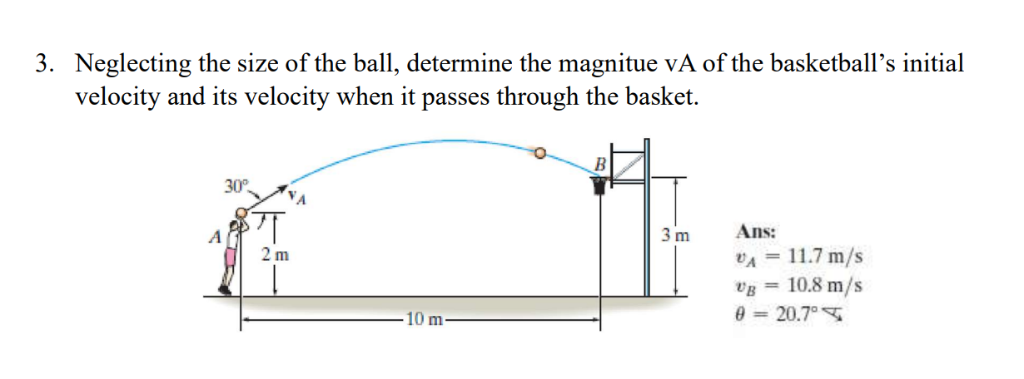 3. Neglecting the size of the ball, determine the magnitue vA of the basketball’s initial
velocity and its velocity when it passes through the basket.
0 A
Wy ry, — Hi
A IT im Ans:
2m vy =11.7m/s
vg = 108 m/s
[— 0=207"%
This is AI generated Response.
Asked by: manish kumar
Created at: 2025-09-27 00:49:42
Asked by: manish kumar
Created at: 2025-09-27 00:49:42
Final Answer:
Rendered
Raw Text
Did you like this answer?
Let's break down the problem and solve it step by step:
---
## **Given Data**
- **Initial height (\( y_A \))**: \( 2 \) m
- **Final height (\( y_B \))**: \( 3 \) m
- **Horizontal distance**: \( 10 \) m
- **Launch angle (\( \theta_A \))**: \( 30^\circ \)
- **Gravity (\( g \))**: \( 9.81 \) m/s²
---
## **Step 1: Break Initial Velocity into Components**
Let \( v_A \) be the initial velocity.
- Horizontal: \( v_{Ax} = v_A \cos 30^\circ \)
- Vertical: \( v_{Ay} = v_A \sin 30^\circ \)
---
## **Step 2: Time to Reach the Basket (Horizontal Motion)**
The horizontal motion is **uniform** (no acceleration):
\[
x = v_{Ax} t
\implies 10 = (v_A \cos 30^\circ) t
\implies t = \frac{10}{v_A \cos 30^\circ}
\]
---
## **Step 3: Vertical Motion Equation**
Use the second equation of motion:
\[
y_B = y_A + v_{Ay} t - \frac{1}{2} g t^2
\]
Plug in values:
\[
3 = 2 + (v_A \sin 30^\circ) t - \frac{1}{2} (9.81) t^2
\]
\[
1 = (v_A \cdot .5) t - 4.905 t^2
\]
---
## **Step 4: Substitute \( t \) from Step 2**
From Step 2:
\[
t = \frac{10}{v_A \cos 30^\circ}
\]
\[
\cos 30^\circ = .866
\]
\[
t = \frac{10}{v_A \cdot .866}
\]
Substitute into the vertical equation:
\[
1 = (v_A \cdot .5) \left( \frac{10}{v_A \cdot .866} \right) - 4.905 \left( \frac{10}{v_A \cdot .866} \right)^2
\]
\[
1 = \frac{5}{.866} - 4.905 \cdot \frac{100}{v_A^2 \cdot .866^2}
\]
\[
1 = 5.773 - \frac{490.5}{v_A^2 \cdot .75}
\]
\[
1 = 5.773 - \frac{654}{v_A^2}
\]
\[
\frac{654}{v_A^2} = 5.773 - 1 = 4.773
\]
\[
v_A^2 = \frac{654}{4.773}
\]
\[
v_A^2 = 137.03
\]
\[
v_A = \sqrt{137.03} = \boxed{11.7 \text{ m/s}}
\]
---
## **Step 5: Find the Velocity at the Basket (\( v_B \))**
### **Horizontal Component at B**
Remains the same:
\[
v_{Bx} = v_A \cos 30^\circ = 11.7 \times .866 = 10.13 \text{ m/s}
\]
### **Vertical Component at B**
\[
v_{By} = v_{Ay} - g t
\]
First, find \( t \):
\[
t = \frac{10}{v_A \cdot .866} = \frac{10}{11.7 \times .866} = \frac{10}{10.13} = .987 \text{ s}
\]
Now,
\[
v_{Ay} = v_A \sin 30^\circ = 11.7 \times .5 = 5.85 \text{ m/s}
\]
\[
v_{By} = 5.85 - 9.81 \times .987 = 5.85 - 9.69 = -3.84 \text{ m/s}
\]
### **Magnitude of \( v_B \):**
\[
v_B = \sqrt{v_{Bx}^2 + v_{By}^2}
\]
\[
v_B = \sqrt{10.13^2 + (-3.84)^2} = \sqrt{102.6 + 14.75} = \sqrt{117.35} = \boxed{10.8 \text{ m/s}}
\]
---
## **Step 6: Direction of \( v_B \) Below the Horizontal**
\[
\theta = \tan^{-1} \left( \frac{|v_{By}|}{v_{Bx}} \right) = \tan^{-1} \left( \frac{3.84}{10.13} \right) = \tan^{-1}(.379) = 20.7^\circ
\]
---
## **Final Answers**
\[
\boxed{
\begin{aligned}
\text{Initial velocity, } v_A &= 11.7 \text{ m/s} \\
\text{Velocity at basket, } v_B &= 10.8 \text{ m/s} \\
\text{Angle below horizontal, } \theta &= 20.7^\circ
\end{aligned}
}
\]
Let me know if you want a visual breakdown or further clarification!
📢 Instructions:
- Ask anything relatd to above question only.
- For new Question goto :